
” …and I will remove the heart of stone from your flesh and give you a heart of flesh.” Ezekiel 36:26b


” …and I will remove the heart of stone from your flesh and give you a heart of flesh.” Ezekiel 36:26b
Some years ago I wrote an article on this week’s Torah Portion [Vayishlach: Genesis 32:4-36:43], around the issue of being distressed by the loss of life – see https://globaltruthinternational.com/2012/11/30/distressed-by-the-tragedy-of-loss-of-life/
But I think this Torah Portion has a much more powerful message to share, and it’s that Jacob is really a great role-model for those going through struggles in the lives, which of course is all of us at some time!
And why is Jacob such a great role model in this regard?
I would suggest for two main reasons. Firstly, he epitomises fallibility and secondly, I think he epitomises someone with a diminished sense of self-worth.
As Rabbi Jonathan Sacks states Jacob was “…The man who, more than any other, epitomises fallibility is Jacob…. His life was a series of struggles. Nothing came easily to him…
There are saintly people for whom spirituality comes as easily as did music to Mozart. But God does not reach out only to saints. He reaches out to all of us. That is why He gave us Abraham for those who love, Isaac for those who fear, and Jacob/Israel for those who struggle.
Hence this week’s life-changing idea: if you find yourself struggling with faith, you are in the company of Jacob-who-became-Israel …“ and the father of the 12 Tribes.
So while his life was a life of struggle, both with man; with his brother and his family; but also with God Himself, ultimately he saw great reward and redemption in that all his children stayed within the faith.
Sacks: “’According to the pain is the reward’ – Mishnah, Avot 5:23. That is Jacob.”
So while Jacob struggled he was eventually triumphant. This should encourage all who struggle – don’t give up, there is light at the end of the tunnel; it will be worth it; the pain will one day pass; the Olam HaBah (the Kingdom of God) will one day appear!
And how does a low sense of worthiness come into it?
I think that Jacob may well have had some sense of unworthiness, after-all he really knew that he was the 2nd born and that he had stolen the birthright of his older brother Esau. Not only did he pay a heavy price for this deception, his mother did as well[1], and surely this would have impacted him.
How does this impact and exacerbate the life of struggle?
I discuss this in my blog post ‘The Power of Vulnerability’ which highlights the work of the social researcher, Brene Brown.
See – https://globaltruthinternational.com/2017/05/27/the-power-of-vulnerability/
Her argument is that those who don’t feel worthy are more likely to fall for addictions; to feel dis-connected (which is not at all the same thing as enjoying solitude), to struggle to find joy and happiness. Someone who feels worthy is more easily able to be vulnerable, and in turn such people are more easily able to ‘hear’ the lessons that God gives us every day and grow from them.
A lack of a sense of worthiness in turn leads to placing barriers and walls which not only lead to disconnection but inhibit any openness to growth and learning.

Perhaps Jacob also struggled in this way, and yet he persevered and broke through. You can too!
[1] I have written at length on this. Please see ‘Feeling For Rebekah’ – https://goo.gl/YtMqfi
Please find below a developing series of Facebook Live sessions exploring in some more depth, the Ten Happiness Principles.
First things first though – thanks Danny!
I decided to do these FB Live recordings after encouragement from Danny, a good friend who is an entrepreneur, Social Media wiz, Life Coach and International Businessman
– check him out below:
I created a Udemy Course on the Ten Happiness Principles a couple of years ago – accessible here
So I will post below the series of Facebook Live recordings as I work through presenting again, The Ten Happiness Principles!
Happiness Principle #1 – Give Thanks
This weeks Torah Portion, Ki Tetzei (Deuteronomy 21:10-25:19) has some very challenging passages – at least when first read on a fairly superficial level, but even perhaps still challenging after deeper reflection!!
It starts off with the narrative about the beautiful woman captured in wartime (Deut 21:10-14).
I love this answer as a great lesson in confronting our ‘evil inclination’, our Yetzer haRa, – http://www.aish.com/tp/i/wbr/48922022.html
Thus those who dismiss the Tanakh and it’s teaching because of their rejection of a text they take in a very literal and simplistic manner are really shown to be both ignorant and arrogant in their approach.
I have also written briefly on this Torah Portion in an earlier blog post, ‘Darkness Cannot Drive Out Darkness’ here.
Dysfunctional Relationships by Rabbi Ari Kahn: http://www.aish.com/tp/i/moha/54308942.htl
Thanks to a great insight from author Shalom Denbo:
In Genesis 17 we read where God and Avraham have made a covenant and Avraham has just been circumcised and the Almighty comes to comfort him.
So we read in Genesis 18:1 “YHVH appeared to Abraham by the oaks of Mamre while he was sitting at the entrance to his tent during the hottest time of the day.”
Surely, most of us would consider a personal visit from YHVH, where He appears to us and talks with us would be the greatest thing that could ever happen to us!
Consider a less dramatic analogy:
Some great and famous person such as your country’s President or Prime Minister, or your greatest sportsman or guru comes to visit you and is sitting with you in your lounge. Surely, the honour and prestige would be so great that you would not get up and leave him/her?
Yet, this is exactly what Avraham does, and not just to the President, but to the Creator of the Universe!!
He gets up and leaves Him when he sees 3 strangers walking by; 3 strangers who may just be vagrants or poor travellers.
Read on from verse 1 to verses 2-5:
“2 Abraham looked up and saw three men standing across from him. When he saw them he ran from the entrance of the tent to meet them and bowed low to the ground.
3 He said, “My lord, if I have found favor in your sight, do not pass by and leave your servant.
4 Let a little water be brought so that you may all wash your feet and rest under the tree.
5 And let me get a bit of food so that you may refresh yourselves since you have passed by your servant’s home. After that you may be on your way.” “All right,” they replied, “you may do as you say.” – NET
Avraham doesn’t just leave God ‘standing’, he runs from Him!!
I had never seen this before or thought of what it signifies.
Is Avraham so ‘familiar’ with the Almighty that he can do this; or is he simply not aware of the great and awesome honour bestowed upon him to have YHVH in his presence, communing with him?
Denbo suggests another option.
He argues that we learn from this text that Avraham wishes to emulate the Almighty, that is to be godly.
To be godly is to wish to be like God and to take responsibility for the world.
Avraham sees the 3 strangers and cares for their welfare as they travel exposed to the heat at the hottest time of the day.
Avraham desires to help these strangers, to offer them refreshment and shelter for a moment from the heat of the day.
Avraham sees being like God s more important that being with God!
What an amazing lesson!
This is surely what God wants from all of us. Not to wish that the peak of our existence is to commune with Him, but the peak of our being is to be as much like Him, as godly as possible and as a result to undertake ‘tikkun HaOlam’, that is, to undertake to repair the world, to take responsibility to do all within our power to impact the world for the better.
To be Godly, to be Holy!
This insight from “7 Traits: How to Change Your World” by Shalom Denbo.
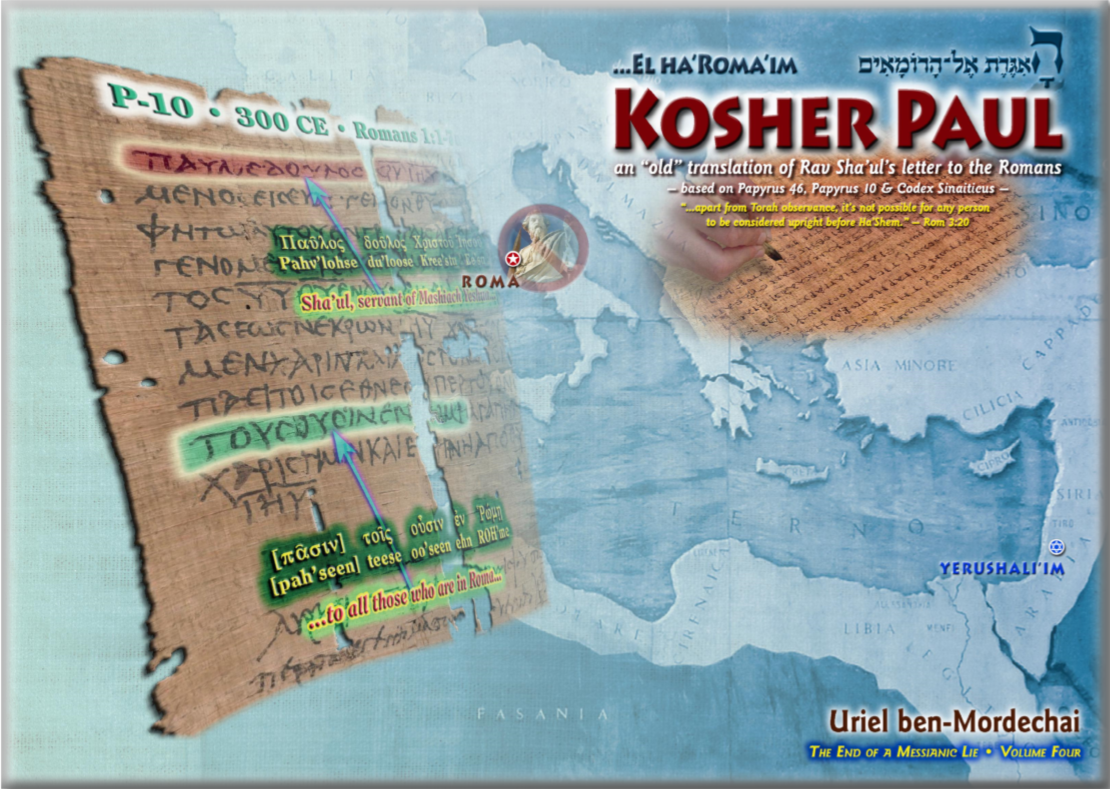
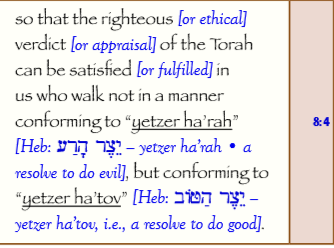
In Uriel Ben Mordechai’s new translation of Romans (principally from the earliest extant version we have, Papyrus 46 – circa 170 CE), we see the use of the Hebraic understanding of our nature consisting of two ‘hearts’, that is, of a fleshly heart and a spiritual heart; an evil inclination (the Yetzer haRa), and a good inclination, (the Yester HaTov).
For much more on this and other Hebraic principles or Hebraisms, please see my articles on the Hebraic Mindset as circumcisedheart.info as well as my book ‘Doctrinal Pitfalls of Hellenism’.
I discuss Flusser’s approach unique and revolutionary approach in my book ‘The New Testament: The Hebrew Behind the Greek’. This excerpt summaries his approach:
… A significant part of Flusser’s approach as a linguist fluent in over 9 languages including Greek and Hebrew, was to translate the Greek versions of Luke, for example, back into Hebrew. When he did this, he was able to show how good a fit such ‘reverse-translations’ were, as well as highlight small but significant portions where this does not work.
Brene Brown is a social researcher. She has a very powerful message to share that she has found through her research.
She argues that human “connection is why we’re here. It’s what gives purpose and meaning to our lives.”
From her research she divided people into two basic groups; those who have a strong sense of love and belonging (and thus feel connected), and those who really struggle for it (and thus feel disconnected).
And here’s the kicker, here’s her revelation from her research:
“The people who have a strong sense of love and belonging believe they’re worthy of love and belonging.”
She found that these people are “whole-hearted.”
That they had a sense of courage, where she uses the original definition of “tell(ing) the story of who you are with your whole heart.”, and thus having the courage to be imperfect.
They had the compassion to be kind to themselves first and then to others.
And “as a result of this authenticity, they were willing to let go of who they thought they should be in order to be who they are, which you have to absolutely do that for connection.”
And they “fully embraced vulnerability.”
They believed that what made them vulnerable made them beautiful. This means that they have “the willingness to say, “I love you” first … the willingness to do something where there are no guarantees …”; the willingness “to invest in a relationship that may or may not work out.”
Brene argues that vulnerability is “the birthplace of joy, of creativity, of belonging, of love.”
Yet, as she also discovered from her research we all have a tendency to numb our vulnerability, but the problem is “that you cannot selectively numb emotion.”
“You can’t numb those hard feelings without numbing the other affects, our emotions. You cannot selectively numb. So when we numb those, we numb joy, we numb gratitude, we numb happiness. And then, we are miserable, and we are looking for purpose and meaning, …”
Instead she argues that we need to accept our feelings of vulnerability because it means we are really alive, and we need to “believe that we’re enough.”
I strongly recommend you listen to her TED talk here.
In reflecting on this I see many ways in which our upbringing can predispose us to being in one group or the other.
With an upbringing by wise and loving parents we should grow into adults who have this sense of belonging and being worthy.
Yet there are many factors that work against this, not just our natural tendency to question and second-guess ourselves, and perhaps lack the confidence to be authentic due to peer pressure, etc., but a whole media push to constantly tell us we are not good enough without buying into the latest fad or getting the latest toy or gadget, etc., or being part of some special group that ‘has it all’.
Also, I suspect for many brought up in recent decades within a Christian environment, the false ‘Original Sin’[1] doctrine has been far from helpful here as it tries to convince people that they are at their core, and from birth, sinful and depraved beings with little hope of redemption without miraculous external support.
Rather Brene’s research rings so true with foundational Biblical principles. Consider the Sh’ma (Deut 6:4 …) for example and the two greatest commandments according to Yeshua.
Sh’ma, Yisra’el:
“Listen, O’ Israel: YHVH is our God, YHVH is one!
You must love YHVH your God with your whole mind, your whole being, and all your strength.
These words I am commanding you today must be kept in mind, and you must teach them to your children and speak of them as you sit in your house, as you walk along the road, as you lie down, and as you get up…”
And Leviticus 19:18: “…love your neighbour as yourself; I am YHVH.”
You cannot truly love your neighbour unless you love yourself. True love and devotion to the Almighty should also being the revelation that you are indeed fearfully and wonderfully made, and you cannot hope to give your all in loving God if you find yourself unworthy.
But you can change!
You can grow in acceptance of yourself; in being more authentic; in being ‘whole-hearted’ so that you can give ‘whole-heartedly’ to God!
For more please see my article ‘You Shall be Holy’[2] and my ‘The Ten Happiness Principles’[3] on Udemy.
Note:
The two groups of people that Brene refers to are not those who are very gregarious and love being around others, compared with those who prefer a more solitary life. This was not the distinction she was making.
I think in this respect, there is also a lot going for the ‘solitary life’ or at the very least for times of peace and quiet and times of reflection away from the ‘madding crowd’, including family, etc. But Brene was instead contrasting 1) those who believe they’re worthy of love and belonging with 2) those who don’t.
Her argument is that those who don’t feel worthy are more likely to fall for addictions; to feel dis-connected (which is not at all the same thing as enjoying solitude), to struggle to find joy and happiness. Someone who feels worthy is more easily able to be vulnerable, and in turn such people are more easily able to ‘hear’ the lessons that God gives us every day and grow from them.
A lack of a sense of worthiness in turn leads to placing barriers and walls which not only lead to disconnection but inhibit any openness to growth and learning.
[1] See this excellent article for more on this very damaging doctrine – https://goo.gl/HVrhiF
[2] https://globaltruthinternational.com/2015/03/21/you-shall-be-holy-introduction/
I think this is a universal principle.
We are all given at least one, if not many unique opportunities in life to make a positive and significant difference. This situation (or situations) occurs where there is seemingly no-one else available to stand up and be counted, yet it always seems the situation requires a serious stepping out of our comfort zone, and most likely some serious risk to our job, our reputation, or relationships, or even our very freedoms.How many times might we even baulk and fail to make a stand. Yet the Almighty is most gracious. I believe He gives us another, and another, chance to show our true heart, to show that we really are His children, with His desire to see justice and mercy prevail.
As part of the famous ‘Sermon on the Mount’, we read that Yeshua said to ‘turn the other check’:
“You have heard that our fathers were told, ‘Eye for eye and tooth for tooth.’ But I tell you not to stand up against someone who does you wrong. On the contrary, if someone hits you on the right cheek, let him hit you on the left cheek too! – Matthew 5:38-39 (CJB)
While the ‘eye for an eye’ passage in the Tanakh (see Exodus 21:24; Leviticus 24:20; and Deuteronomy 19:21) is well known, I believe it is seriously misunderstood, as I explain in my ‘An Eye for an Eye or Measure for Measure’[1].
However, I wish to focus on the ‘turn the other check’ teaching.
The brilliant Professor David Flusser, in my opinion, had perhaps the most intimate and accurate understanding of the Yeshua ben Yosef that anyone has had, since the First Century of the Common Era.
Flusser argued that all of Yeshua’s teaching could be found in the Tanakh or other earlier Jewish writings (while not trying in any way to diminish the power and authority of Yeshua’s words). For example he wrote: “From ancient Jewish writings we could easily construct a whole Gospel without using a single word that originated with Jesus.”[2]
Yet, it is not always easy to verify Flusser’s argument.
Some are very subtle. For example Yeshua states in Mathew 23:23a: “Woe to you, scribes and Pharisees, hypocrites! For you tithe mint and dill and cumin, and have neglected the weightier matters of the law: justice and mercy and faithfulness. …”.
It may not be obvious to all but I believe he was quoting Micah 6:8 here which states that: “He has shown you, O man, what is good; And what does the Lord require of you But to do justly, To love mercy, And to walk humbly with your God?[3]” – NKJV
But what of this ‘turn the other cheek’ teaching and effectively to bless those who curse you? Or as Yeshua added: “If someone wants to sue you for your shirt, let him have your coat as well!”. That is, if someone is taking something precious from you, do not fight this, but bless them even more! Well the prophet Jeremiah shares a very similar message to the Babylonian exiles when they first arrive in Babylon.
I had not seen this message. At least I don’t recall it sinking in in the many, many times I have read Jeremiah 29. This may be because this chapter goes on to offer a couple of real gems that I have often focussed on.
It is in Jeremiah 29 that we read: “For I know what plans I have in mind for you,’ says Adonai, ‘plans for well-being, not for bad things; so that you can have hope and a future.” – Jer 29:11
And one of my all-time favourites: “You will seek me and find me, when you seek me with all your heart” – Jer 29:13
But recently I was listening to Prof. Cynthia Chapman narrate her book ‘The World of Biblical Israel’, when she alluded to this very chapter and portion:
1 These are the words of the letter that Jeremiah the prophet sent from Jerusalem to the surviving elders of the exiles, and to the priests, the prophets, and all the people, whom Nebuchadnezzar had taken into exile from Jerusalem to Babylon.
2 This was after King Jeconiah and the queen mother, the eunuchs, the officials of Judah and Jerusalem, the craftsmen, and the metal workers had departed from Jerusalem.
3 The letter was sent by the hand of Elasah the son of Shaphan and Gemariah the son of Hilkiah, whom Zedekiah king of Judah sent to Babylon to Nebuchadnezzar king of Babylon. It said:
4 “Thus says the Lord of hosts, the God of Israel, to all the exiles whom I have sent into exile from Jerusalem to Babylon:
5 Build houses and live in them; plant gardens and eat their produce.
6 Take wives and have sons and daughters; take wives for your sons, and give your daughters in marriage, that they may bear sons and daughters; multiply there, and do not decrease.
7 But seek the welfare of the city where I have sent you into exile, and pray to the Lord on its behalf, for in its welfare you will find your welfare.
8 For thus says the Lord of hosts, the God of Israel: Do not let your prophets and your diviners who are among you deceive you, and do not listen to the dreams that they dream,
9 for it is a lie that they are prophesying to you in my name; I did not send them, declares the Lord.
10 “For thus says the Lord: When seventy years are completed for Babylon, I will visit you, and I will fulfill to you my promise and bring you back to this place.
11 For I know the plans I have for you, declares the Lord, plans for welfare and not for evil, to give you a future and a hope.
12 Then you will call upon me and come and pray to me, and I will hear you.
13 You will seek me and find me, when you seek me with all your heart.
14 I will be found by you, declares the Lord, and I will restore your fortunes and gather you from all the nations and all the places where I have driven you, declares the Lord, and I will bring you back to the place from which I sent you into exile.” – Jeremiah 29:1-14
She explained that the God of Israel had, through His prophet Jeremiah told these people who had just wept bitterly beside the rivers of Babylon and even promised to bring evil upon their captors. We read of their pain and anger in Psalm 137: “1. By the rivers of Babylon we sat down and wept as we remembered Zion … 8 Daughter of Babylon, you will be destroyed! A blessing on anyone who pays you back for the way you treated us! 9 A blessing on anyone who seizes your babies and smashes them against a rock!”
Yet, here’s Jeremiah telling them to bless these sons and daughters of Babylon, their captors. To repeat, he turns the whole attitude around and calls them to “… seek the welfare of the city where I have sent you into exile, and pray to the Lord on its behalf, for in its welfare you will find your welfare.”
If this isn’t ‘turning the other cheek’; ‘going the extra mile’ and giving ‘not just your shirt but your coat as well’ then I don’t know what is!
And how did it all turn out? Just as prophesied they returned some 70 years later and were very much supported by the Babylonians to do so.
Not only this; but a great many stayed on in Babylonia, and it became a great centre for Jewish learning for centuries to come. It is in fact the Babylonian Talmud that has been the main source of Jewish jurisprudence for the entire Diaspora until the last century (rather than the Jerusalem Talmud[4]).
So this ‘turning the other cheek’ turned out to be a good thing for the exiled Jewish people, and helped to fulfil the promise that God had “… plans for (their) welfare and not for evil,” and to give them “… a future and a hope”.
Update:
A friend and fellow Bible student directed me to Lamentations 3:28-30
“28 Let him sit alone in silence when he has laid it on him.
29 Let him submit absolutely; there may yet be hope.
30 Let him offer his (other) cheek to the one who strikes it and receive his fill of insults.” (CJB)
When Yeshua was confronted in the garden, arrested and taken before his accusers, he did indeed heed his own advice and remain silent, not reacting to their insults and aggression.
Yeshua’s ‘turn the other check’ teaching, is clearly a teaching from this very passage in Lamentations.
[1] http://circumcisedheart.info/measureformeasure.pdf
[2] For detail see http://circumcisedheart.info/The%20Times%20of%20Yeshua.pdf
[3] To ‘walk humbly with your God’ is to trust Him to provide, and therefore to walk with quiet assurance in His Instructions. This is true ‘faithfulness’.
[4] Dr. David Neiman explains this is fascinating detail in his ‘The Jews in History’.
This book has just been extensively updated.
It presents the argument that much, if not most of the New Testament was originally written in Hebrew, not Greek, and that the quotes of the Tanakh (OT), which are almost all thought to be from the Septuagint (LXX) are much more likely to have been from a Hebrew version, very similar to the Masoretic Text (MT).
The book is available of Amazon as a Kindle download or free as a pdf at my circumcisedheart.info site
The link below is to an audio introduction to this book:
Audio Introduction