


” …and I will remove the heart of stone from your flesh and give you a heart of flesh.” Ezekiel 36:26b
Relevant articles


” …and I will remove the heart of stone from your flesh and give you a heart of flesh.” Ezekiel 36:26b
Below is a series of posts I am creating that highlight some of the amazing revelations that are being made from a re-translation of the Gospel of John:
Post #1
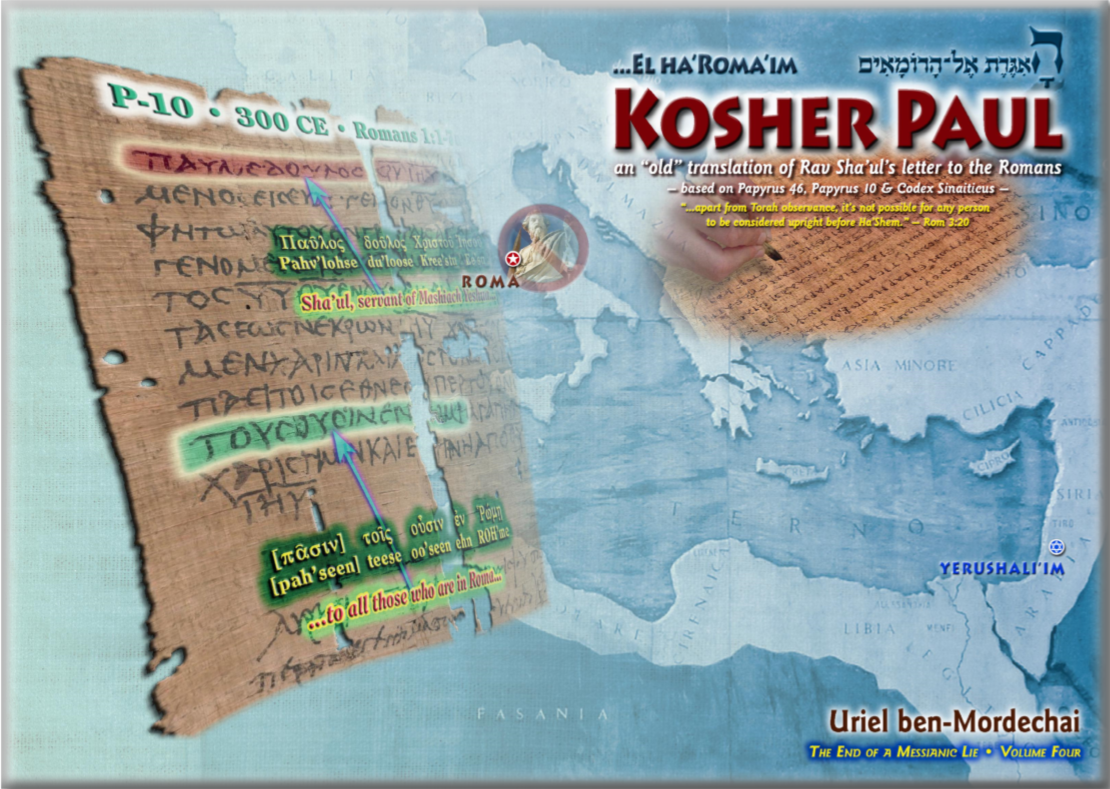
Uriel Ben Mordechai has made a number of ‘dynamic equivalence translations’ of selected NT letters and narratives based upon the earliest Greek manuscripts available e.g. Papyrus 46 [dating to between 170-200 CE] and Codex Sinaiticus [dating to about 350 CE].
These English translations, produced with a Jewish pro-Torah bias, have been published and distributed from the Eternal City just as the Prophet predicts… “…out from Tzion the Torah shall go forth, and out from Yerushalai’im, the Word of HaShem” [Yishaiyahu/Isaiah 2:3].
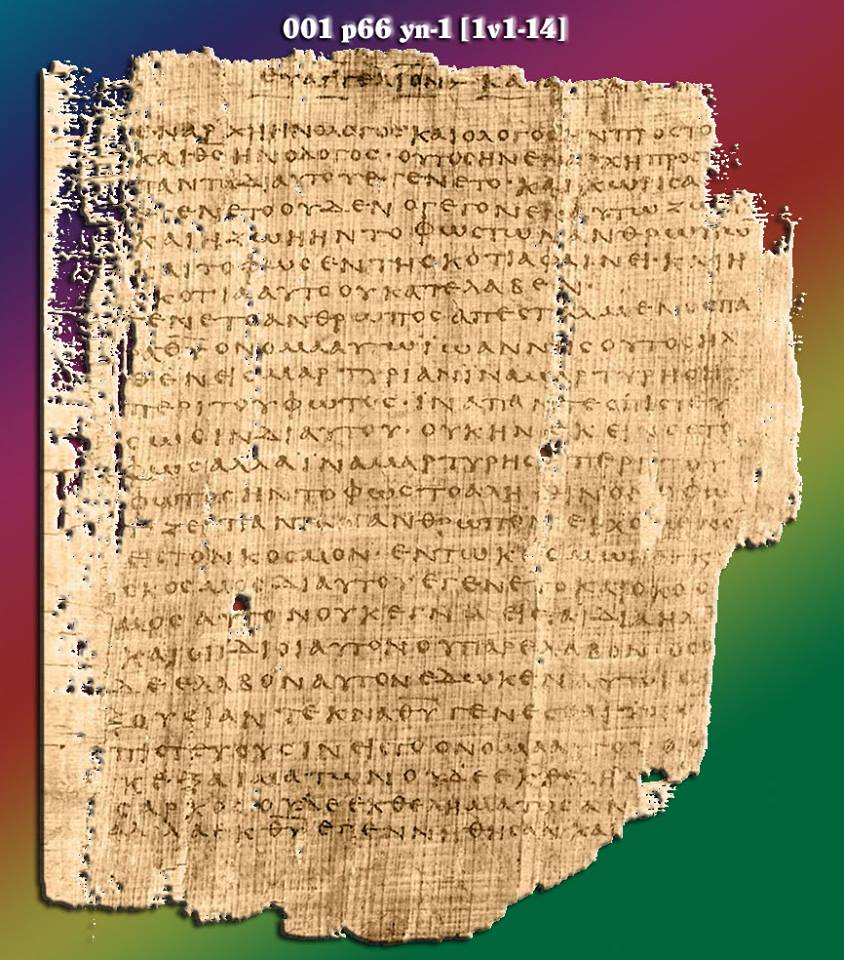
Uriel has now turned his attention to Papyrus 66. The manuscript contains John 1:1-6:11, 6:35b-14:26, 29-30; 15:2-26; 16:2-4, 6-7; 16:10-20:20, 22-23; 20:25-21:9, 12, 17. It is one of the oldest well preserved New Testament manuscripts known to exist.
The manuscript was found in 1952 at Jabal Abu Mana near Dishna (Egypt). There is debate over when this codex was produced with some arguing for as early as the middle of the second century (~ 150 CE), though most scholars now ascribe a date in the 3rd to 4th century (201 – 399 CE).
I would like to share a few details on Uriel’s translation of the first chapter of John’s Gospel (using the more appropriate terminology of “Yochanan’s narrative”).
Long before Uriel began this work a number of scholars including the late Professor David Flusser had argued for a very different translation of Yochanan 1:1.
I discuss this in some depth in two articles ‘The Torah Dressed Itself in Flesh’ (https://goo.gl/xMiGVm) and ‘John 1:1c – Arianism’s Fatal Flaw’ (https://goo.gl/fMmkbU).
Here is Uriel’s latest rendering of Yochanan 1:1-3 based on P-66:
Yochanan 1:1 “Essential for creation was the Torah, and the Torah was in the presence of G-d, and a godly object was the Torah”
1:2 “This object stood with high honor, in harmony with G-d.”
1:3 “All things came into existence because of IT, and outside of IT, not a single notion came into being that was fashioned.”
And with Uriel’s amplification for improved readability in square brackets:
Yochanan 1:1 “Essential for [or Before] creation [or With high honor] was the Torah, and the Torah was in the presence of [or befitting, or consistent in character with] G-d, and a godly [or godlike] object was the Torah [or the Torah was also a godly thing]!”
1:2 “This object [or element, i.e., the Torah] stood with high honor [or existed before creation], in harmony [or consistent in character] with G-d.”
1:3 “All things came into existence because of IT [i.e., on account of the Torah], and outside of IT [or apart from having the Torah in mind], not a single notion came into being that was [later] fashioned [by the hand of Ha’Shem].”
There is so much to unpack here in these 3 verses alone!Jewish Rabbi’s and scholars have long argued that it was the Torah that was with the Almighty before He created the Universe, that it was the Torah that was the blueprint for the Creation. Even Hellenistic Jewish philosophers like Philo (1st Century CE) argued for this understanding (for more on this also see my article here – https://goo.gl/CZUH2D).
I would love to hear peoples thoughts on these verses. For example, note that Uriel uses ‘IT’ in verse 3 where most modern translators have made what appears to be an unjustifiable inference and used ‘him,’ and even going so far in most cases as to capitalize ‘Him.’ The 1599 Geneva Bible however appears to have been more true to the original without introducing such inferences as this translation also used ‘IT’.
For those interested in observing Uriel’s progress as they translate P-66, I highly recommend consider joining him and his wife Adi, as they present their translation one verse at a time during their weekly LIVE webinar broadcasts from Jerusalem. To register for the class, use this link:http://ntcf.org/register.html.
Post #2:
Many of us in reading our English translations of the Bible without any deep knowledge of the underlying Hebrew language and Jewish approach and idioms can so easily be led astray and totally misunderstand many passages.
One example that I have dealt with at length in the past is the Augustine’s doctrine of Origin Sin and the associated doctrines of Calvin’s TULIP principles, that I believe lead to some very harmful consequences in life and especially relationships.
A section from the Apostle Paul’s Epistle to the Romans is often used to support these flawed doctrines of mainstream Christendom. That section is Romans 3:10-18 and especially verse 10 “As it is written, There is none righteous, no, not one …”
I discuss this section in pages 51-59 of my book ‘The New Testament: The Hebrew Behind the Greek’ – https://www.amazon.com/new-testament-language-mindset-hellenistic-ebook/dp/B009XO0NQU/ (Also available as a free pdf @ circumcisedheart.info)
The quote in verse 10, a quote from the Tanakh is taken out of context by most when read as to be a blanket statement that no-one is or can be righteous.
There are many reasons for this error as I discuss in my book, but I wish to highlight just one for now.
The Hebrew can quite often leave out a word, especially an adjective, that in English may be necessary to communicate the correct understanding, but that is simply not there in the Hebrew.
For example if Kohelet (Ecclesiastes) 7:20 is translated directly we get something like: “For there is no righteous man on earth who does good and does not sin.”
Yet, all the Jewish Sages (i.e., Rabbinic scholars) will translate this as “For there is no righteous man on earth who does [only] good and does not sin.” – see for example page 9 of ‘Gates of Repentance’ by Rabbeinu Yonah of Gerona.
Some English versions do get this correct, such as the NET and CJB, but for example the KJV, NKJV, NIV, ASV and ESV do not.
Rather than re-addressing the issue of Romans 3:10 though, I wish to use this as an example to highlight the need for greater humility from Christian students of the Bible in approaching the text, and also perhaps a greater reverence for the underlying understanding and wisdom of Jewish scholarship, of those who have an in-depth knowledge of Hebrew and Jewish thinking.
One such person is the Jewish translator, Uriel ben-Mordechai. Uriel has great experience in this area having already re-translated a number of books of the New Testament working from the earliest extant versions but approaching them with a Jewish mindset and pro-Torah pre-suppositional perspective.
Thus I think his translations should be given serious attention from all who see themselves as humble, but zealous, seekers of Truth.
In this post I want to touch on just 3 verses that Uriel has very recently translated from Papyrus 66 and the first chapter of Yochanan’s narrative (John’s Gospel).
As I have already intimated a lot of flawed doctrines within Christendom are often birthed out of just one or two verses. One example of this is the flawed doctrine of pre-existence and the related deduction than ‘Jesus’ created the Universe.
This is seen for example in John 1:10 where most translations essentially have Jesus/Yeshua ‘making’ (creating) the world (‘… the world was made by him …).
For example, the KJV translates verse John 1:10-12 has
“10 He was in the world, and the world was made by him, and the world knew him not.”
11 He came unto his own, and his own received him not.
12 But as many as received him, to them gave he power to become the sons of God, even to them that believe on his name:”
Uriel instead has:
“1:10 IT was present within the world, and even the world came into existence by virtue of IT, even though the world did not acknowledge IT
1:11 In the midst of this one special people, IT ended up being deposited, especially to this one chosen people; the same which they embraced.
1:12 As many as did take hold of IT, IT gave them prerogative to emerge as children of G-d; to those who are trusting in His Name,”
And his ‘amplified’ version for greater clarity (i.e. adding words to make greater sense of the direct translation):
“1:10 IT [i.e., the light of the Torah] was present within the world, and even the world [itself] came into existence by virtue of [or using] IT, even though the world did not acknowledge IT [i.e., the light of the Torah].
1:11 In the midst of [or Contributing to] this one special [or distinctive, or chosen] people, IT [i.e., the light of the Torah] ended up being deposited [or given], especially to this one chosen [or distinctive] people; the same [object, i.e., the light of the Torah] which they [readily] embraced [i.e., welcomed, or experienced].
1:12 As many as did take hold of IT [i.e., this illumination from the Torah], IT gave them prerogative to emerge as children of G-d; to those who are trusting in His [i.e., Ha’Shem’s] Name,”
Clearly there is no way this version of verses 10-12 could possibly lead to any implications of ‘pre-existence and the related deduction that ‘Jesus’ created the Universe’!
Please read and prayerfully consider. I look forward to your feedback as well.
Post #3:
In this the 3rd post in this series I want to touch on 4 verses that Uriel has recently translated from Papyrus 66 and the first chapter of Yochanan’s narrative (John’s Gospel) chapter 1:15-18.
First the translation and then an ‘amplified’ (i.e. some explanatory text in square brackets) version:
1:15 Yochanan was testifying concerning IT, and even shouted out, saying, “THIS was the very thing to which I had referred, which will go onward after me, has stood in existence before me. Because of that, IT has been most influential for me,
1:16 seeing that extending out from ITS abundance, each and everyone of us shall also express gratitude as a response to generosity,
1:17 in view of the fact that through Moshe this precious gift — the Torah — was given, AND THEN the age of truthfulness shall come to pass by way of Yeshua, Mashiach.
1:18 On G-d, not one has ever set eyes! G-d is unique! For the one who lives surrounded by the Father’s embrace — in that place He will reveal.”
And amplified:
1:15 Yochanan was testifying concerning IT [i.e., the Torah], and even shouted out, saying, “THIS [i.e., the Torah] was the very thing to which I had referred, which will go onward after [or subsequent to] me, has stood in existence [long] before me. Because of that, IT has [always] been most influential for me,
1:16 seeing that extending out from ITS [i.e., the Torah’s] abundance, each and everyone of us shall also express [or choose] gratitude as a response to [Ha’Shem’s] generosity [or goodwill],
1:17 in view of the fact that through Moshe this precious gift — the Torah — was given, AND THEN [the added benefit of] the age of truthfulness [or legitimacy] shall come to pass [or be realized] by way of [or as a result of] Yeshua, Mashiach.
1:18 On G-d, not one has ever set eyes [and lived]! G-d is unique [i.e., He is without equal, or unprecedented]! For the one who lives surrounded by [or absorbed in] the Father’s embrace — [there] in that place He will reveal [or poss. passive ‘…there He shall be fully revealed, explained and declared’].”
Clearly, the object being referenced here is not the same as in most translations, yet if considered without our common ‘Christian’ pre-suppositions I think it has an internal consistency and integrity. That is, if this was being read for the first time as a Jewish text written for, and to Jewish readers familiar with the G-d of Israel and His Torah, then it mostly gives a message well-known and well-understood, while at the same time adding something new as a result of the revelation of the life and resurrection of Yeshua.
So, to reiterate, Yochanan has first extolled the great grace provided to Israel through the Torah. The Torah has brought true freedom (please see my article ‘Freedom and the Law’ https://goo.gl/XYGC8t for details on this aspect).
It has given the people of Israel (AHM Israel), a great foundation to their history, their uniqueness and their trials and tribulations but most importantly the Torah; in defining the Way (Psalm 119); in defining how best to live; how to get the most out of your life through loving G-d and your neighbour, it has given them a past, a present and a future.
Yet something was missing. Two thousand years ago AHM Israel was failing on two counts. Firstly, they were not being the ‘light to the Gentiles’ (for more on this please see my article on Isaiah 49 – https://goo.gl/d3Vy8b) they were called to be. They were not, for the most part, introducing the pagan world to the Truth of the One True G-d and away from all the idolatry that the pagan Gentile world practiced.
And secondly, a large part of the reason for why this failure was occurring was the internal ‘hatred’ of Jew for Jew, or as the Rabbinic scholars have described it, the ‘baseless hatred’ that existed and was instrumental in the horror that was the fall of Jerusalem in 70 CE.
So Yochanan was speaking into this reality with the ‘good news’ of the arrival of Yeshua to speak truth to AHM Israel, to call for their repentance and full return to the embracing of Torah so that they could in turn be that light to the Gentiles that was their central mission.
The Resurrection acted to convince and confirm to all open and willing to listen, that Torah really was ultimate Truth, the obeying the Torah because of a faithfulness (trusting) in the Almighty and His revelation was not only the Way to walk, but the way to convict the Gentile world of this Truth as well.
It seems to me that if the great majority of AHM Israel had been open to and heeded this message, then the Olam ha’Bah (The Coming Age, the Kingdom of G-d) truly could have fully dawned in the first century and the Temple could well have remained standing. Yeshua most clearly intimated such.
But Yeshua’s living example and his Resurrection instead may be viewed as a failure, if time were fixed and the future stopped.
However, hope still lives on, and the future still beckons. Yeshua, the suffering servant, the Messiah ben-Yosef still stands at the ready to return to our midst and, as Messiah ben-David, to usher in the Olam Ha’Bah.
Yochanan will be proven correct and “…the age of truthfulness shall come to pass by way of Yeshua, Mashiach.”
Please consider this translation – perhaps your path has at this very moment reached the place where your heart and mind is open to Yeshua’s call to return to; or to learn of Torah and The Way. Perhaps today is the day and now the hour for you to reconsider the doctrines of your youth and time within the walls of your church and reconsider what and where Yeshua preached.
Also, if you really wish to dig much deeper and learn how Uriel goes about these translations and get a greater perspective on the Torah-centric reality of the New Testament, then you may wish to consider joining Uriel and Adi’s weekly LIVE webinar broadcasts from Jerusalem.
To register for the class, use this link: http://ntcf.org/register.html.
This weeks Torah Portion, Ki Tetzei (Deuteronomy 21:10-25:19) has some very challenging passages – at least when first read on a fairly superficial level, but even perhaps still challenging after deeper reflection!!
It starts off with the narrative about the beautiful woman captured in wartime (Deut 21:10-14).
I love this answer as a great lesson in confronting our ‘evil inclination’, our Yetzer haRa, – http://www.aish.com/tp/i/wbr/48922022.html
Thus those who dismiss the Tanakh and it’s teaching because of their rejection of a text they take in a very literal and simplistic manner are really shown to be both ignorant and arrogant in their approach.
I have also written briefly on this Torah Portion in an earlier blog post, ‘Darkness Cannot Drive Out Darkness’ here.
Dysfunctional Relationships by Rabbi Ari Kahn: http://www.aish.com/tp/i/moha/54308942.htl
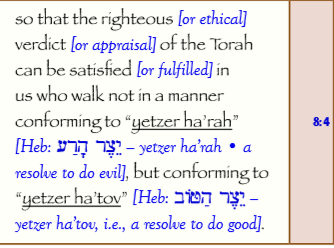
In Uriel Ben Mordechai’s new translation of Romans (principally from the earliest extant version we have, Papyrus 46 – circa 170 CE), we see the use of the Hebraic understanding of our nature consisting of two ‘hearts’, that is, of a fleshly heart and a spiritual heart; an evil inclination (the Yetzer haRa), and a good inclination, (the Yester HaTov).
For much more on this and other Hebraic principles or Hebraisms, please see my articles on the Hebraic Mindset as circumcisedheart.info as well as my book ‘Doctrinal Pitfalls of Hellenism’.
I discuss Flusser’s approach unique and revolutionary approach in my book ‘The New Testament: The Hebrew Behind the Greek’. This excerpt summaries his approach:
… A significant part of Flusser’s approach as a linguist fluent in over 9 languages including Greek and Hebrew, was to translate the Greek versions of Luke, for example, back into Hebrew. When he did this, he was able to show how good a fit such ‘reverse-translations’ were, as well as highlight small but significant portions where this does not work.
Brene Brown is a social researcher. She has a very powerful message to share that she has found through her research.
She argues that human “connection is why we’re here. It’s what gives purpose and meaning to our lives.”
From her research she divided people into two basic groups; those who have a strong sense of love and belonging (and thus feel connected), and those who really struggle for it (and thus feel disconnected).
And here’s the kicker, here’s her revelation from her research:
“The people who have a strong sense of love and belonging believe they’re worthy of love and belonging.”
She found that these people are “whole-hearted.”
That they had a sense of courage, where she uses the original definition of “tell(ing) the story of who you are with your whole heart.”, and thus having the courage to be imperfect.
They had the compassion to be kind to themselves first and then to others.
And “as a result of this authenticity, they were willing to let go of who they thought they should be in order to be who they are, which you have to absolutely do that for connection.”
And they “fully embraced vulnerability.”
They believed that what made them vulnerable made them beautiful. This means that they have “the willingness to say, “I love you” first … the willingness to do something where there are no guarantees …”; the willingness “to invest in a relationship that may or may not work out.”
Brene argues that vulnerability is “the birthplace of joy, of creativity, of belonging, of love.”
Yet, as she also discovered from her research we all have a tendency to numb our vulnerability, but the problem is “that you cannot selectively numb emotion.”
“You can’t numb those hard feelings without numbing the other affects, our emotions. You cannot selectively numb. So when we numb those, we numb joy, we numb gratitude, we numb happiness. And then, we are miserable, and we are looking for purpose and meaning, …”
Instead she argues that we need to accept our feelings of vulnerability because it means we are really alive, and we need to “believe that we’re enough.”
I strongly recommend you listen to her TED talk here.
In reflecting on this I see many ways in which our upbringing can predispose us to being in one group or the other.
With an upbringing by wise and loving parents we should grow into adults who have this sense of belonging and being worthy.
Yet there are many factors that work against this, not just our natural tendency to question and second-guess ourselves, and perhaps lack the confidence to be authentic due to peer pressure, etc., but a whole media push to constantly tell us we are not good enough without buying into the latest fad or getting the latest toy or gadget, etc., or being part of some special group that ‘has it all’.
Also, I suspect for many brought up in recent decades within a Christian environment, the false ‘Original Sin’[1] doctrine has been far from helpful here as it tries to convince people that they are at their core, and from birth, sinful and depraved beings with little hope of redemption without miraculous external support.
Rather Brene’s research rings so true with foundational Biblical principles. Consider the Sh’ma (Deut 6:4 …) for example and the two greatest commandments according to Yeshua.
Sh’ma, Yisra’el:
“Listen, O’ Israel: YHVH is our God, YHVH is one!
You must love YHVH your God with your whole mind, your whole being, and all your strength.
These words I am commanding you today must be kept in mind, and you must teach them to your children and speak of them as you sit in your house, as you walk along the road, as you lie down, and as you get up…”
And Leviticus 19:18: “…love your neighbour as yourself; I am YHVH.”
You cannot truly love your neighbour unless you love yourself. True love and devotion to the Almighty should also being the revelation that you are indeed fearfully and wonderfully made, and you cannot hope to give your all in loving God if you find yourself unworthy.
But you can change!
You can grow in acceptance of yourself; in being more authentic; in being ‘whole-hearted’ so that you can give ‘whole-heartedly’ to God!
For more please see my article ‘You Shall be Holy’[2] and my ‘The Ten Happiness Principles’[3] on Udemy.
Note:
The two groups of people that Brene refers to are not those who are very gregarious and love being around others, compared with those who prefer a more solitary life. This was not the distinction she was making.
I think in this respect, there is also a lot going for the ‘solitary life’ or at the very least for times of peace and quiet and times of reflection away from the ‘madding crowd’, including family, etc. But Brene was instead contrasting 1) those who believe they’re worthy of love and belonging with 2) those who don’t.
Her argument is that those who don’t feel worthy are more likely to fall for addictions; to feel dis-connected (which is not at all the same thing as enjoying solitude), to struggle to find joy and happiness. Someone who feels worthy is more easily able to be vulnerable, and in turn such people are more easily able to ‘hear’ the lessons that God gives us every day and grow from them.
A lack of a sense of worthiness in turn leads to placing barriers and walls which not only lead to disconnection but inhibit any openness to growth and learning.
[1] See this excellent article for more on this very damaging doctrine – https://goo.gl/HVrhiF
[2] https://globaltruthinternational.com/2015/03/21/you-shall-be-holy-introduction/
I think this is a universal principle.
We are all given at least one, if not many unique opportunities in life to make a positive and significant difference. This situation (or situations) occurs where there is seemingly no-one else available to stand up and be counted, yet it always seems the situation requires a serious stepping out of our comfort zone, and most likely some serious risk to our job, our reputation, or relationships, or even our very freedoms.How many times might we even baulk and fail to make a stand. Yet the Almighty is most gracious. I believe He gives us another, and another, chance to show our true heart, to show that we really are His children, with His desire to see justice and mercy prevail.
Life IS school. We are always in school, we just don’t know it!
Our entire life lies before us as a great unwritten but very well designed curriculum, designed and presented by the greatest Teacher and Educator of all, the Almighty Himself!
Every day, the good, the bad and the ugly comes our way to help mold us (if we are willing), to be the unique people God intended us to be. This ‘curriculum’ is daily before us whether we consciously choose to engage with it or not. It is impacting our lives, and hopefully in a positive manner, whether we acknowledge it or not.
But learning of this ‘curriculum’ and being aware of its daily teachings can make the path to completing it, both smoother and quicker.
Surely, if we all realized we were in ‘school’ and working on a curriculum designed by the world’s best Educator (God Himself), to lead us to be the best person we could be, and that we were designed to be, wouldn’t we want to complete the curriculum as quickly and effectively as possible!?

Almost every character trait that defines humanity is in every person. Every single person has some character traits that they find more problematic than others, and that they need to work on more than others. We should not see these traits that we struggle with as bad or wrong or sinful, but as traits that need addressing so that ultimately they become under our control, and in the proper balance. As part of our personally and individually designed ‘curriculum’, the great Educator presents ‘lessons’, ‘tests’, and ‘practical projects’ to us, every single day, that we can embrace and learn from and move toward our ultimate successful ‘graduation’ as the full embodiment of the unique individual we were designed to be.
Or we can ignore the ‘lesson’, ‘test’ or ‘practical project’, and fail to grow, but instead be presented with the same maddening lesson over and over again, by the most patient and caring Educator ever!
For example, the person who appears in general to be an extremely angry person, still has some moments of calm and some circumstances in which he/she has control over that anger. But also the calmest person has some degree of anger in him/her, and some circumstances that really test his or her peace and serenity.
Anger can be bad, yet anger at injustice helps motivate us to try to correct that injustice. Thus, the character trait of ‘anger’ is not all bad, but rather a positive character trait when harnessed in the proper manner and at the right time.
What about the character trait of ‘lust’, especially ‘sexual lust’ (The person who has a ‘lust for life’ is simply a positive person with passion to embrace their life curriculum)?
A man with unbridled lusting for a women not his wife, is clearly acting in a sinful manner (it is breaking the 10th Commandment – … do not covet – lust after – your neighbour’s wife …), yet this very Commandment implies that a man should lust after his own wife!

What! Really? Why weren’t we men taught this? When we were teenage boys with raging hormones, why weren’t we taught that sexual lust was such a positive commandment of God (when directed at the appropriate object of desire)?
Why, when lust or intense desire is the true secret to a successful marriage.
A marriage where that intense desire for each other is recognized and knowingly cultivated and maintained is a marriage that will survive (and without being sexist, this should start and be led by the man).
Isn’t that what we all want? Surely the secret to a successful marriage can not be this simple?!
Yet, I believe it is.
I have read a great many books on marriage (and divorce). I have been to hell and back. I have been challenged to the very core of my existence. I have been suicidal. I have felt totally betrayed, full of despair. My world has seemed lost and bleak. My heart has been broken, and broken and broken.
But miracle of miracles, I have come out the other side. I have grown, I have submitted to my God and sought His direction (which was hugely challenging and totally counter-intuitive). He led me through the valley of death and out the other side. So after a great deal of pain and many years of heartache, searching and reading I eventually found what I believe is the very best book ever on how to make marriage work.
It is Rabbi Shmuley Boteach’s ‘Kosher Lust: Love is not the Answer’. In this book, Rabbi Boteach explains how and why ‘true love’ is not the answer but lust is.
When men lust for their wives, and act on this lust in the proper way, almost any marriage can be made whole.
Read his book and then help others by sharing its message.
For more on the issue of life’s curriculum and character traits please see my blog post ‘You Shall Be Holy’ – http://wp.me/p2HSTx-7C
A series of commentaries on the soul:
“Poetry, music, love, wonder – these things that have no survival value, but which speak to our deepest sense of being – all tell us that we are not mere animals, assemblages of selfish genes.
By bringing that which is animal within us close to God, we allow the material to be suffused with the spiritual and we become something else:
no longer slaves of nature but servants of the living God.” – Rabbi Jonathan Sacks (from a commentary on the Torah Portion Vayikra)
As ‘servants’ what does the living God ask of us? He asks that: ‘You shall be holy’.
This is your purpose for your life. This is your calling as a servant of the living God.
This is the advice from the Almighty. He has built into our very being, a desire to improve ourselves (and our surroundings). Yet, this urge can be mistaken as a drive for material possessions. It is instead, an innate drive to spiritual growth, to becoming holy.
In the Tanakh (the Hebrew Bible – see in particular, Leviticus), the Hebrew word translated as ‘Holy’ is קָדוֹשׁ (qadosh) and is an adjective, or an active verb and thus a state of being. The goal of holiness is an individual one, but it is also one which we are all, (and by ‘all’ I mean every single living human being), called to hear, even if that call is virtually deafened out by our chaotic lifestyles.
We were made incomplete. Deliberately so.
While we were made ‘very good’, and made in the image of the Almighty, He has deliberately made everyone of us less than complete, less than whole, so that part of our task in this life is to heal and complete ourselves, and in doing so, and as part and parcel of this task, we are called to heal or ‘repair the world’ (tikkun haOlam).
Full Holiness means wholeness.
In this sense then, all our weaknesses, our shortcomings and failings are deliberate, to the degree that we have been made with these less than perfect traits so that we do, in fact, have a job to do – the job of completing ourselves.
What is really challenging and almost unbelievable is that it is in fact possible to complete ourselves!
It is possible to gain that state of completeness, when a person becomes all that HaShem created him/her to be.
Sadly, most brought up in the Western tradition, and especially within the Christian community are taught to reject this fact, through the insidious and seriously harmful doctrine of ‘Original Sin’.
So how are we to become holy?
Firstly, we need to appreciate that we all have a life curriculum – the good, the bad and the ugly come our way to help mould us (if willing), to be the unique people G-d intended us to be and to be fully Holy. This ‘curriculum’ is daily before us whether we consciously choose to engage with it or not. It is impacting our lives, and hopefully in a positive manner whether we acknowledge it or not.
But learning of this ‘curriculum’ and being aware of its daily teachings can make the path to completing it, both smoother and quicker.
Surely, if we all realized we were in ‘school’ and working on a curriculum designed by the world’s best Educator (G-d Himself), to lead us to be the best person we could be and that we were designed to be, wouldn’t we want to complete the curriculum as quickly and effectively as possible!?
There is a spark of Holiness, a spark of divinity in every person. There is also every character trait in every person. As part of our “curriculum’ we each uniquely have some traits that we find more problematic than others, and that we need to work on more than others. We should not see these traits that we struggle with as bad or wrong or sinful, but as traits that need addressing so that ultimately they become under our control and in the proper balance.
The person who appears in general to be an extremely angry person, still has some moments of calm and some circumstances in which he/she has control over that anger. But also the calmest person has some degree of anger in him/her, some circumstances that really test his or her peace and serenity.
Anger can be bad, yet anger at injustice helps motivate us to try to correct that injustice.
A man with unbridled lusting for a women not his wife, is clearly acting in a sinful manner (it is breaking the 10th Commandment), yet this very Commandment implies that a man should lust after his own wife!
Lust (as in a ‘lust of life’) or desire is the true secret to a successful marriage. A marriage where that desire for each other is recognized and knowingly cultivated and maintained is a marriage that will survive.
All character traits can be shown to be beneficial if in the right balance and exercised to the right degree.
Imagine all the possible character traits on a continuum, such as anger and passivity being at opposite ends of a balance. Or humility and arrogance on a separate continuum. Imagine each and every character trait being on a continuum between the two extremes of that characteristic.
Inside us, in our inner-most soul is a light of divinity, a light made in the image and likeness of the Almighty that should shine out from us and brighten the world around us.
But also imagine the many character traits that are not in balance as ‘clouds’ that block that light or ‘sun’ that should be shining out from within.
As we mature and grow so that each trait moves towards being in the right balance, our inner ‘light’, our spark of divinity, shines out more strongly as the ‘clouds’ are removed.
As we work on ourselves and our traits, a trait’s balance then moves towards its proper centre, and the ‘black or dark cloud’ gets less and less opaque and more and more transparent.
With many traits to balance, the clouds can really block out the ‘sun’s rays’ (our inner light), the light that should be shining out from our core.
As we learn to improve ourselves and find the proper balance of our character traits and learn which are most problematic for each of us, and how we can learn to control and rectify/balance these traits, we should find that without any real and noticeable effort, our light shines brighter, and begins to impact those around us in positive and helpful ways.
So in seeking to complete ourselves, we quite naturally and effortlessly end up helping others to ‘see the light’ and in so doing perhaps help them to complete themselves.
Next: Dealing with the inner adversary, the Yetzer HaRa.
— to be continued —
This introduction and the articles to further and bring some depth to this overview are some reflections from Mussar instruction and other Rabbinic teachings.
The books that this series of short articles are primarily based on:
‘Everyday Holiness: The Jewish Spiritual Path of Mussar’ by Alan Morinis.
‘10 Conversations You need to Have With Yourself’ by Rabbi Shmuley Boteach
‘Shalom in the Home’ by Rabbi Shmuley Boteach
‘Kosher Lust: Love Is Not the Answer’ by Rabbi Shmuley Boteach
‘God According to God: A Physicist Proves We’ve Been Wrong About God All Along’ by Dr Gerald L Schroeder
At the heart of the world is the family. At the heart of the family is the relationship between a husband and wife.
This relationship is the foundation upon which a family is built, children are raised and they in turn become contributing adults and normally marry and become parents and begin the whole cycle over again.
For a marital relationship to work well, good communication is vital and yet, there are few courses that offer the in-depth and strenuous training needed for couples to enter into a relationship with the communication skills needed to cope with the inevitable tensions and relationship break-downs that occur.
No marriage is immune (or at least I am not aware of any). Few, if any couples, begin a marriage with perfect skills in communication. Effective, supportive and helpful communication is easy when times are good; when the full bloom of the relationship is in its ascendancy. When the inevitable disagreements arrive and the tension and separation occurs, good communication is difficult. If the tension escalates; normally the emotional separation grows and the barrier to effective resolution rises and begins to seem insurmountable.
A wall is built up, a dividing wall of pain and misunderstanding, of hurt and frustration and fear. How is this dividing wall to be torn down, but even more importantly, how can the communication skills be improved so that it rarely begins to build in the first place?
Well-developed communication skills are needed in great measure. It is at this point that we all need guidance. This guidance surely includes an appreciation of how serious the consequences can be to relationship breakdown and poor communication, even while the marriage remains intact.
This brings me to this weeks Torah Portion, Toldot (Genesis 25:19-28:9). In this parshah, we read about the deception of Rebekah.
While some may search hard to excuse Rebekah’s apparently immoral and unethical behaviour, on reading and reflecting on the narrative here, most would feel that Rebekah acted in a deceptive manner. Rather than try to find excuses for her behaviour, let us instead accept it at face value and ask the question, what can we learn from this mistake of Rebekah’s? What lead to this inappropriate behaviour and what life lessons should it teach us.
There is a link below to a brilliant article from Chief Rabbi Sacks of London about this very situation. He argues that there was most likely a power/position imbalance in the marriage of Isaac and Rebekah that made it difficult for Rebekah to be as direct and up-front with Isaac as she should have been. This meant she kept things to herself and when suddenly faced with a potential calamity in her eyes, her reaction was underhanded instead of open and trusting.
Isaac was much older than Rebekah when they met and married. It was also some 20 years before Rebekah fell pregnant with her first babies, the twins Esau and Jacob. And yet, Isaac knew the promises that the Almighty had made to his father Abraham, that through him (Isaac) would come a great nation. The tension of these barren 20 years would have had some impact and perhaps negatively affected their communication and harmony.
Add to this the great, yet troubling message that Rebekah received while pregnant: “And the LORD said to her, Two nations are in your womb, and two peoples from within you shall be divided; the one shall be stronger than the other, the older shall serve the younger.” – Gen 25:23.
It appears she never shared this prophecy with Isaac. So when the time of the blessings arrives, it is quite possible that there was a significant communication barrier, a dividing wall, between Rebekah and Isaac, and therefore she looked for an ‘easy way out’.
I would suggest that there are at least two central lessons we can take away from this:
1) Honesty and good communication are central to all relationships and in particular to the relationship at the centre of this world, the marriage;
2) We can often learn more from the imperfect lives of the great characters of the Bible, than from the explicit teachings contained therein. Often, it is the mistakes that the Biblical heroes make that help us to better see ourselves reflected in their human frailty, and in turn, this enables us to reject their mistakes and instead turn from error to truth, from distance to close communication, and heal our relationships. I believe an appreciation of the conflict of the ‘good’ and ‘evil inclinations’ also helps with this – see the 2 part series of podcasts on the Hebraic Mindset for some more details on this – at http://aubreyandpaul.podomatic.com/
The great Chief Rabbi of London, Lord Sacks explains this all brilliantly in his blog post ‘The Tragedy of Good Intentions’, which I strongly recommend – at Aish.com – http://www.aish.com/tp/i/sacks/134230588.html
Update: 2nd December 2016
Since writing this short reflection over 4 years ago, I have revisited this Torah Portion and few times and read a number of books that discuss these events surrounding Rebekah (including Gary Rendsburg’s brilliant ‘The Redaction of Genesis’ and Rabbi Sacks great ‘Not in God’s Name’.
I wrote a couple of articles related to insights gained from Gary’s book – see Feeling for Rebekah – http://circumcisedheart.info/Feeling for Rebekah.pdf
I have also read a number of books on marriage, and now would argue that the best book on marital relationships that I have ever read (of 10’s of books on Marriage and Divorce), is Rabbi Shmuley Boteach’s ‘Kosher Lust: Love is Not The Answer’.
I strongly recommend all three books!