
The standard translations of The Gospel of John chapter 14 verse 6 have raised concerns with me for many years, as this statement is, in many ways, so contradictory to virtually everything else that Yeshua said and especially to everything he did. This passage is also used to justify an exclusiveness for many Christians, and even with some, perhaps far too many, an elitist attitude.
Firstly though, I have no doubt that Yeshua walked The Way, was a Man of Truth and that through him we are offered Life Eternal.
But Yeshua always pointed to the Father, to Yehovah. He very rarely placed the focus on himself. He told us how to be part of his family, to be his brothers and sisters, and that was by living as he did, and living and acting in the will of God and following the Almighty’s Instructions (i.e. Torah). See for example his statement in Mark 3:35.
A decade ago now, Pastor Aubrey Burt wrote a short but very powerful article on this fact that Yeshua preached God, not himself – I wrote a short reflection on his message at the time – see it here: http://circumcisedheart.info/Christian%20site/Yeshua%20preached%20God.pdf
Add to this that this phrase screams out Psalms 119, which begins with ”How happy are those whose way of life is blameless, who live by the Torah of Yehovah!”.
For example:
Psalms 119:1 “Blessed are the undefiled in the way, who walk in the Torah of Yehovah.”
Psalms 119:142 “Thy righteousness is an everlasting righteousness, and your Torah is truth.”
Psalm 119:151 “You are near, Lord, and all your commands are truth.”
Psalms 119: 37 “Turn my eyes away from worthless things; with your ways, give me life.”
Psalms 119:40 “See how I long for your precepts; in your righteousness, give me life!”
Also:
Psalms 32:8 “I will instruct you and show you the way to go; with my eye on you, I will give counsel.”
Exodus 18:20 ”And you shall teach them the statutes and the laws, and show them the way in which they must walk and the work they must do.”
When reading this verse I always heard echoes of Psalm 119 and the foundational principle that the way of life and truth is Torah.
So, I have lived with the cognitive dissonance of this passage (and a couple of others) for many years.
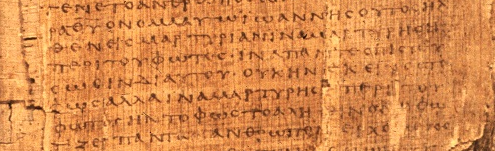
Now, at last the Bible translator Uriel ben Mordechai has given us a much more faithful and Torah-centric translation of this verse from P66 (circa 150 CE), the earliest extant Greek manuscript for this verse.
It reads:
“Yeshua replied, “I represent that pathway along with the legitimacy. And on that path of life, none WILL appear adjacent to Ha’Ahv except for me.”. – Yochanan 14:6
And his amplified version (the words in the square brackets are not in original but added for clarity):
“Yeshua replied, “I represent [i.e., live-out, personify or animate] that pathway [of the Writings] along with the legitimacy [or genuineness, validity or integrity of the Torah]. And on that path of life, none WILL [or can] appear adjacent to [or to the right of, or before] Ha’Ahv [ i.e., the Father] except for me.”
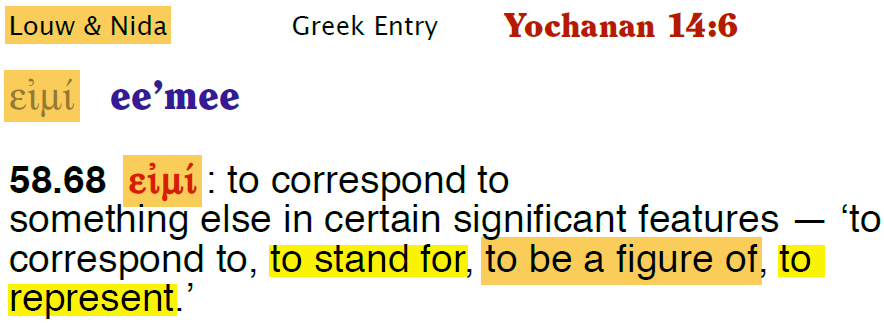
He also makes the critical point that the Greek εἰμί (ee’mee) used here normally means “I stand for, am a figure of, or represent …”. That is, Yeshua represents The Way (of Torah) but he is not stating here that he is himself the one and only “Way”. Rather, the context of the exclusiveness of the ‘except for me’ is that Yeshua is telling his disciples that where he is going, they cannot come, and only he can go to sit to the right of HaShem.
That is, no-one else is going to Heaven, only Yeshua! Heaven is not our ultimate home, the Olam HaBah, the Coming Age, the Kingdom of God on Earth is!
There is a sense in which an exclusiveness is relevant and that is with respect to Yeshua’s role as the High Priest on Yom Kippur (in the Coming Age), when only Yeshua is permitted to approach Yehovah.
To quote Uriel ben Mordechai is discussing his translation here:
“Yeshua is not talking about his future role as Kohein, who alone will be permitted to approach Ha’Shem on behalf of AHM Israel in the Olam Ha’Bah during the Yom Kippur service. In any case, if we will refuse to approach Ha’Shem apart from the Kohein Gadol, Ha’Shem will not receive us.”
An awesome message that is not in contradiction with the Tanakh and Torah. A message for all people. A practical message of hope coming from the greatest preacher and prophet of hope who ever lived!
So in conclusion, what is Yochanan really telling us in this first portion of 14:6?
That Yeshua declared that he has walked the pathway of Torah and demonstrated its truth, its legitimacy as the correct (and really only) path to walk to have a relationship with Yehovah and ultimately live on in the Coming Age and in the New Creation.
This translation may not have the poetic beauty that the King James translators gave the verse, but it has much more, because it has the power of truth!
An Update oh Yochanan 14:6
εγω εἰμί — ‘I am’??
Thanks to a serious truth seeker, Sophie and also to a gentleman trying to defend Christian orthodoxy in NT translations, I was asked to dig a little deeper and to question Uriel ben-Mordechai for more clarity around this passage.
Sophie asked for some background as to how Uriel had translated the first two words that Yeshua apparently utters in this verse, namely ‘I am’ (the way, the truth and the life).
Here was Uriel’s explanation on εγω εἰμί (EY’goh “EY’mee):
“EY’mee [the second word] is a verb that in its simplest form renders as “to be,” “is,” “exists.” In the first person, you can render it as “am,” as in “I am.” But strangely enough, translators throughout the last 500 years also render it in the past tense, e.g., “I was,” as well as in the future tense, e.g., “I will be.” Even jamesville [KJV] does this. See LXX Shmu’el Bet 15:34, Mizmor 91:15, Yishaiyahu 43:2, Hoshe’ah 5:14 and others.
But more to your question, even in English, the verb “to be,” being perhaps to the most basic verb expressing the action of existence, carries also the notion of representation. Saying “I am an idiot,” is functionally the same thing as saying “I represent an idiot.”
Thus, when koine Greek — which is a primitive language compared to English, especially in terms of the size of the vocabulary English has at it’s disposal, when compared to the size of vocabulary koine Greek had at its disposal — uses “EY’mee,” the nuances when rendered into English are far and wide, and allow not only for “I am,” but also for I “represent, symbolize, stand for, personify, epitomize, typify, embody, illustrate, designate, depict, portray, pretend to be, constitute, amount to, am regarded as,” and many others as well. Take your pick.
Only christianity, which invents apple pie out of fig leaves, insists and fictionally concludes the ridiculous notion that “I am” is the grammatical equivalent of Hebrew’s “Eh-hee’yeh ah’shehr Eh-hee’yeh” from Sh’mot 3 [“I will be that which I will be”]. NOT!
As for EY’goh, the first word, is just a simple first person singular pronoun for “I.””
From his extensive and very comprehensive translation work on Yochanan (John’s Gospel) Uriel ben-Mordechai shares with me the conviction that Yochanan was first written in Hebrew, so even the P66 scroll is a translation and possibly a transcription as well.
So it is enlightening to look back at some of the occurrences of εγω εἰμί in the Greek translations of the Tanakh such as Hosea 5:14. Here we see the original Hebrew directly translated into English as ‘I will be’ and in fact most English translations also have ‘I will be’.
This should at least convince us that ‘I represent’ is a reasonable translation (although ‘I will be’ could also be plausible if Yeshua were speaking of the coming Day of Judgement – though, an uncorrupted translation of verse 7[1] would appear to rule this option out.)
And when we also consider Yochanan 1 and recognize the introduction of Yeshua as the ‘Torah Dressed in Flesh’ (https://circumcisedheart.info/Torah%20dressed%20in%20Flesh.pdf ) this makes even more sense.
[1]Yochanan 14:7 “But only when this will be acknowledged with me, will you also then come to recognize Ah’vee [i.e., my Father], and from this point forward, from Him, this is being revealed [or seen] by Him, and IT will be looked after [or seen to] by Him.
 Global Truth International
This gives a new understanding of Jn.14:6 indeed!
Pingback: Restoring the Fallen Sukkah of David – Global Truth International