
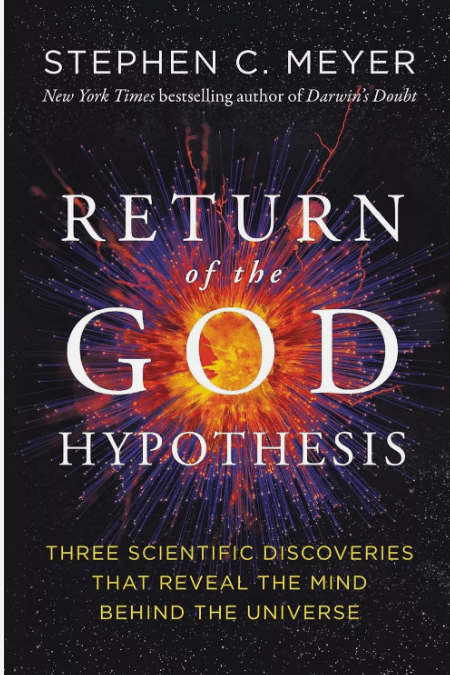
The Return of the God Hypothesis

The Return of the God Hypothesis

I wrote this 3 years ago and was reminded of it today:
Stephen Meyer’s third book, ‘The Return of the God Hypothesis: Three Scientific Discoveries That Reveal the Mind Behind the Universe ‘ is most impressive!

View at https://returnofthegodhypothesis.com/

His other 2 main books, ‘Signature in the Cell’ and ‘Darwin’s Doubt’ were absolute classics that give abundant support for the scientific paradigm of Intelligent Design (ID).

I have a whole section on my main website, circumcisedheart.info on ID.

Some of the historical facts that he introduces have really surprised and delighted me. Having spent many years at University studying Physics, and even reading some biographies on Physicists like Einstein I still found some of his insights really illuminating. I am also dismayed and a little disappointed with myself to learn that there were certain great questions of Physics that I don’t ever remember asking, such as how gravity actually works!

I learned all the laws of Universal Gravitation, etc., and could apply them as needed, but I don’t remember asking some of the deeper questions. 

In learning Physics and doing research in areas of Physics (for me it was mainly Electronics, Microwave Theory and Atmospheric Physics) I didn’t really need to know much of the history of Physics beyond what I learned in a few years of Physics classes at High School but Meyer has specialized in the history of Science, so he brings a wealth of great insights and historical narratives. 

A couple that have really struck me:
I knew a fair bit about Isaac Newton and the fact that he spent more time on his theological studies than his scientific research (if the church and government had known of some of his doctrinal positions they would have dumped him in prison, such as his rejection of the Trinity). And I knew his mathematical model of Universal Gravitation was a massive advance at the time.

But I was not aware that it had led him to argue for an infinite Universe (to balance the gravitational forces of the stars, etc.). This position was problematic for him from a theistic perspective.

Almost three hundred years later, Albert Einstein introduces his General and Special Relativity theories and turns the world of Physics on its head. But as he understood his own theories at the time, and as he rejected the idea of a Creation of the Universe from nothing (i.e the Genesis story), he had to introduce a special ‘fudge factor’, his cosmological constant to try to argue for a steady state Universe that had existed eternally. While the evidence mounted against his cosmological constant for years, it took him close to 20 years to finally overcome his own ego and accept he was wrong!

This from one of the greatest minds in all human history!

If an intellect as great as Einstein can so struggle to place facts and logic ahead of his own pet pre-suppositions and biases, how hard must it be for the rest of us!!

I am firmly convinced that this book should be read be all who wish to reject atheism and the evils that it engenders. This book should also be required reading in Senior High School Science classes.

In Meyer’s ‘Return of the God Hypothesis’ he argues that Theism provides a better explanation of how the first cell was created along with subsequent innovations in the history of life.

He states that “there are 3 keys facts about biological and cosmological origins:

  1. the material universe had a beginning
  2. the material universe has been finely tuned for life from the beginning, and
  3. large discontinuous increases in functionally specified information has entered the biosphere since the beginning.

Deism can explain the first two of these facts, but Theism can explain all three.”

Science today is increasingly finding supporting evidence for Theism and for a Creation event as described in the Bible. The worm has turned! Science truly supports a Creation event ‘ex-nihilo’   (creation out of nothing).

For more on Intelligent Design go to ID @ Circumcised Heart

I also refer to Meyer’s Darwin’s Doubt in this blog post about abductive reasoning:
https://luke443.blogspot.com/2018/01/understanding-abductive-reasoning-and.html

Genesis Repunctuated – Part 2:

In the last two posts I tried first to show that God’s Words have the power to create.

I referred to some verses from both the Tanakh and the NT such as:

“By the word of YHWH were the heavens made, and by the breath of His mouth all their hosts… For He spoke and it was done, He commanded and it stood firm” Ps 33:6,9

Let them praise the name of the LORD, for he commanded and they were created.” Ps 148:5

“By faith we understand that the worlds were prepared by the word of God, so that what is seen was not made out of things which were visible.” Heb 11:3

“…by God’s word the heavens existed and the earth was formed out of water” 2 Peter 3.5

God speaks and it must happen.

I then suggested an alternative approach to understanding the Genesis account of Creation. Before time and space existed, in the ‘eternity’ before our Universe existed, the Creator declared (proclaimed or gave a series of  ‘fiats’) to the Host of Heaven what would happen.

Thus His fiats were separate to the outworking of them. They stand alone as a summary of His intent, His plan, His purpose (echoed in the Gospel of John’s prologue). This has many significant implications. For example, it means the process of creating, especially in terms of its timing, it largely independent of the order of His fiats.

To reiterate, given that God speaks before His Creation unfolds, the order and timing of events need not be identical to the order in which they were first pronounced. Thus for example the fossil record, while similar to the order in Genesis 1, is not, and need not be the same.  Assuming that all of the creative processes were started in the same order as the proclamations, but acknowledging that different processes may take differing lengths of time we would then expect some overlap in the various periods of active creation.

Many critics accuse Genesis 2:4-25 as being a second and contradictory creation account. They argue for example, that in Genesis 1 God created the vegetation on the 3rd day and Adam on the 6th, yet in Genesis 2 Adam is created before the Garden of Eden and then placed in it. We also read in Genesis 1 that God created animals on the 5th day and Adam and Eve on the 6th, yet in Genesis 2 we read that after God had created Adam he created the animals to see if one would be a suitable partner for Adam and only then did he create Eve.

When we view Genesis 1 as divine proclamations we no longer see any conflict here as having declared what was to take place the timing and order is left unstated. It seems obvious (especially with the great cosmological understanding of the Universe’s evolution that we now have), that the stars and planets need to be formed; and the vegetation on the earth established before the many animals were created and all this long before the earth was ready for the arrival of man.

Is there any other approach within Judaism that seems consistent with the ‘fiat theory’? The Talmud (Chagiga, Ch. 2) argues that Genesis 1 to the beginning of Genesis 2 is given in parable form, but particularly as a poem with a text and a subtext. This understanding is certainly supportive of the re-punctuation approach I mentioned in the last post.

It appears that some early Jewish sources (eg. Nachmanides – 13th century Spain) believed that the Bible’s calendar is in two-parts. They argued that in the closing speech that Moses makes to the people, where he states “consider the days of old, the years of the many generations” (Deut. 32:7), Moses was indicating that the ‘days of old’ are the Six Days of Genesis and that ‘the years of the many generations’ is all the time from Adam forward. Again, this understanding finds some harmony with the Fiat Theory in that a distinction is made where the Six Days are measured differently.

So what are the broader implications of the Fiat Theory if it is correct? Firstly, its internal consistency is very strong as it fits so well with the principle that the ‘word of God’, or the breath or plan of God, once expressed will be fulfilled.

Further though, it means that science (specifically astronomy and cosmology) and biblical creation are not in serious conflict. We can therefore accept that the scientific understanding that the universe is some 13 (currently thought to be 13.7 Billion +/- 200 Million) Billion years old may prove to be correct and that man may well have lived on the earth thousands of years earlier than 4000 BCE. It also means we don’t need to reject the great many legitimate scientific tools and methods for measuring time and ages.

It certainly seems to me that the Fiat Theory carries the lightest burden of proof and offers the greatest degree of freedom as well as very good agreement with much of established science.

It also fits beautifully with the rising paradigm that is Intelligent Design, the new appreciation of the glory of God.

I also think though, that it is important to recognize that the Tanakh and in particular Genesis is not a ‘Book of Science’. The brilliant Chief Rabbi of London, Jonathon Sacks puts it very well:

Torah is not a book of history, even though it includes history. It is not a book of science, even though the first chapter of Genesis – as the 19th-century sociologist Max Weber pointed out – is the necessary prelude to science, because it represents the first time people saw the universe as the product of a single creative will, and therefore as intelligible rather than capricious and mysterious. It is, first and last, a book about how to live. Everything it contains – not only commandments but also narratives, including the narrative of creation itself – is there solely for the sake of ethical and spiritual instruction.

It moves from the minutest details to the most majestic visions of the universe and our place within it. But it never deviates from its intense focus on the questions:

  • What shall I do?
  • How shall I live?
  • What kind of person should I strive to become?

It begins, in Genesis 1, with the most fundamental question of all. As the Psalm (8:4) puts it: “What is man that You are mindful of him?” …

As the rabbis put it (Bereishith Rabbah 8:1; Sanhedrin 38a): “Why was man created last? In order to say, if he is worthy, all creation was made for you; but if he is unworthy, he is told, even a gnat preceded you.”

The Torah remains God’s supreme call to humankind to freedom and creativity on the one hand, and on the other, to responsibility and restraint – becoming God’s partner in the work of creation.”

– see http://www.aish.com/tp/i/sacks/173307801.html – I strongly recommend reading the whole article – Sacks is most insightful!

For more on the Creation of the Universe, as well as the creation of the Next Universe, see my podcast from a speech I gave to Christian Restoration Fellowship (Australia) some years ago – http://pfherring.podomatic.com/player/web/2009-02-21T16_17_38-08_00

The background paper is here: It’s Life Jim, but not as we know it

Next: Other approaches worthy of consideration …
Coming Soon: Aubrey and I present a podcast on the Hebraic Mindset