A different take on Isaiah 9:6

This prophecy is one, which is extremely well known within Christendom, or more accurately, it is very often quoted and preached on by Pastors and preachers in the mainstream Christian churches. For example, I have attended Christmas Day services where this was the main Scripture quoted and discussed.

One of these occasions some years ago led me to write to the Pastor of a large Pentecostal church here in Brisbane, and try to share with him my understanding of the many ways in which he was mis-interpreting this passage.

Now, in looking back over what I wrote, while I still believe I was pointing him in the right direction, I now believe that if I had better understood this passage in Hebrew, I would have been much more able to show him how very far his understanding was from the truth. I am fairly sure though, that I would still not have influenced him in any significant way to change his cherished Hellenistic doctrines and lens through which he read this passage.

Here though is the utterly remarkable way in which the Hebrew of this passage can be fairly and accurately translated into English that sheds an amazing light on what this passage was really revealing.

Let me first share his translation and then try to explain how this comes about and what it means:

“… For unto use a child is born, to us a son is given, and the government shall be on his shoulders.
A Wonder, a Counselor, Mighty G-d, my Father in perpetuity, shall call him … “Prince of Peace”’
– translation by Uriel ben Mordechai

There are many Christian ‘Hebrew scholars’ who have translated this phrase differently, but very few of those ‘Hebrew scholars’ have been native speakers of Hebrew like Uriel.

As Uriel points out in much detail, his translation is much closer to how a native Hebrew speaker who knows his/her Tanakh would pronounce it, in particular because they would know how to read the ‘nikud’ (a system of diacritical signs used to represent vowels and distinguish between alternative pronunciations and determine the intended grammatical structure).

Many Hebrew versions of the text also have ‘cantillation marks’ (a system of marks to help with chanting the text which are very much like todays commas and colons, but which dates back to the time of Ezra – circa 510 BCE). This clearly establish where breaks occur in the text and thus establishes that the first 4 ‘nicknames’ belong to the ‘caller’ and only the last nickname, ‘Prince of Peace’ belongs to the one being ‘called’ by the ‘caller’.

Further evidence that these first four nicknames; Wonder, Counselor, Mighty G-d and ‘my Father in perpetuity’ all are labels/names for the Creator and King of the Universe; the God of Israel, is seen in these verses from the Tanakh, where each of this ‘nicknames’ are applied to the Almighty:

פֶּ֫לֶא – ‘Peleh’, a noun meaning a ‘Wonder’ – see Ex 15:11 “Who is like you, Adonai, among the gods? 
Awesome in praise, doing a wonder (peleh)?”

יוֹעֵץ (Yo-etz) – a noun meaning ‘a counselor’ – see Psalm 16:7 “I will bless Adonai, my counselor.”

(el Gibor גִּבּוֹר אֵל – Hebrew back to front sorry) – meaning ‘mighty or powerful God’ – see Deut 10:17 “For the LORD your God, He is God of gods, and Lord of lords, the great God (Ha’El – הָאֵל), the mighty (ha-Gibor הַגִּבֹּר), and the awful, who regardeth not persons, nor taketh reward.”

אֲבִי-עַד – (Avi-ad) – meaning ‘my Father for eternity’ or ‘my Father for perpetuity’ – see 1 Chronicles 29:10b “…Blessed be Thou, O L-RD, the God of Israel our father for eternity”

So we can see that al these ‘nicknames’ have been used elsewhere in the Tanakh to refer to the Almighty. It is true that ‘El Gibor’ can also refer to great leaders of men, but in the grammatical structure of this verse, Uriel shows very clearly, that here it is referring to YHWH Himself.

Lastly שַׂר-שָׁלוֹם (sar Shalom) refers to a Prince or Ruler of peace (see Psalms 2 for example). In could well be that Isaiah had Hezekiah in mind when he penned this, but we can also see how this verse may apply to the end-times Mashiach when he comes to rule the Earth and bring the Peace of God to this world.

This is all articulated in great detail in ‘If: The End of the Messianic Lie’ – get it at http://above-and-beyond-ltd.com/store/books/if.html


The 2nd Word Revisited – A Prophetic Statement?

In his brilliant book, ‘If: The End of a Messianic Lie’, Jewish author and teacher, Uriel ben Mordechai points out that most English translations of Exodus 20:3, which is the 2nd Word (Commandment) are incorrect.

He points out the the phrase עַל-פְּנֵי (Al Panai) has been mistranslated as ‘before me’ or ‘over me’, wherein fact the phrase should be translated as ‘upon the face of’. This phrase occurs in Genesis 1:2 for example and is translated as ‘upon the face of’.

The Hebrew for Ex 20:3 is לֹא-יִהְיֶהלְךָאֱלֹהִיםאֲחֵרִים, עַל-פָּנָי and this is transliterated as “Lo yihyeh lecha elohim acherim al-panai.”

Most translations put this is English as “You shall have no other gods before Me.”.

Commentaries such as the Pulpit Commentary explain that “Before me” literally means, “before my face,” and is a Hebrew idiom, and equivalent to “beside me,” “in addition to me.”

However, Uriel goes into great detail to point out that a more accurate translation is “You shall have no other gods before me” or better still “There shall not be for you another G-d of Israel upon My Face’.

He then goes on to explain that the Almighty is making it clear that the Jewish people were called to never, ever place a face of any being, man, animal or spiritual entity onto the image of God. No being with a face of any sort can fully be YHWH.

As Uriel ben Mordechai puts it “.. we are forbidden to ASSIGN OR ATTACH ANY (visible) FACE, ON OR UPON THE FACE OF GOD’.”

Therefore, this commandment means “You shall not regard another persona imposed upon My Face, as the G-d of Israel’.

What a prophetic statement!

How many have tried to place a ‘face’, a persona upon the Face of the God of Israel and tried to call someone else the Creator and King of the Universe?!

This is a great book – get it now – see http://above-and-beyond-ltd.com/store/books/if.html

A couple of others who share this understanding:

“It is crystal clear in many, many verses that the Almighty 
G-d of Israel is the ONE and only creator. He was, is and will continue to exist forever. He shares his glory with NO ONE. He is the only Rock and Saviour.

There is NO ONE else. That is the crux of Judaism’s belief. G-d made that very clear to my people at Mt. Sinai from the Ten Commandments alone. Why does it say as part of the Second that you shall not have any G-d’s upon my face?

It means that you shall not add on any additional G-ds. We must worship the One and only G-d of Israel.”

– Rebecca – http://disqus.com/proud_conservative_mom/

And:

“After witnessing what Israel had witnessed in Egypt, the mere thought of projecting onto G-d an image or “Face” was not an option.

The second commandment accurately states this. In English, it is translated as; “You shall have no other gods before me.” (Ex.20:3).

Actually a correct translation should read, “You shall have no other gods upon my Face.”

–        Rabbi Ariel Bar Tzadok – http://www2.mrbrklyn.com/resources/avodah-zara.pdf 


What does it mean to be God’s witness?

“Do not desecrate My holy name. I must be sanctified among the Israelites. I am YHVH, who made you holy and who brought you out of Egypt to be your God. I am YHVH’ – Leviticus 22:32
[
Two great commands[1]: – from this weeks Torah Portion – Emor – Leviticus 21-24]

In this sentence are two really important instructions from the Almighty – they are firstly a prohibition against desecrating God’s name, and secondly the positive corollary, to sanctify God’s name.

What are these commands and what do they mean?

First we have to understand the concept of “name” as it applies to God.

A name is how we are known to others. God’s “name” is therefore His standing in the world.

Do people acknowledge Him, respect Him, honour Him?

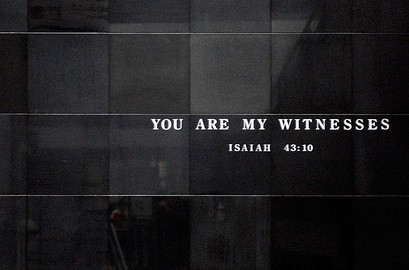
We read in Isaiah: “You are my witnesses, says God, that I am God” (Isaiah 43:10)

Witness2

So here we see that HaShem (The Name = YHVH), through the great prophet Isaiah informs the Jewish people that they are the witnesses to God Himself and to the reality that He is God. His standing; the degree to which the Almighty is held in respect and honoured is through the degree to which the Jewish people have been powerful and effective witnesses.

Yet, the God of Israel is the God of all humanity. He created the universe and life itself. He made all of us – Jew and Gentile – in His image. He cares for all: “His tender mercies are on all his works (Psalm 145:9).

Because He is Spirit, because He created the Universe, He transcends it; HE is beyond it. So how can He be known?

Science can only measure and ‘know’ the material universe. Yet there is no question that Nature does declare the Almighty and His works. Science continues to further reveal the amazing design of the Universe and the powerful and undeniable inference of an Intelligent Designer[2].

Science is increasingly revealing to us that this mind-bogglingly vast Universe was created over an incredibly long period of time for the central purpose of creating mankind! Science is also demonstrating that the truths of the Universe have been revealed to us in a tutorial like fashion, in a similar way to the unpeeling of an onion of increasing complexity as we reach toward its core.

But such revelations of Science tell us little about the nature and ‘personality’ of this Designer or Creator.

So incredibly the Creator decided to reveal Himself to the world through a ‘Chosen People’, the nature sons and daughters of Abraham, Isaac and Jacob – the Jewish people.

Yet, because He is the God of the Gentile as well as the Jew, he also eventually opened a doorway for Gentiles to not only learn of Him through the witness of the Jewish people, but also to be adopted into the family of Abraham.

To reiterate then, the Creator of the Universe has made Himself and His nature known primarily (not exclusively), through Jewish history and the Jewish impact, influence and witness to the world.

At the end of his life Moses stated:

Ask now about the former days, long before your time, from the day God created human beings on the earth; ask from one end of the heavens to the other.

Has anything so great as this ever happened, or has anything like it ever been heard of?

Has any other people heard the voice of God speaking out of fire, as you have, and lived?

Has any god ever tried to take for himself one nation out of another nation, by testings, by signs and wonders, by war, by a mighty hand and an outstretched arm, or by great and awesome deeds, like all the things YHVH your God did for you in Egypt before your very eyes?  -Deut. 4:32-34

Some 3,300 years ago Moses already knew that Jewish history was and would continue to be unique. No other nation has survived such trials. The revelation of God to Israel was unique.

No other religion is built on a direct revelation of God to an entire people as happened at Mount Sinai.

Therefore God – the God of revelation (nature & Mt Sinai) and redemption (the Exodus & the Resurrection) – is known to the world through Israel.

Thus the Jewish people (and all who have been grafted into the commonwealth of Israel) are testimony to something beyond ourselves.

They (we) are God’s ambassadors to the world.

Therefore when the Jewish people, or the ‘Grafted Ones’, behave in such a way as to evoke admiration for their faith and way of life, that is a sanctification of God’s name.

When the opposite occurs – when they/we betray that faith and way of life, causing people to have contempt for the God of Israel – that is a desecration of God’s name.

That is what the prophet Amos means when he says:

“They trample on the heads of the poor as on the dust of the ground, and deny justice to the oppressed … (in doing) so (they) desecrate My holy name.” – Amos 2:7

When Jews or ‘grafted ones’ behave badly, unethically, unjustly, they create a desecration of God’s good name.

People then say, ‘I cannot respect a religion, or a God, that inspires people to behave in such a poor manner’.

The same applies on a larger, more international scale. Ezekiel made this clear:

I dispersed them among the nations, and they were scattered through the countries; I judged them according to their conduct and their actions. And wherever they went among the nations they profaned my holy name, for it was said of them, “These are YHVH’s people, and yet they had to leave his land.”  – Ezekiel 36:19

Rabbi Sacks writes:

“When Jews are defeated and sent into exile, it is not only a tragedy for them. It is a tragedy for God. He feels like a parent would feel when he sees a child of his disgraced and sent to prison. He feels a sense of shame and worse than that, of inexplicable failure.

“How is it that, despite all I did for him, I could not save my child from himself?”

When Jews are faithful to their mission, when they live and lead and inspire as Jews, then God’s name is exalted. That is what Isaiah means when he says, “”You are my servant, Israel, in whom I will be glorified” (Isaiah 49:3).”[3]

The fate of God’s “name” in the world is dependent on us (Jews and ‘grafted ones’) and how we behave.

No nation has ever been given a greater or more fateful responsibility than Israel.

When we gather to pray for the peace of Jerusalem (Ps 122:6) and share in the support of her people, we ‘grafted ones’ also have a share in this task.

BUT, when we, especially the more religious and zealous amongst us, behave badly; that is when we act unethically in business, or are guilty of sexual abuse, or utter a racist remark, or act with contempt for others, etc. – such failure; such desecration of He who we represent; who we are witnesses of;  reflects badly on all Jews and righteous Gentiles, and on the faith of Abraham itself[4].

And when we act well – when we develop a reputation for acting honourably in business, or caring for victims of abuse, or showing conspicuous generosity of spirit – not only does this reflect well on our community, and on the commonwealth of Israel, it naturally increases the respect people have for religion in general, and thus for the One True God, YHWH.

This is how Maimonides puts it in his law code:

If a person has been scrupulous in his conduct, gentle in his conversation, pleasant toward his fellow creatures, affable in manner when receiving, not retorting even when affronted, but showing courtesy to all, even to those who treat him with disdain, conducting his business affairs with integrity …
And doing more than his duty in all things, while avoiding extremes and exaggerations – such a person has sanctified God.”[5]

Throughout history the Jewish people have been trust into the limelight so that their witness, both good and bad, has really been unavoidable. Despite their very small numerical size, their witness has been undeniably huge.

The Jew, Milton Himmelfarb wrote: The number of Jews in the world is smaller than a small statistical error in the Chinese census. Yet we remain bigger than our numbers. Big things seem to happen around us and to us.‘[6]

God trusted the Jewish people enough to make them His ambassadors to an often faithless, brutal world.

Yet, individually, tribally and corporately the choice is always theirs.

They each daily need to decide ‘Will my life be a sanctification of God , or a desecration? Will my life further enhance the good reputation of God, or will my choices today bring dishonour on Him and further denigrate the reputation of good standing of the Almighty in the eyes of the world?”

If you are Jewish or a ‘grafted one’, you too need to make this choice every day. I think all who seek God; all who are truth seekers, will eventually learn that they are, or can become part of the family of Abraham.

Yet this choice, this freedom to follow our ‘fleshly hearts’, our ‘Yetzer HaRa’ and in turn potentially desecrate the name and reputation of the Almighty, or instead to heed the call of our ‘spiritual heart’, our ‘Yetzer HaTov’ and act in ways that sanctify His Name, is always in front of us.

Perhaps when we reflect that an act of good that we participate in has in turn sanctified the honour, and reputation of God, and in doing so has been a faithful and effective witness of the true reality of our Father in Heaven, our joy should increase!

We can then also take comfort in having inspired others to believe and have faith, and in turn, seek Him whose mercies are new every morning!

May it be so! Amen!

[1] Most of the article is a paraphrasing of a great Parsha from Rabbi Jonathan Sacks. Rabbi Sacks is one of the most amazing theologians and authors of our time. I am deeply indebted to his scholarship.

[2] See my article ‘Does God Exist’ – https://goo.gl/dfZ7aE

[3] I have written at length on Isaiah 49, an amazing and prophetic chapter – see Isaiah 49 – a commentary

[4] For more on the ‘family of Abraham’ see ‘The Tripartite Salvation Paradigm’

[5] Maimonides, Hilkhot Yesodei ha-Torah, 5:11

[6] Milton Himmelfarb, Jews and Gentiles, Encounter Books, 2007, 141

‘And God Saw That It Was Good’ – Share the Praise

Faith in God should lead us to have faith in people, for God’s image is in each of us, and we have to learn how to discern it.

Consider the phrase in Genesis 1, “And God saw that it was good,”. The Almighty said this of His created World and also of His creation of mankind.

If we are to embrace being in His image, then surely we too are to see the good in our world, and especially to see the good in others.

praise others

We should seek to praise our family, our friends and our neighbours. We should seek to see the good in them and the good in the events in our lives, that may on the surface seem bad, but in which some good can always be found to focus on and to encourage and strengthen us.

At the heart of praising others, is the 5th Commandment to ‘Honour and respect our parents’.

This instruction and moral code also cuts both ways. The child who shows no respect for his or her parents will in turn know disrespect from his or her own children.

Honoring one’s parents is the most basic and logical of inter-personal laws, and its effects are far-reaching: The son or daughter who respects his or her parents will, by extension, be kind to his siblings and their children as well.

Whenever we find time to pause and reflect, and hopefully to bring praise to our Father in Heaven, let us all also seek, with eyes wide open, to find time and opportunity to praise our family, our friends and all those who enter our circle of life.

In an earlier blog post I spoke about the importance of praising others. Here’s a repost to support the comments above:

We don’t praise the good efforts of others enough.

We lift them, and in turn, ourselves when we praise something that someone else has done.

If we have an appreciative attitude to the blessing of life that we have been given, if we can awake and be thankful that we have awaken, surely we can be more attentive to those around us when they do something that helps us or helps someone and in turn show that we have noticed by praising them.

Obviously, praise needs to be genuine, but often being genuine only requires a change of perspective.

Just consider the last person you spent a few minutes interacting with. Had they done anything today that helped make your life easier or more comfortable or successful, or perhaps had you observed them do this for someone else.

If so, say so!

Praise is a boomerang!

The more we all try to give praise to others the more it will come back on us and in turn lift our spirits and encourage us to try even more to help others.

Appropriate and honest praise is important. So while praising others may bring us happiness, when it comes to praising our children, there are some important points to consider, as  Marnie Winston-Macauley points out:

Five Principles of Healthy Praise

The positive power of praise is well documented. As children grow, they need emotional feedback to mirror who they are. Praise is one way they learn about themselves. When they learn honest, specific positives, they develop confidence and esteem.

But lavishing general, over-reaching praise often has the opposite effect, setting the child up for unrealistic and fraudulent expectations. Telling a child: “You’re a wonderful, son,” “You’re the most honest person I know,” “You’re Mommy’s little angel,” “It’s always such a pleasure to be around you,” “You’re one great artist, writer, [fill in the blanks]. “You’re so smart, there’s nothing you can’t do,” they all sound like confidence boosters, but in fact, they land like “dares.”

These dares set up impossible standards. Parents may hope it’s true but our children know it’s not. After all, who could live up to such overwhelming kudos?

Praise is a lot like medicine. The right amount and type at the right time can restore and contribute to our child’s well-being. But too much of the wrong kind or given at the wrong time and we’ve got one sick puppy for whom the praise:

  1. is inaccurate and won’t jibe with his or her own self-view.
  2. raises anxiety as he feels like not only a fraud, but, like little David, one who may quickly lose his halo if he’s “found out.”
  3. could lead to impossible self-expectations. “I’m perfect or nothing,” then becomes the emotional compass.

So how can we praise without “punishing?”

#1: Praise realistic achievement specifically

“Thanks for helping me clean the basement. It looks like new,” or “You followed the recipe, and we all really enjoyed your cookies,” instead of “What a terrific cleaner or cook you are” telegraphs our children did a fine job, without raising anxiety by expecting them to be Bob Vila or Martha Stewart. Letting children know what they’re actually achieving offers a realistic emotional mirror. The message they hear? “My work really paid off! I did something new, and I can learn, listen, follow directions. It was fun, my family appreciated me. I feel sooo grown up and can’t wait to do more.”

#2: Praise proportionally

Proportion in any excellent recipe is critical. Too much sweet (praise) is as unhealthy as too much salt (criticism). Our child cleans her room well. It’s her job and her challenge. She deserves the simple, honest, recognition, not a marching band. We all want our children to own their real accomplishments, and not become “sugar junkies.”

#3: Praise in the here and now without prophesizing or readying your mantel for a Nobel Prize

In the Siddur we say each morning, “A person must always acknowledge the truth and speak truth in his heart.” Over-praising is a fundamental “untruth” and, despite well-intentioned praise, our children know they’re not deserving of all that glory. Not only do they feel the stress, they start to doubt themselves, and us. 

Ironically, hyper-praise can cause our children to either shut down, or become competitive at all costs. On the other hand, specific, proportional praise encourages children to believe in the value of a job well done.

#4: Helpful praise allows the child to infer the truth about himself and his character

Saying, “I really appreciate you telling me I gave you a five dollar bill instead of a one,” beats, “You’re always so honest!” by letting children get the idea – for themselves – that honesty is a positive quality, one they can and should continue as an ethical standard that is important, noted, and respected.

#5: Praise a good attempt, as well as accomplishment.

“Wow! An 85 in math. That was a tough test. And I know you were worried about it. This grade shows you really put a lot into it and it paid off!” tells the child effort and perseverance are more important than instant success.

Useful praise supports positive reality, acts as an accurate emotional mirror, and lets the child develop self-knowledge and ethics. With these character traits, children can then grow and mature with true confidence – confidence they’ve earned, and confidence they can trust.  – see http://www.aish.com/f/p/How_to_Praise_Your_Children.html

I would argue that Marnie’s wisdom here can also be applied to our interactions with other adults.

We need to find the opportunities to give praise, but it must be honest, specific, proportional and an invitation to critical self-reflection, rather than a conclusion and end in itself.

Shalom!

Amazing Ada – joy liberally mixed with grief

Amazing Ada – joy liberally mixed with grief

Some 20 weeks ago, one of my daughters had a 19 week pregnancy scan which for the first time indicated that her unborn baby girl was seriously deformed both physically and in terms of her vital organs.

While medical advice was to abort this very young and unique human being, my daughter, being very strongly pro-life, and strongly supported by her husband, choose to remain pregnant.

It was hard in many ways; each scan added more bad news, yet she embraced her pregnancy and her baby they named Ada (originally meaning ‘jewel’ or ornament). The next 19 weeks to the birth were both good and bad, but my daughter was now unquestionably a mother!

Being a mother was a role we had all seen, as her most desired and important role since she was around 8 years of age herself (now 31).

Because of even more complications the birth was brought forward and a Caesarean birth scheduled. We were all at the hospital and the afternoon went well but Ada was taken immediately to the Neonatal Intensive Care Unit (NICU), so the family didn’t get to see Ada that day.

She survived the night and displayed very early that she was a real fighter. The next day we all got to go one at a time, into the NICU with her mum or dad and see her, and touch her, and talk to her. She was beautiful with huge deep and knowing eyes!

The next few days were mercifully prolonged, as many blood tests were performed to try to determine exactly what was wrong with Ada. At the same time we knew that her heart and lungs weren’t working well enough to keep her alive without being on a ventilator.

After all the tests had been conducted it was now six days since her birth. She had nearly left us a few times but she had also spent a few hours off the ventilator.

The amazingly professional and caring approach of the medical staff was always evident. For example it would take 4 nurses 15 minutes to maneuver Ada (with all the many tubes and sensors attached) to be placed on her mum or dad for skin to skin contact.

There were many prayers and we were all regulars at the maternity hospital during that week.

The doctors and medical experts, having determined there was nothing that could be done for Ada had organized for her mum and dad to take her home the next day to pass away in their arms in the comfort of their home. But Ada had other ideas.

Only some 20 minutes after the hospitals Chaplain had visited and shared a blessing with some of the family gathered around Ada in NICU, Ada pulled out her ventilator tube – she clearly disliked having the tube down her throat. To re-insert was not a pleasant procedure for Ada and she was normally sedated for it. Rather than put her through this again, her mum and dad took her up to her mum’s room in the hospital and they shared the last very special hours with her and she slowly and peacefully passed away, to rest,  in the early morning hours of the 7th day.

Many, both medical practitioners, and religious people, including Pastors had thought that she should have been aborted 20 weeks earlier (to presumably save someone some pain or suffering).

Instead her parents had let the Giver and Taker of Life determine Ada’s lifespan. As a result, her mother was emphatic that the week since the birth had been the best week of her life!

Yes, it was hard to part with her. It was very hard to see her two parents carry her coffin to the Funeral car to travel to the cemetery. It was hard to witness that very small white coffin (though beautifully decorated with words of love and care from her family), lowered, again by her mum and dad into the grave. I will miss my beautiful grand-daughter for far too long.

But is what also a time of joy, a time to celebrate the life and love we were blessed with through this beautiful and perfectly innocent baby girl. She united a family in our love of her. Her light shone very brightly for the short time she was with us.

She was more than worth fighting for.

Among the many beautiful words, kind thoughts and prayers we received, I particularly liked this poem from Leon in South Africa:

Let me come in where you are weeping, friend

And let me take your hand

I, who have known a sorrow such as yours,

Can understand.

Let me come in, I would be very still

Beside you in your grief

I would not bid you cease your weeping, friend

Tears can bring relief.

Let me come in, I would only breathe a prayer

And hold your hand

For I have known a sorrow such as yours

And understand.

As long as we live, they too will live, for they are now a part of us, as we remember them. Amen

Here is also just a few scriptures that I found of some comfort:

Ps 16:7,8,11

I bless the Lord who gives me counsel;
 in the night also my heart instructs me.

I have set the Lord always before me;
because he is at my right hand, I shall not be shaken.

You make known to me the path of life; in your presence there is fullness of joy;
at your right hand are pleasures forevermore.

 Psalm 73:26

My flesh and my heart may fail, but God is the strength of my heart and my portion forever.

Isaiah 25:8
He will swallow up death forever. The Sovereign YHVH will wipe away the tears from all faces; he will remove the disgrace of his people from all the earth. YHVH has spoken.

Isaiah 40:18-31
Do you not know? Have you not heard? YHVH is the everlasting God, the Creator of the ends of the earth. He will not grow tired or weary, and his understanding no one can fathom. He gives strength to the weary and increases the power of the weak. Even youths grow tired and weary, and young men stumble and fall; but those who hope in YHVH will renew their strength. They will soar on wings like eagles; they will run and not grow weary, they will walk and not be faint.”

When some said that God had forsaken them , He answered through the prophet Isaiah:

“Can a mother forget the baby at her breast and have no compassion on the child she has borne? Though she may forget, I will not forget you! See, I have engraved you on the palms of my hands…” – Isaiah 49:14-16


My Prayer for the Funeral Service:

Blessed are you, Yahweh our God, King of the Universe, who fashioned us with justice, nourished and sustained us and knows the sum total of all our lives and will restore and resuscitate us with judgment. Blessed are you Father God who resurrects the dead.

Of Father God, Almighty King and Creator, you spoke through your prophets like Moses and Daniel and through your great Kings like David and Solomon, that when we die we sleep with our ancestors.

But you also said to Daniel that many of those who sleep, the sleep of death, shall awake, some to everlasting life.

So thank you Father, for giving us the certain knowledge and great hope that Ada who now sleeps, will awake on that Great Day and because of her absolute innocence, be resurrected into Life in the World to Come.

She will awake to a life of perfect peace and joy, a life with no suffering or pain, and she will stand proud and tall, beautiful and strong!

Oh Father, you gave a jewel to us, an ornament so pure, in Ada was your grace proclaimed, in her your heart revealed.

We thank you Father for sending her and for all the love she shared. Father God, you gave this unique and precious gift of Ada to <her parents> and all our family. You gave almost 40 weeks of life to this amazing child. You gave us the sound of a cry. You gave us those most beautiful eyes, You gave us the opportunity to meet this child. You gave her mother the best week of her life.

Father God, thank you for her beauty, which shone so brightly though only for a moment.

The passage of years will never fill the void in our hearts, nor can time soften the pain of bereavement. Though Ada is no longer in our midst, her memory shall forever be enshrined in our hearts.


O merciful God, Giver of life, you have recalled what is yours, and we thank you that you now hold her close to you. We ask that you give us all the strength we need as we still grieve in our separation from our adorable baby Ada.

We also ask that you surround <her parents> with your gentle but powerful embrace and carry them through the dark times and also lift them onto the highest mountains of joy and peace as they remember the best times of their lives entwined with Ada’s.

Also Father, I beseech you that you open the hearts and minds of everyone here today. Circumcise our hearts anew Father God, so that we may all know your grace and mercy, Your loving kindness that endures forever. Open our eyes Lord so that we may all return to you, so that we may all be in right standing before you and so in turn, on that Great Day, and in the World to Come we may be united with Ada once again.

Amen


The Ethics of Ya’acov

The Ethics of Ya’acov (died 62 CE):

The oldest book in the New Testament is the Book or Letter/Epistle of James. The author’s name,  Ya’acov (or Yaakov) HaTzadik, has  been transliterated to Jacob (‘the Righteous’) and then to James (the Just)!

Josephus wrote of him: “He was surnamed the Righteous because of both his piety towards God and his benevolence to his countrymen.”  (translated from Josephus, ‘Antiquities’, Xii.43)

His letter is a letter of encouragement and of ethics.

For example, Ya’acov speaks out against:

  • a superficial  hearing of God’s Word;
  • pious speech on what the Jewish people should believe, but little practice of the same;
  • the error of being dogmatic about both the Written and Oral Torah, yet not fully understanding proper practice – for example, the healing of a man on the Sabbath[1];
  • a failure to fulfill the most foundational requirements of Torah, while at the same time getting pedantic about the more minor requirements (the narrative in Matthew 23 is a great example of this where Yeshua finishes (see v23) his condemnation with a reference to the great Micah 6:8 passage. See James 1:26 for just one example of how Ya’acov addresses this;
  • the pursuing of wealth which leads to divided loyalties between riches and YHVH;
  • the futility of the exercise of prayer without faith in God;
  • the slandering and cursing of their neighbours, and;
  • the taking of oaths too lightly (perhaps indicative of a lack of commitment to the path of holiness).

Just as a number of Jewish scholars, such as Joseph Klausner[2] of Hebrew University in Jerusalem (1874-1958), have recognized that Yeshua was a great ethical teacher, the same emphasis on ethics is seen in this short Book of James/Ya’acov.

It starts with a message of encouragement to those facing temptations/trials. Part of the answer from Ya’acov to such challenges is to call his readers to heed the Torah because it brings freedom!

“But if a person looks closely into the perfect Torah, which gives freedom, and continues, becoming not a forgetful hearer but a doer of the work it requires, then he will be blessed in what he does.” James 1:25[3]

With the Exodus, the Jewish people were freed from physical slavery in order to voluntarily place themselves under the restrictions of moral integrity.

As Rabbi Benjamin Blech states in ‘Freedom without limits’: Freedom without any restraints may very well be just as destructive as slavery. “No one can ever tell me what to do” – an idea not limited by ethical constraints – is potentially just as much a threat to the social order as slave masters…”.  

For example, in James 1:12 he writes How blessed is the man who perseveres through temptation! For after he has passed the test, he will receive as his crown the Life which God has promised to those who love him.”  We see here that obedience and perseverance in obedience brings the ‘Crown of Life’.

Yaacov’s call in v1:22Don’t deceive yourselves by only hearing what the Word says, but do it! is strongly reminiscent of much of what Yeshua declared in terms of obedience to the divine instructions (Torah) of the Almighty. For example, in Matt 12:50 we read: For whoever does the will of my Father in heaven is my brother and sister and mother.”

In chapter 2:13, Ya’acov having just stressed the need to be obedient to all 10 of the Ten Words, then makes the powerful call to his Jewish brethren to both speak and act with this appreciation of the Ten Words, while recognizing that ultimately while the Almighty will judge us in terms of our obedience to Torah, His mercy will temper and even triumph over His judgment so that we need have no anxiety with respect to our, at times, imperfect obedience to the perfect Torah of freedom:  So speak and so act as those who are to be judged under the Torah of liberty. For judgment is without mercy to one who has shown no mercy. Mercy triumphs over judgment.” James 2:12-13

In this statement I believe we can also hear the echo of Micah 6:8: He has shown you, O man, what is good. What does YHVH require of you, but to act justly, to love mercy, and to walk humbly with your God?”

This is even further accentuated when Ya’acov goes on to write:

“18 But someone will say that you have faith and I have actions. Show me this faith of yours without the actions, and I will show you my faith by my actions!
19 You believe that “God is one”? Good for you! The demons believe it too — the thought makes them shudder with fear!”
– James 2:18-19

Notice that Ya’acov is extremely emphatic that ‘faith’ or belief without ‘works’ or ‘actions’ is no faith at all. As he confirms, even the demons have faith or believe that YHVH is One, that there is no God beside Him, but such faith of demons will not save them because they are not exercising such knowledge of the One True God.

Ya’acov is so strong on the need to act according to our faith in YHVH that he gives the analogy that just as a person dies when their ‘spirit’ (the breath of God, or that which animates them) leaves them, so to, faith that is not exhibited through living obedience is really dead or non-existent.

Indeed, just as the body without a spirit is dead, so too faith without actions is dead.” – James 2:26

Further confirmation, though not needed, is then seen in v22 where Ya’acov clarifies that ‘works’ or actions (i.e. obedience) ‘completes’ faith:
“22 You see that faith was active along with his works, and faith was completed by his works;
23 and the Scripture was fulfilled that says, Abraham believed God, and it was counted to him as righteousness—and he was called a friend of God.
24 You see that a person is justified by works and not by faith alone.”
– James 2:22-24 (ESV)

I also love the humble and gracious manner in which Yaacov explains that a life of obedience to Torah, being a life of true freedom, is then also, by implication, a life that exhibits a pure and peaceful attitude towards others, so that it can be seen that the faithful servant of YHVH is truly ‘loving his neighbor as himself’.

“Who among you is wise and understanding? Let him demonstrate it by his good way of life, by actions done in the humility that grows out of wisdom.” – James 3:13

“But the wisdom from above is, first of all, pure, then peaceful” James 3:17

For more, see my article ‘James the Just: Reevaluating his legacy’ at circumcisedheart.info

[1] Luke 13:14 “but the President of the synagogue, indignant that Yeshua had healed on Shabbat, spoke up and said to the congregation, “there are six days in the week for working; so come during those days to be healed, not on Shabbat!”  Yeshua was falsely accused. He is both condoning a practice that had developed (Oral Torah), and expanding it in an intriguing way. The practice had been developed that if a boy’s 8th day from birth was the Sabbath, the person (a ‘mohel’) performing the circumcision was allowed to break the Sabbath by carrying the tools required through the village and performing the ritual. It was considered that when this conflict between the requirements of observing the Sabbath and of circumcising a male child on the 8th day were in conflict the circumcision took precedence. If however the child was ill on his 8th day since birth (which say was the Wednesday) and he was not well until the Saturday, the Sabbath, the ruling was that now, the Sabbath took precedence and so the circumcision would not be performed until a later day. Yeshua by his comments appears to condone this approach to the potential conflict between these mitzvot (commandments). However, Yeshua also argues that, given this ruling, why should he be condemned for healing the whole man on the Sabbath. The clear understanding being that circumcision was a form of healing (not only a token, or marker but a positive commandment), perhaps primarily because it was a mark of entry into the family/tribe of Israel.

[2] Klausner argues that Yeshua was best understood as a Jew who was trying to reform the religion, and that he died as a devout Jew. He writes: ”But Jesus is, for the Jewish nation, a great teacher of morality and an artist in parable.  He is the moralist for whom, in the religious life, morality counts as – everything.  … in his ethical code there is a sublimity, distinctiveness and originality in form unparalleled in any other Hebrew ethical code; neither is there any parallel to the remarkable art of his parables.  The shrewdness and sharpness of his proverbs and his forceful epigrams serve, in an exceptional degree, to make ethical ideas a popular possession.  If ever the day should come and this ethical code by stripped of its wrappings of miracles and mysticism, the Book of the Ethics of Jesus will be one of the choicest treasures in the literature of Israel for all time.”
 – Klausner, Joseph “Jesus of Nazareth; His Life, Times, and Teaching’ (1925) p 413-414

Fighting Fair: Bringing Balance to the Table Regarding Israel’s Place in the Plans of God

I see so much false thinking amongst almost every Gentile people group throughout the entire world, and even amongst many liberal/non-religious Jews (especially in the Diaspora) regarding the reality of the State of Israel today.

The mass media has been hugely successful in falsely portraying Israel as a demonic bully in its relationship with its Arab neighbours, and as a usurper of the affections of God. The mass media and the great majority of advocacy groups from almost every political and religious persuasion has done a brilliant job is painting Israel as an aggressive ‘occupier’ and serious blight on world’s hopes and dreams for peace in the Middle East and around the globe.

What perhaps most saddens me is that this evil propaganda campaign has been so successful that even many ‘Christian’ Messianic groups and individuals have been duped into believing these false reports.

There are a number of great organisations such as Honest Reporting (www.honestreporting.com) that work tirelessly to try to counteract the incredibly false message about Israel that dominates the mass media and social media networks around the world.

However, I think that some serious factual background information about the historical, political, theological and social events that have brought us to the present reality of the State of Israel are needed before such Israel advocacy voices such as Honest Reporting can be properly appreciated.

In this regard I believe that there are two vital books that give such background evidence. They are ‘Should Israel Exist’ by Prof. Michael Curtis, and ‘A History of the Jews’ by the historian Paul Johnson.

Both of these books are brilliant and very powerful narratives that document so much of the relevant information to give the open minded ‘truth seeker’ the comprehensive grounding needed to make proper sense of the events of the present time.

In ‘Should Israel Exist’ Prof. Michael Curtis addresses the recent political and historical events that lead to the formation of the State of Israel in 1948 and the subsequent wars and political events that have been waged to try to reverse the miracle of 1948. He very clearly and effectively analyses the legal, ethical and moral perspectives surrounding these events and the existence of the State of Israel in the historic Land of Israel.

Historian Prof. Paul Johnson’s book is a lot more detailed and comprehensive as it traces the complete history of the Jewish people. While Johnson is not Jewish (he is a Roman Catholic), his ability to faithfully and accurately portray the Jewish people through their long chequered history is amazing, both in its detail, and in its real empathy and appreciation for this miraculous people of God.

For a very short but inspirational video that starts down this path to proper enlightenment I strongly recommend Inside Israel – How A Small Nation Makes A Big Difference’ – see http://www.israelinsidethemovie.com/

‘Inside Israel’ looks at why Israelites have been so amazingly successful in so many areas of human endeavour and why the Nation of Israel continues it’s miraculous development as one of the greatest and most successful countries on the planet.

In this movie Dr Tal Ben-Shahar outlines the 6 main principles that he sees as foundational to this success. These principles are  all derived from the Sh’ma (Shema – Deut 6:4-9; 11:12-22 & Num 15:37-42), which is perhaps the most important foundational portion of the Tanakh (Hebrew Scriptures) for the Jewish people.

I have travelled to Israel twice and on my second trip spent three weeks travelling the whole country. I have seen first hand both the daily miracles that the Almighty blesses Israel with, as well as the amazing way that the Jewish people go overboard (in fact, perhaps to an unhelpful extreme) to be more than equitable, to be more than fair to all within their borders and without. I believe that the Israeli people are the greatest example in the world of a people who heed Yeshua’s call to ‘turn the other cheek’.

I would most strongly encourage everyone, whatever your current understanding and persuasion regarding the State of Israel to read the two books by Prof Curtis and Prof Johnson that I have listed above.

After reading these books; even after reading only Prof Curtis’ book, I am convinced that most will then see the falsehood of the message that is painted by the great majority of news outlets and social media posts.

The Ten Happiness Principles #10

We are now up to Happiness Principle #10.

Before we go into any details on this 10th Principle, let us recap a little.

We have been working through Rabbi Jonathan Sack’s Ten Happiness Principles and for each one I have been adding some personal reflections. It should be obvious already that Rabbi Sack’s Principles are not just sweet sentiments, sugary illusions or even the power of positive thinking. There do not declare that we simply need to become beautiful, wealthy and successful. Rather, his principles are all based around a life of values, meaning and significance. These are eternal principles.

Psychologists who study happiness inform us that there are essentially three main types:

1)   Happiness from pleasurable pursuits that gratify the senses such as good food and wine, and of-course sexual gratification;

2)   Happiness that comes form being fully engaged in an enjoyable activity so that you lose sense of time. For some this may be fishing, or playing a sport or even just listening to your favourite music;

3)   Happiness that comes from giving, from altruistic behaviour. Being involved in altruistic actions has also been shown to change our brain chemistry. It actually changes who we are.

While the first two type are somewhat culturally dependent, the third is very much the same in its impact and effectiveness across all cultures, genders and ages.

The third type of happiness is also most often promoted by religious philosophies and groups. Thus religions generally add meaningful happiness (though clearly there are exceptions to this). Meaningful happiness appears to extend life as well.

So now we come to Happiness Principle #10: Transform suffering.

Quoting Rabbi Sacks:

“Perhaps the oldest question in religion is: “Why do bad things happen to good people?” But there are two ways of asking this question. The first is, “Why has God done this to me?”

Never ask this question, because we may never know the answer. God cares for us, but He also cares for everyone and everything. We think of now; God thinks of eternity. We could never see the universe from God’s point of view. So we will probably never find the answer to the question: “Why me?”

But there is another way of asking the question.

“Given that this has happened, what does God want me to learn from it?
How is He challenging me to grow? How is He calling on me to respond?”

Asking it this way involves looking forward, not back. “Why did God do this?” is the wrong question.

The right one is: “How shall I live my life differently because this has happened?”

This is a huge change of emphasis and perspective. It is so great, it is almost a reformation!

It involves first an acceptance of life unhelpful or unwanted life events, and an acceptance that God is still God. Just because some event happened to me that I didn’t want, doesn’t mean that I should question the Creator or His role in my life. The practical and forward looking response is to accept that this unwanted event has occurred and how can I best move forward in light of this truth. It’s an approach that is living in the here and now while still eagerly awaiting the better age to come.

So from this attitude, we should recognize that an attitude of praise is the natural consequence of such an approach.”

Which of course brings us full circle back to Happiness Principle #1.

In my ‘Amazing Grace’ article I talk a little about ‘Tikkun HaOlam’ (repairing the world). This is clearly just another way of stating the principle of ‘Transforming Suffering’.

To quote Rabbi Sacks again:

“Abraham sees a palace. That means that he sees the world has order. Therefore, it has a Creator. But the palace is in flames! – which means the world is full of disorder. It is full of evil, violence, injustice. Now nobody builds a building and then goes away and deserts it. Therefore, if there is a fire there must be somebody in charge to put it out. The building must have an owner. Where is he? And that is Abraham’s question. Where is God in this world?

That is the question that gives Abraham no peace. Here, if I am right, that is the starting point of Jewish faith.

In Judaism, faith does not begin with an answer. It begins with a question. It doesn’t begin in harmony. It begins in dissonance.

Here it is: if God created the world then God created man. Why then does God allow man to destroy the world? How can we reconcile the order of the world with the disorder of human society? Can God have made the world only to desert it?

That is Abraham’s question. Can it be the world has no-one in charge, no owner? That is his question. …”

Rabbi Sacks goes on to explain that there are only two logical possibilities here and what they are and imply, but that Abraham rejects both of them!

“ … Either God exists, in which case there is no evil.

Or evil exists, in which case there is no God.

But supposing both exist? Supposing there are both God and evil? Supposing there are both the palace and the flames?

Now if that is so, if my interpretation is right, then Judaism begins not in the conventional place where faith is thought to begin, namely in wonder that the world is. Judaism begins in the opposite, in the protest against a world that is not as it ought to be.

At the very heart of reality, by which I mean reality as we see it, from our point of view, there is a contradiction between order and chaos: the order of creation and the chaos we make.

Now the question is: how we do we resolve that contradiction?

And the answer is that that contradiction between the palace and the flames, between the world that is and the world that ought to be, cannot be resolved at the level of thought.

It doesn’t exist! You cannot resolve it! Logically, philosophically, in terms of theology or theodicy, you cannot do it!

The only way you can resolve that tension is by action; by making the world better than it is.

That is the only way you can lessen the tension between the palace and the flames. When things are as they ought to be, when there is only a palace and no flames – then we have resolved the tension. Then we have reached our destination. But that is not yet.

It was not yet for Abraham and it is not yet for us. And from this initial contradiction, from this cognitive dissonance, are born the following … fundamental features (of Judaism):

Firstly, the primary thing (in Judaism) is ‘doing’, is action, is deed, is mitzvah. Because only the mitzvah makes the world a little less dissonant between what it is and what it ought to be.

Secondly: the whole programme of Judaism, the project of the Torah, is ‘tikkun olam’ in the precise sense ‘mending a fragmented, fractured, world’. …”

This is ‘transforming suffering’; this is the vital 10th Principle that ultimately and most powerfully impacts all the others.

This is the principle, if heeded and acted upon by a significant number, that will change the world and not just make it a happier place for the individual seeking happiness, but for all around them and ultimately, or at least potentially, for all the world.

Begin here. Begin with ‘transforming suffering’; begin by finding someone ‘near’ you in pain and work to ease or alleviate their pain.

This will not only help them; this will not only mean that you are truly ‘loving your neighbour’ (the 2nd Tablet of the Ten Commandments), but also this will improve your world and your happiness and help you to implement all the other 9 principles. When you do these, through them all, but perhaps most powerfully, through the ‘silence of your soul’, you will encounter the Almighty in a more powerful way and come to love Him so that you are ready to heed the call to  ‘love God’ (and so obey the 1st Tablet or the first five of the Ten Commandments, the Moral Code of the Universe!).

You will now find that you are indeed experiencing and obeying the two greatest commandments:

Mark 12:28-31

28 One of the Torah-teachers came up and heard them engaged in this discussion. Seeing that Yeshua answered them well, he asked him, “Which is the most important commandment of them all?” 29 Yeshua answered, “The most important is, ‘Sh’ma Yisra’el, Adonai Eloheinu, Adonai echad [Hear, O Isra’el, the Lord our God, the Lord is one],
30 and you are to love Adonai your God with all your heart, with all your soul, with all your understanding and with all your strength.’

31 The second is this: ‘You are to love your neighbor as yourself.’

There is no other commandments greater than these.” – Mark 12:28-31

So to recap, here are the Ten Happiness Principles as suggested by Rabbi Jonathan Sacks that I have discussed and elaborated on, over the last few blog posts:

They are:

1. Give thanks;
2. Praise;
3. Spend time with your family;
4. Discover meaning;
5. Live your values;
6. Forgive;
7. Keep growing;
8. Learn to listen;
9. Create moments of silence in the soul; and,
10. Transform suffering.

Shalom!

The Ten Happiness Principles #’s 7, 8 and 9

#7  Keep Growing.

Don’t stand still. Change the world by first beginning to change yourself!

We can never know enough. The world is so full of so much information, knowledge and wisdom in so many spheres. Seek wisdom in areas that can help you grow as a person; that can improve your relationships with your spouse; your family; your community and in your workplace.

Also find a passion; find a hobby or sport that you can also continue to improve and grow in. But pass it on. Use your improved knowledge and wisdom for the benefit of others.

All this will continue to move your life forward and also uplift and encourage you and in turn, you will be happier!

Both in your relationships and even your hobbies, as you grow and improve this will have a knock on effect on those around you, that you are in turn helping, as your relationship with them develops and improves.

#8  Learn to listen

Listening is a real art – it does not come easily to many of us.

Some of you may even be like me – I am often in a another world in my mind, and only half-aware of my immediate surroundings. Sometimes it takes a very serious effort to bring my whole focus to bear on those next to me who are speaking to me.

When I do this, it is normally most helpful, even if only in avoiding the ills of poor communication, especially when that someone is my wife!

When I don’t, I lose. I lose the connection with another human being and the growth and wisdom that can come through that connection.

When we pay close attention to what someone is sharing with us, and when the conversation is an important one and we are able to accurately reflect back to them what they have said, we give them a gift.

When we listen we give a gift of our time and attention, but also we give the gift of our respect for the person we are listening to, in that we display a good appreciation of where they are at.

To listen is to do more than just be there and hear. It means to pay attention; to heed to the point of taking action of what we have heard.

The foundation text of Judaism is the Sh’ma which starts with ‘Hear O’Israel’ or ‘Listen to Me, My people Israel!’

The Almighty is calling and pleading with His chosen people to heed His instructions, His Torah.

When you truly listen, you more fully hear so that your world is clearer and your future actions are likely to be better focussed and appropriate to the circumstances. Thus, as you are now in less conflict with your environment; your world, you are much more likely to be at ease and in turn happier!

So open and active listening leads to greater happiness!

#9  Create moments of silence in the soul:

We are so enveloped by a very fast moving world today, a world of technology and people everywhere. A strange world in which sometimes we spend more time connecting with people on the other side of the world (through Facebook or Twitter and other social media apps), than we do with our neighbours, or horror of horrors, perhaps more than we do with our family!

In such a world, we need to occasionally take a breather – to escape into nature or at least into a ‘prayer cupboard’!

At the very least, we need to find time to go for a walk or a run (perhaps without the music), or to do some star-gazing out on the porch, or find someway where we can still our soul and let it me surrounded by silence.

Perhaps when we do, when we are silent and stilled, we will be fully open to listening and to then hearing beneath and beyond the noise of the busy world, to the deep speech of the Universe and the song that she sings to her Creator.

The heavens declare the glory of G-d,
The skies proclaim the work of His hands.
Day pours forth speech to day,
Night communicates knowledge to night.
There is no speech or language
Where their voice is not heard.  (Ps 19:1-3)

Finding silence for our souls can lead to reconnecting with the Source of our souls. It can bring refreshing and rejuvenation and a deep sense of peace. It all this it leads to greater happiness.

But it can offer even more.

When we are silent enough to hear the voice of the Almighty, perhaps we are also silent enough to hear the silent cry of the innocent unborn being sucked into oblivion, or the distressed cries of the poor and needy, the neglected and marginalized.

Our silence may help us tune in to God’s mercy, and see this very important attribute of the Creator and us, His creation made in His image.

For more on the silent scream of the unborn see Where is the outcry – why is the church silent?

For more on God’s mercy see ‘Les Miserables: Reconciling God’s attribute of Justice with Mercy’

For more on God’s Grace see ‘Amazing Grace’

Next: Happiness Principle #10 – Transforming Suffering

The Ten Happiness Principles #6

This is one of the most underrated and I suspect misunderstood of these vital principles to a ‘happy’ and fulfilled life.

Lack of forgiveness is an illness. It eats away at a person. The real problem is not whether or not someone else has sought your forgiveness for something they did wrong towards you, but whether or not you have forgiven all those who have hurt you, whether knowingly, intentionally or unintentionally.

It is forgiving others that matters.

I have written a little on this in this blog site previously – please check out ‘Darkness Cannot Drive Out Darkness’

Because forgiving others frees us up inside to be more loving and more giving, it also frees us up inside to be more embracing of the joy and laughter and beauty that surrounds us. It can’t help but make us happier!

Of course the greatest examples and demonstrations of forgiveness are those where the Almighty forgives us!

Consider the great prophecy of Jeremiah 31:31-34

31 “Here, the days are coming,” says ADONAI, “when I will make a new covenant with the house of Isra’el and with the house of Y’hudah.
32 It will not be like the covenant I made with their fathers on the day I took them by their hand and brought them out of the land of Egypt; because they, for their part, violated my covenant, even though I, for my part, was a husband to them,” says ADONAI.
33 “For this is the covenant I will make with the house of Isra’el after those days,” says ADONAI: “I will put my Torah within them and write it on their hearts; I will be their God, and they will be my people.
34 No longer will any of them teach his fellow community member or his brother, ‘Know ADONAI’; for all will know me, from the least of them to the greatest; because I will forgive their wickednesses and remember their sins no more.”
(CJB)
The Coming Age of great peace, joy and happiness will occur ultimately thanks to the great forgiveness of YHVH!