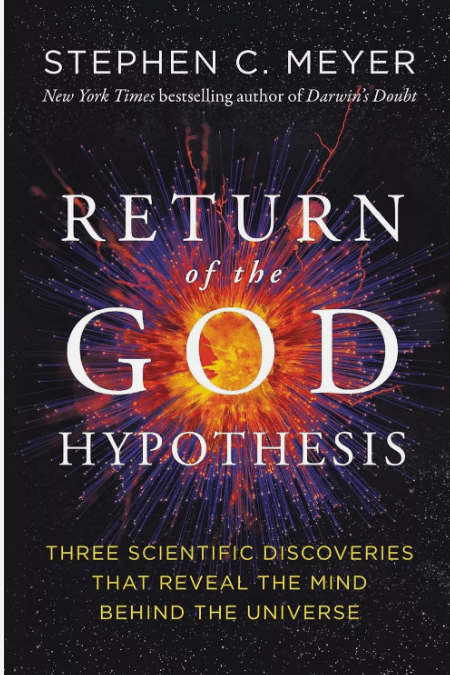
The Return of the God Hypothesis

The Return of the God Hypothesis

I wrote this 3 years ago and was reminded of it today:
Stephen Meyer’s third book, ‘The Return of the God Hypothesis: Three Scientific Discoveries That Reveal the Mind Behind the Universe ‘ is most impressive!

View at https://returnofthegodhypothesis.com/

His other 2 main books, ‘Signature in the Cell’ and ‘Darwin’s Doubt’ were absolute classics that give abundant support for the scientific paradigm of Intelligent Design (ID).

I have a whole section on my main website, circumcisedheart.info on ID.

Some of the historical facts that he introduces have really surprised and delighted me. Having spent many years at University studying Physics, and even reading some biographies on Physicists like Einstein I still found some of his insights really illuminating. I am also dismayed and a little disappointed with myself to learn that there were certain great questions of Physics that I don’t ever remember asking, such as how gravity actually works!

I learned all the laws of Universal Gravitation, etc., and could apply them as needed, but I don’t remember asking some of the deeper questions. 

In learning Physics and doing research in areas of Physics (for me it was mainly Electronics, Microwave Theory and Atmospheric Physics) I didn’t really need to know much of the history of Physics beyond what I learned in a few years of Physics classes at High School but Meyer has specialized in the history of Science, so he brings a wealth of great insights and historical narratives. 

A couple that have really struck me:
I knew a fair bit about Isaac Newton and the fact that he spent more time on his theological studies than his scientific research (if the church and government had known of some of his doctrinal positions they would have dumped him in prison, such as his rejection of the Trinity). And I knew his mathematical model of Universal Gravitation was a massive advance at the time.

But I was not aware that it had led him to argue for an infinite Universe (to balance the gravitational forces of the stars, etc.). This position was problematic for him from a theistic perspective.

Almost three hundred years later, Albert Einstein introduces his General and Special Relativity theories and turns the world of Physics on its head. But as he understood his own theories at the time, and as he rejected the idea of a Creation of the Universe from nothing (i.e the Genesis story), he had to introduce a special ‘fudge factor’, his cosmological constant to try to argue for a steady state Universe that had existed eternally. While the evidence mounted against his cosmological constant for years, it took him close to 20 years to finally overcome his own ego and accept he was wrong!

This from one of the greatest minds in all human history!

If an intellect as great as Einstein can so struggle to place facts and logic ahead of his own pet pre-suppositions and biases, how hard must it be for the rest of us!!

I am firmly convinced that this book should be read be all who wish to reject atheism and the evils that it engenders. This book should also be required reading in Senior High School Science classes.

In Meyer’s ‘Return of the God Hypothesis’ he argues that Theism provides a better explanation of how the first cell was created along with subsequent innovations in the history of life.

He states that “there are 3 keys facts about biological and cosmological origins:

  1. the material universe had a beginning
  2. the material universe has been finely tuned for life from the beginning, and
  3. large discontinuous increases in functionally specified information has entered the biosphere since the beginning.

Deism can explain the first two of these facts, but Theism can explain all three.”

Science today is increasingly finding supporting evidence for Theism and for a Creation event as described in the Bible. The worm has turned! Science truly supports a Creation event ‘ex-nihilo’   (creation out of nothing).

For more on Intelligent Design go to ID @ Circumcised Heart

I also refer to Meyer’s Darwin’s Doubt in this blog post about abductive reasoning:
https://luke443.blogspot.com/2018/01/understanding-abductive-reasoning-and.html

You intended to harm me, but God intended it for good:

Some 12 months ago I reflected on the Torah Portion Vayechi (see here).

I started off with the comment that Yosef (Joseph) states to his brothers who had rejected and betrayed him, “You intended to harm me, but God intended it for good.”

In my post I discussed how the Almighty worked through a very trying time for Yosef and ultimately placed him in an exalted position where he was able to help his brothers who had much earlier rejected and punished him.

But where are we now 12 months later in terms of the world-wide challenges facing us as a result of the Corona virus.

Many are now being, in a very real sense, ‘sent to prison’, as Yosef was. Who are these people?

In my opinion it is a great many of the most educated among us, but not only are these ‘outsiders’, these newly designated ‘unclean’, well educated but more importantly they are the ones who clearly have well-developed critical thinking skills and reasonable logical thinking skills as well.

Here in Queensland, these ‘outsiders’ include some 6000 teachers and 7000 nurses (according to the leading unions for these professions).  

These outsiders need to hear the prophetic and extremely powerful words of Yosef:

You intended to harm me, but God intended it for good.”.

These teachers, nurses, police, hospitality workers and others in allegedly ‘high-risk’ workplaces are being fired from their vital roles and facing the prospects of having to sell their homes and leave family and friends behind in pursuit of new ways of putting a roof over their heads and food on their tables.

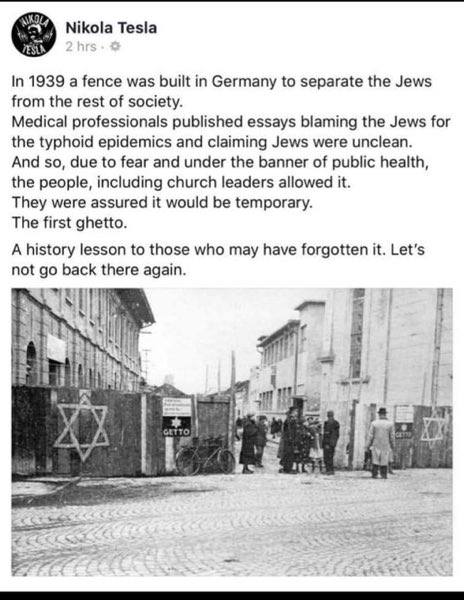
There clearly is a lot of pain and serious financial hardship as we see a growing discrimination and segregation in our society that so easily and ignorantly accepts medical apartheid (erringly similar to what happened to the Jewish People in Germany in the 30’s).   

But despite the battles lost so far, and the set-backs being experienced at this time, we know who the ultimate winner is.

The Almighty will prevail!

He will somehow make it work for good.

As I stated 12 months ago, we really need to draw close to Yehovah and trust Him and know that He is at work through all this and He will find a Way where there seems to be no way.

We need to hold onto to Him as we continue to stand for truth and justice and against the increasing tyranny (both intentional and blind) of most of those in leadership over us.

I am doing something new; it’s springing up — can’t you see it?
I am making a road in the desert, rivers in the wasteland.
” – Isaiah 43:1
9

Have I not commanded you? Be strong and courageous. Do not be frightened, and do not be dismayed, for the Lord your God is with you wherever you go.” – Joshua 1:9

I have said these things to you, that in me you may have peace. In the world you will have tribulation. But take heart; I have overcome the world.” – John 16:33

At this time, as the darkness and madness grows daily, we may not be able to see how we will be like Yosef and able to help the world when it wakes up and escapes into the Light, but we are called to #holdtheline and trust Him.

And He Called – Seeking Your Higher-Calling

Vayikra (Leviticus 1:1–5:26) (וַיִּקְרָא ‎ — Hebrew for “and He called,”) is the first word in this week’s Torah Portion.

When you look out from within, the world in a very real sense revolves around you.

You see it, feel it, experience it, though your senses and your perspective. You can heighten specific senses to then perhaps experience something a little different, a little more enhanced or deeper, and you can significantly change your perspective and this can bring about huge and life-changing epiphanies. Yet it is still you and it is still a world that surrounds you.

But if you try to fly out (in your mind’s eye) beyond the atmosphere, beyond the moon, past the sun and the solar system, out of the Milky Way galaxy to view a trillion+ other galaxies, then from this perspective, you are now less than a dot, less than a grain of sand and less significant than a moon or planet or star. From this perspective, you may seem to be pointless and valueless.

Yet, the Creator of this vast Universe, created you.

He choose you, a totally unique person and placed you into this world at a specific time and place for a purpose. He wanted you here as He has a task for you. A task or tasks that you are uniquely qualified for. While it may be true that if you reject His purpose for your life, He is more than capable of finding another way to achieve His purposes.

But His hope really is in You!

Yehovah has called you. He has a task, a vocation for you. It could be a gift to give the world; a kindness to ease someone’s pain, a love to share that heals a broken life, or a smile to light a dark corner.

Discerning that task, hearing Vayikra, God’s call, is one of the great spiritual challenges for each of us.

For example, being a care-giver for a partner or parent or even parent-in-law with Alzheimer’s Disease is a modern day example of a sacrifice almost beyond reason, beyond rationale foresight. Yet many willingly take on this sacrifice.

Rabbi Sacks argues that “We are willing to make sacrifices when we feel they are part of the task we are called on to do.

Obviously, if the family member with Alzheimers for example is very much loved, then it may seem very natural to take up the challenge of being a care-giver and sacrifice much of your own life for a season.

Whether the care-giver would see this as the task or role that Yehovah has called them to is another matter. Perhaps though, the lessons learned though this great challenge and sacrifice may prove crucial in future situations where the call may even be more vital.

The very nature of spiritual challenges and the natural changes over time in a persons life journey would seem to me to suggest that discernment and clarity of purpose is never easy and even when attained it may prove only temporary and fleeting.

 Rabbi Sacks also argues that “Where what we want to do meets what needs to be done, that is where God wants us to be.”. This certainly has a synergy about it and perhaps may resonate with your soul.

I think we all need to stop and take stock at times (this is actually one of the reasons that the Almighty gave us the gift of Shabbat!). So to seek this synergy and find our unique task and purpose, we may also need to refresh and replenish our soul.

And it also seems timely that once again Passover (Pesach) approaches, as this too is an ideal time for some soul-searching and seeking of your higher-calling.

Please see my article ‘Searching for the Soul’ for more on this: https://globaltruthinternational.com/2018/03/31/searching-for-the-soul/

The Sabbath is Spirit in the Form of Time:

In this week’s Torah Portion, Vayakhel (Exodus 35:1–40:38) Moses assembles the people of Israel and reiterates to them the commandment to observe the  Shabbat (Sabbath):

Exodus 35:
“1 Moses assembled the whole community of the people of Israel and said to them, “These are the things which Yehovah has ordered you to do. 
On six days work is to be done, but the seventh day is to be a holy day for you, a Shabbat of complete rest in honour of Yehovah…”


Why is the Sabbath so important. Of what significant benefit to mankind is it?

These are worthwhile and important questions to ask. What follows is just a small attempt to offer some of the answers.

The Sabbath was and is one of the most significant indicators of freedom ever!

In the ancient world no other people group had a day off each week; no other nation had such freedom. The Sabbath is one of the greatest gifts God has ever given man – a day free from labour and a day to honour the King of the Universe, our Creator!
In the desert wanderings of the Exile from Egypt, a double portion of the manna was collected on the 6th day to last through the Sabbath. When this was tried on other days the manna rotted. God demonstrated in this miracle alone, how important it was Him, that His people observed a day of ceasing or abstaining from their normal labours of providing for themselves and their families.

The Sabbath day; a day spent with community and family in study, prayer, discussion, and peace, reminds us how we should regulate and perfect our spiritual, intellectual, physical, domestic and social behaviours.
Observing the Sabbath reminds and instructs us to sanctify our lives, the way God has sanctified the Sabbath day.

This commandment does not limit our freedom, it gives us distinct guidance toward holiness and therefore meaningfulness for our lives.

The first six days God made good, the seventh He made holy.

We may struggle to stop working on the Sabbath (‘Shabbat’ in Hebrew), but because it is commanded by God, their should be no guilt about having some downtime.

The Sabbath also reminds us of our potential for doing good. We, human beings, created on the 6th day are the bridge between the worldly and the divine – between the rest of creation (on the first 5 days) and the sanctified 7th day.

The appreciation of a non-productive day is predicated on a week of labour. Six days you shall labour, and do all your work” Ex 20:9 (ESV)

During the week we emulate the creative side of God.

The Sabbath is then the culmination of a productive week on which the non-productivity can be appreciated only when preceded by creativity.

Community prayers and fellowship are an important part of the Sabbath. The Sabbath was given to the Israelites as a reminder of God’s freeing them from slavery – as a reminder then of both God and the sanctity of human freedom. It should serve the same purpose for all followers of Yeshua who, along with all his disciples and the Apostle Paul also observed Shabbat every week.

On the Sabbath we search for the essence of God.

Shabbat is the antidote to the tendency toward self-idolatry.

Every time we live a day dedicated to holiness we have the opportunity to bring some residual effect into our daily lives.
The Sabbath is not about time off, it is about sacred time.

The Sabbath is a real day, NOT some theoretical, spiritual inner delusion of rest when the real man/woman continues to sweat blood and tears!

“The Sabbath is spirit in the form of time.” (Abraham Joshua Heschel – ‘The Sabbath’ 1951) 

For more on the Sabbath I recommend my book ‘Doctrinal Pitfalls of Hellenism’ (available from Amazon.com as a Kindle eBook It is also available in paperback or as a free pdf on the Links page at circumcisedheart.info).

Also I highly recommend: “The Ten Commandments: The Significance of God’s Laws in Everyday Life” by Dr Laura Schlessingger and Rabbi Stewart Vogel.

Righteous Anger – Moshe’s Tablets and Yeshua’s Whip:

This week’s Torah Portion, Ki Tisa (Exodus 30:11–34:35) introduces an interesting question about anger, and about sin. Is anger always bad? Is it wrong and unhelpful or is it good when properly directed? 

Firstly, here is part of the Chabad’s ‘Torah Portion in a Nutshell’ summary:  

“When Moses does not return when expected from Mount Sinai, the people make a golden calf and worship it. G‑d proposes to destroy the errant nation, but Moses intercedes on their behalf. Moses descends from the mountain carrying the tablets of testimony engraved with the Ten Commandments; seeing the people dancing about their idol, he breaks the tablets, destroys the golden calf, and has the primary culprits put to death. He then returns to G‑d to say: “If You do not forgive them, blot me out from the book that You have written.” G‑d forgives, but says that the effect of their sin will be felt for many generations. At first G‑d proposes to send His angel along with them, but Moses insists that G‑d Himself accompany His people to the promised land. Moses prepares a new set of tablets and once more ascends the mountain, where G‑d reinscribes the covenant on these second tablets …” – from https://www.chabad.org/parshah/article_cdo/aid/2833/jewish/Ki-Tisa-in-a-Nutshell.htm  

As in every Portion, there is so much great insight and wisdom that can be drawn from these narratives. I would argue that the most significant event here is the giving (twice) of the Ten Commandments (the Ten Words). I have already addressed this a little in an earlier blog post, so for now I wish to consider Moshe’s anger. 

If you read Exodus Chapter 32 from the start you will note that God informed Moses that the people had made a golden calf. So Moses descends the mountain already knowing this and yet when he sees it with his own eyes he gets angry and throws down and smashes the Ten Commandments, the Instructions of God!

The most important instructions ever given to mankind are destroyed!!   

But Moses already knew about the sin of the golden calf, so why did he bring the Tablets down the mountain at all, and why did he still lose it and smash them in anger? 

Well notice that the verse states: “It happened as he drew near the camp, he saw the calf and the dances, and Moses became angry, he threw the tablets down from his hands and shattered them at the foot of the mountain” (Ex 32:19). 

The new information here is that the people were dancing. Not only had they sinned in creating this idol to worship, but they were so lost in their sin that they were celebrating it, dancing around it and fully embracing it, perhaps to the point of not even noticing Moses.  So perhaps his anger and smashing of the very words of Yehovah was needed to open their eyes; for them to see him; to hear him and to have any chance of recognizing and repenting of their error.   

Moses anger was righteous anger, and his anger and corresponding actions (read on with horror) would have clearly stopped many in their tracks and lead them to recognize the gravity of their actions.  So we read: The next day Moshe said to the people, “You have committed a terrible sin. Now I will go up to Yehovahi ; maybe I will be able to atone for your sin. …” – Exodus 32:30 

If many or most of the people had not recognized and repented of their sins, then it is most unlikely that Moses would have make this statement of intent and shared some hope that Yehovah might accept their repentance and have their sin atoned. (It seems that this concept is not well understood – please see my blog post on what atonement really means – https://globaltruthinternational.com/2020/06/20/atonement-covering-our-sins-from-ourselves/). 

So on reflection we should see that Moshe’s anger and consequent actions ultimately lead to a positive outcome. His righteous anger has a positive effect. It did not mitigate the sin of the people nor in any way reduce the reality of their sin, but it does appear to have lead to much repentance from the children of Israel, and a consequent return to fellowship with Yehovah.   

Now consider as well the anger of Yeshua: 

13 “It was almost time for the festival of Pesach in Judah, so Yeshua went up to Jerusalem. 
14 In the Temple grounds he found those who were selling cattle, sheep and pigeons, and others who were sitting at tables exchanging money. 
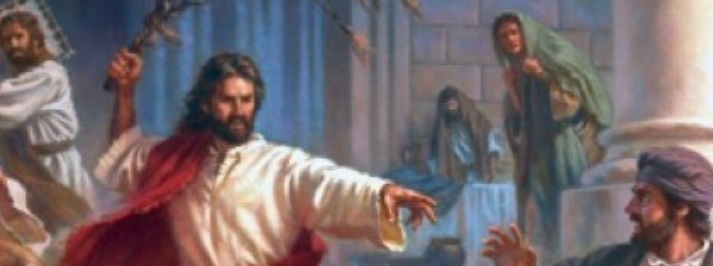
15 He made a whip from cords and drove them all out of the Temple grounds, the sheep and cattle as well. He knocked over the money-changers’ tables, scattering their coins; 
16 and to the pigeon-sellers he said, “Get these things out of here! How dare you turn my Father’s house into a market?” 
17 His disciples later recalled that the Tanakh says, “Zeal for your house will devour me.”

– John 2:13-17 

Yeshua also displayed righteous anger here. It was not a total spur of the moment thing either. He saw a serious lack of respect for the Temple and went and made a whip from three or more chords before using it to angrily usher these sacrilegious business people out of the Temple of Yehovah. 

Did Yeshua’s anger bring a positive benefit (apart from its immediate, though probably very temporary, restoration of the sacred and holy)? 

Yes, because it helped confirm to his disciples that they could trust in the Tanakh and in the words of Yeshua as well: 
22 “Therefore, when he was raised from the dead, his disciples remembered that he had said this, and they trusted in the Tanakh and in what Yeshua had said.”  – John 2:22

These are just two examples of righteous anger. Mussar (a form of Jewish ethics which has now been around for 600+ years), argues that all attributes of our characters and personality can be used for good if controlled and directly in the correct and godly way.  

Anger can be bad, yet anger at injustice helps motivate us to try to correct that injustice.  

I discuss this important Mussar approach in my article ‘You Shall Be Holy’:  https://globaltruthinternational.com/2015/03/21/you-shall-be-holy-introduction/      

May you seek to see injustice in the world that also drives you to righteous anger and further helps motivate you to do ‘tikkun haolam’. It is a sin not to serve – we all have talents; we are all are called to use those talents to help repair or better the world. – https://globaltruthinternational.com/2012/12/21/the-rarity-of-repentance/


Revisiting the First Tablet from the Moral Code of the Universe:

Revisiting the First Tablet from the Moral Code of the Universe:

This week’s Torah Portion Yitro (Exodus 18:1–20:23): includes the miracle of the Ten Words given by the Creator of the Universe and written on two tablets of stone, five on one and five on the other. The first five relate to our relationship with Yehovah and the second five speak to our relationship with each other.

The Giving of the Torah (The Ten Commandments) was a revelation given to many thousands of people at the same time. They knew that Moses was a Prophet of God. There was no question – they had experienced the reality of God and the reality of the two Tablets on which were written the Ten Commandments or Ten Words.

There was no question, no argument, no logic, or spiritual vision that could shake the nation of Israel’s experience and conviction that God had visited them, and that the Torah of Moses was the very words of God, of Yehovah.

Some argue that as many as 600,000 or more experienced this event. While many Biblical scholars today may question the actual numbers present, there is little doubt that they were a great many and most likely at least many ten’s of thousands. And there is also no doubt that the transformational power of that great cloud of witnesses has travelled down to us through a great many generations.

See my article here for more on what the impact of this has been – https://luke443.blogspot.com/2016/05/600000-traditions-that-establish-truth.html

Many of the faithful within Judaism and Christianity would agree that these commandments are the Moral Code of the Universe. And if so, they are more than important and most vital to know and study. So in this short article I wish to look at a few aspects of the first four of the Ten Words.

The 1st Word:

I am the YEHOVAH your God, who brought you out of the land of Egypt, out of the house of slavery. You shall have no other gods before me Ex 20: 2-3 (ESV)

This was a novel idea around 1300 BCE. The idea of a relationship with God that was not casual but covenantal. “I am the Lord your God”. That is, He is a personal God, a God who wants a relationship with us, His creation.

So a vital principle here is that in our relationship with God, the observation of a commandment brings us closer to God and every time we violate a commandment we become further estranged from God.

The 2nd Word:

You shall not make for yourself a carved image, or any likeness of anything that is in heaven above, or that is in the earth beneath, or that is in the water under the earth. You shall not bow down to them or serve them, for I the Lord your God am a jealous God, visiting the iniquity of the fathers on the children to the third and the fourth generation of those who hate me, but showing steadfast love to thousands of those who love me and keep my commandments. Ex 20:4-6 (ESV)

In Akiva Judaism this is one of the three sins that one must be willing to die for rather than violate – murder and sexual prohibitions against incest and adultery are the other two. When you have studied this Word sufficiently to recognize why it is seen as so important, then you are really on the way to establishing a deep and personal relationship with Yehovah that can be sustained.

Whenever anything, anything at all besides God and acting out of godliness, that is displaying kindness, charity, and compassion, etc., (see Micah 6:8 and Matthew 23:23b) becomes the actual endpoint of your attentions and activities, then that is idolatry, and your actions are not longer in accordance with the 2nd Word.

Consider Psalms 128:1-2: Blessed is everyone who fears the Lord, who walks in his ways! 2 You shall eat the fruit of the labour of your hands; you shall be blessed (happy), and it shall be well with you. and Ps 97:11 Light is sown for the righteous, And gladness (happiness) for the upright in heart.

Yehovah is the ultimate source of meaning and therefore happiness – seek Yehovah and find happiness.Delight yourself in the Lord, and He will give you the desires of your heart‘ – Ps 37:4

If instead, you fall for the worship of idols, you in turn, turn your back on the 2nd Word and move away from God.

Any activity taken to extreme, in spite of obligations to family and society, is a behavior that serves the self and is a form of idolatry.

What is the consequence of idolatry: “The idols of the nations are silver and gold, the work of human hands. 16 They have mouths, but do not speak; they have eyes, but do not see; 17 they have ears, but do not hear, nor is there any breath in their mouths. 18 Those who make them become like them, so do all who trust in them!”Psalms 135:15-18 (ESV)

That is, the more we lead idolatrous lives the more we become blind and deaf and dead to God!

The scary thing here is that as we turn our eyes more and more on our idols, Yehovah hides Himself more and more, even to the point that we are unaware that He is hiding!

Please see my article ‘Moses and the King Who Hides’- https://globaltruthinternational.com/2012/09/23/moses-and-the-king-who-hides/

The 3rd Word:

You shall not take the name of the Lord your God in vain, for the Lord will not hold him guiltless who takes his name in vain. Ex 20:7 (ESV)

The importance of a ‘good name’ or reputation is emphasised in the fact that this command is also repeated with regard to people in the 9th commandment, that is, we are not to bear false witness against others.

God is about relationships – if you give a bad name to Him you may diminish or demolish people’s belief, respect and awe. A name defines something.

God’s name in Ex 3:14-15, ‘I Will Be What I Will Be’ (see https://globaltruthinternational.com/2021/01/08/i-will-be-what-i-will-be-yehovah-the-god-of-the-future/ ) also speaks to his permanency, his reliability.

When we curse God, we are in a sense blaming Him for problems and not taking our responsibility to stand between the evil and innocent. Since it is our duty to emulate God: Speak to all the congregation of the people of Israel and say to them, You shall be holy, for I the Lord your God am holy (Lev 19:2); a clear way to sanctify God’s name is to behave in holy ways. When we fail to do so we are profaning His name, especially if we are trying to declare our faith as believers.

Similarly, trying to argue that God has condoned your sinful acts is a form of profaning His Name.

As we are all tasked with the being a light in a world of darkness, and reaching others with the greatest message of hope, we must take great care to act and speak worthy: But the prophet who presumes to speak a word in my name that I have not commanded him to speak, or who speaks in the name of other gods, that same prophet shall die.Deut 18:20 (ESV)

God swears on his Name:

… establish my covenant with you, that never again shall all flesh be cut off by the waters of the flood, and never again shall there be a flood to destroy the earth.” 12 And God said, “This is the sign of the covenant that I make between me and you and every living creature that is with you, for all future generations: 13 I have set my bow in the cloud, and it shall be a sign of the covenant between me and the earth. 14 When I bring clouds over the earth and the bow is seen in the clouds, Gen 9:11-14 (ESV) and He said, By myself I have sworn, declares the Lord, because you have done this and have not withheld your son, your only son, 17 I will surely bless you, and I will surely multiply your offspring as the stars of heaven and as the sand that is on the seashore. And your offspring shall possess the gate of his enemies, 18 and in your offspring shall all the nations of the earth be blessed, because you have obeyed my voice.Gen 22:16-18 (ESV)

Also:
Thus says the Lord, the God of Israel: Cursed be the man who does not hear the words of this covenant 4 that I commanded your fathers when I brought them out of the land of Egypt, from the iron furnace, saying, Listen to my voice, and do all that I command you. So shall you be my people, and I will be your God, 5 that I may confirm the oath that I swore to your fathers, to give them a land flowing with milk and honey, as at this day.” Jeremiah 11:3-5 (ESV)

God’s name imparts a seriousness above and beyond anything else we might attempt to invoke.

Whoever blasphemes the name of the Lord shall surely be put to death. Lev 24:16 (ESV)        

“Truly, I say to you, all sins will be forgiven the children of man, and whatever blasphemies they utter, but whoever blasphemes against the Holy Spirit never has forgiveness, but is guilty of an eternal sin”—  for they had said, “He has an unclean spirit.” Mark 3:28-30 (ESV)

Invoking God’s Name while involved in evil (e.g. The Crusades) and making vows in God’s Name which you don’t intend to keep are examples of defying the Third Commandment.

The 3rd commandment speaks to the sacred nature of our relationship with God and our responsibilities to each other in His name.

The 4th Word:

Remember the Sabbath day, to keep it holy. Six days you shall labour, and do all your work, but the seventh day is a Sabbath to the Lord your God. On it you shall not do any work, you, or your son, or your daughter, your male servant, or your female servant, or your livestock, or the sojourner who is within your gates. For in six days the Lord made heaven and earth, the sea, and all that is in them, and rested the seventh day. Therefore the Lord blessed the Sabbath day and made it holy. Ex 20:8-11 (ESV)

A double portion of the manna was collected on the 6th day to last through the Sabbath. When this was tried on other days the manna rotted. God demonstrated in this miracle alone how important it was Him that His people observed a day of ceasing or abstaining from their normal labours of providing for themselves and their families.

The Sabbath day, a day spent with community and family in study, prayer, discussion, and peace, reminds is how we should regulate and perfect our spiritual, intellectual, physical, domestic and social behaviours.

Observing the Sabbath reminds and instructs us to sanctify our lives. The way God has sanctified the Sabbath day. This commandment does not limit our freedom, it gives us distinct guidance toward holiness and therefore meaningfulness for our lives.

The first six days God made good, the seventh He made holy.

We struggle to stop working for Shabbat but because it is commanded by God, their should be no guilt about having some downtime.

The Sabbath reminds us of our potential for doing good. We are the bridge between the worldly and the divine – between the rest of creation (on the first 5 days) and the sanctified 7th day.

The Sabbath is spirit in the form of time. (Herschel)

The appreciation of a non-productive day is predicated on a week of labour.Six days you shall labor, and do all your work.Ex 20:9 (ESV)

During the week we emulate the creative side of God.. The Sabbath is then the culmination of a productive week on which the non-productivity can be appreciated only when preceded by creativity.

Community prayers and fellowship are an important part of the Sabbath.

The Sabbath was given to the Israelites as a reminder of God’s freeing them from slavery – as a reminder then of both God and the sanctity of human freedom. It should serve the same purpose for Gentile followers of Yeshua who have also been freed from the slavery of sin.

On the Sabbath we search for the essence of God. Shabbat is the antidote to the tendency toward self-idolatry.

Every time we live a day dedicated to holiness we have the opportunity to bring some residual effect into our daily lives. The Sabbath is not about time off, it is about sacred time.

The proper recognition of this most holy day is worthy of serious reflection. Please see the chapter on the Sabbath in my book ‘Doctrinal Pitfalls of Hellenism’, https://www.amazon.com/Doctrinal-Pitfalls-Hellenism-Studies-Greek-ebook/dp/B00DO17CK8/  as well as this article, ‘The 4-Step Approach to The Sabbath’ available here:  http://circumcisedheart.info/The4StepApproachToTheSabbath.pdf

The 5th Word

Honour your parents!

“Honour your father and your mother, that your days may be long in the land that the Lord your God is giving you.” – Exodus 20:12 (ESV)

The only one of the Ten Words that contains a promise, a promise of a longer and better life, and also a promise to Israel that they would possess the Land of Israel for a much longer time-frame.

There is a great deal that could be written about this Word, both in what it says and what it doesn’t. We are called to honour our parents, to show deference; to remember the sacrifice they made in raising us up; not to shame them or belittle them, not to neglect them or their memory. And in doing so we can expect the same honour to be shown to us by our children, and even in this way alone to prolong our life and length or broaden its impact.

But we are not commanded to love our parents, as love, though principally a commitment, is also much more and sometimes perhaps too much to expect if our parents have not lived up to all that Yehovah created them to be.

It is very hard to love parents who have abused you; or have never even been half-decent at the parenting role. But regardless, Yehovah does ask us to honour them. Our parents represented the Almighty to us as we grew up – they were  His Representatives in our young lives; they were like gods to us. So, when we reach adulthood and honour our parents, we are in turn honouring the Almighty.

Sadly, too many are not even aware of this very special instruction from our Creator and instead treat their parents with a serious lack of honour and respect.

The 5th Word is the last Word on the first tablet. The 6th Word and first on the second tablet is ‘do not murder’.  There is an implicit bond between these two Words, these two instructions from our Creator. Can you sense what it is?

I will address this in my blog post on the second tablet.

For a serious review of all of the 10 Words, I also recommend “The Ten Commandments: The Significance of God’s Laws in Everyday Life” by Dr Laura Schlessingger and Rabbi Stewart Vogel

All The World Will Sing A New Song

In this week’s Torah Portion, Beshalach (Exodus 13:17–17:16) we read of the Song of Moses, the Song of the Sea.

Exodus 14:31 And Israel saw the great hand, which the Lord had used upon the Egyptians, and the people feared the Lord, and they believed in the Lord and in Moses, His servant.
Exodus 15:1 Then Moses and the children of Israel sang this song to the Lord, and they spoke, saying, I will sing to the Lord, for very exalted is He; a horse and its rider He cast into the sea.

15:18  The Lord will reign to all eternity

The prelude to the ‘Song at the Sea’ states that the people “believed in Yehovah and in his servant Moses”—the first time they are described as believing in Moses’ leadership.

The song starts with verse 1 of chapter 15 and goes through to verse 18.

“Song lies at the core of life; its source is in the most supernal ecstasy.” And he explained: “A river went out from Eden to water the garden . . .” (Genesis 2:10) from the source of all delight, the river of life flows downward, branching outward to each world and every created being. Each thing thirsts to rejoin with its source above, and from that yearning comes its song, and with that song it comes alive. The heavens sing, the sun, the planets and the moon; each animal, each plant, each rock has its particular song, according to how it receives life. Until the entire cosmos pulsates with a symphony of countless angels and souls and animals and plants, and even every drop of water and molecule of air, singing the song that gives it life. …”. – Chabad Rabbi Dovber

Music and singing songs can bring a  sense of new life and some healing, they can sweetens the bitter soul and fill a home with light.

A song can also bring unity and a sense of  oneness.  A song can unite those who sing and hear it: When words are spoken, we each hear the words according to our understanding.

But in song, we are all united in a single pulse and a single melody.

Surely the singing of Mose’s song after the parting of the Red Sea was an amazing event of such great unity and ecstasy as the people of Israel were fully united behind the leadership of Moses and in awe of the power of Yehovah.   

Such incredible unity may not have occurred on such a large scale since, yet it would appear that it will occur again with the coming of Mashiach and on the Day of Judgement. We see this implied in Psalm 96 which starts with “All the world will sing a new song,”.

The messianic era is surely within sight and hearing and it will bring that new song, a song of essential oneness expressed throughout the world!

Psalm 96 Sons of Korah

Worship the thou and tremble in awe now 
Worship the in the splendorof all of His 
holy re", let tie nitlonsall say The LORD 
• reigns He is great 
and rnost worthy Of praBe

And singing leads to dancing as we see with King David. So on that great Day I hope you dance as well!

Ronan Keating – I Hope You Dance

Do Not Despair – Waiting On The Lord

“After two whole years, Pharaoh dreamed that he was standing by the Nile, …” Gen 41:1

Genesis 40:9-23:
“9 So the chief cupbearer told his dream to Joseph and said to him, “In my dream there was a vine before me, 
1and on the vine there were three branches. As soon as it budded, its blossoms shot forth, and the clusters ripened into grapes. 
11 Pharaoh’s cup was in my hand, and I took the grapes and pressed them into Pharaoh’s cup and placed the cup in Pharaoh’s hand.” 
12 Then Joseph said to him, “This is its interpretation: the three branches are three days. 
13 In three days Pharaoh will lift up your head and restore you to your office, and you shall place Pharaoh’s cup in his hand as formerly, when you were his cupbearer. 
14 Only remember me, when it is well with you, and please do me the kindness to mention me to Pharaoh, and so get me out of this house. 15 For I was indeed stolen out of the land of the Hebrews, and here also I have done nothing that they should put me into the pit.”…
20 On the third day, which was Pharaoh’s birthday, he made a feast for all his servants and lifted up the head of the chief cupbearer and the head of the chief baker among his servants. 
21 He restored the chief cupbearer to his position, and he placed the cup in Pharaoh’s hand. 
22 But he hanged the chief baker, as Joseph had interpreted to them. 
23 Yet the chief cupbearer did not remember Joseph, but forgot him.
Gen 41:1 “After two whole years, Pharaoh dreamed that he was standing by the Nile, …”

Last week’s Torah Portion is in my opinion one of the most significant as it carries so many foundation messages of hope, especially in terms of the coming of Messiah and the redemption of humanity and restoration of the world. I touched on it here: https://globaltruthinternational.com/2012/12/06/from-joseph-through-judah-foretelling-messiah/

And this week’s Torah Portion, Mikeitz (Genesis 41:1-44:17) brings that hope to fruition while carrying a subtle, but very powerful message, bringing comfort in a time of potential despair.

It starts with the phrase After (or at the end of) two whole years, …’.

Yosef/Joseph, is one of the best examples of a ‘type of Messiah’, that is a person whose life and example bears great similarity to the picture that the Bible paints of the eschatological Messiah or Messiahs (Messiah ben Yosef and Messiah ben David).

In these few words we see great import. Yosef had unjustly suffered and was ‘stuck’ in jail praying and hoping for release. His interpretations of the dreams of the chief baker and chief cup bearer had offered a way out – Only remember me, when it is well with you, and please do me the kindness to mention me to Pharaoh, and so get me out of this house.”

Yet we see here that he had to wait two whole years!

Two whole years in jail, two years of possible despair, of wondering if Yehovah had heard his prayers and when He might answer them. Two whole years in jail, in suffering – plenty long enough to have given up, to despair of ever finding justice and being shown mercy.

Think of you own life – when have you had to wait for something you thought you needed NOW, some prayer that the Almighty would surely answer swiftly and bless you with His response. Yet you were left waiting, and perhaps are even still waiting and perhaps despairing as the pain or suffering is relentless and often seems overbearing and way beyond what you can possibly cope with?

Yosef, our great Messianic figure waited two whole years. Two whole years for one man may equate to two thousand years for all men.

As a primary school child I lived in the days before television. We went to the movie theatre in town most Saturday afternoons for the 2 pm movie. Before the main movie we would watch the next episode in some series. I most remember the Flash Gordon series (this was in the mid 60’s). The episode would almost always end with some high drama and seemingly impossible predicament for Flash Gordon, or the helpless victim that he was trying to save. With great anticipation we would wait all week to see how he would extricate himself or save the poor innocent victim. Though we had no reason to despair, we were at least learning of the need for patience and trust that it would all work out ok in the end.

Similarly, in the days before books and the printed Bible were common-place, the Jewish people would go to the synagogue or Temple every Shabbat and hear the reading of the Torah Portion (this practice dates back to before the time of Yeshua, so it is over 2,000 years old). Imagine some person or child hearing the Torah Portion for the first time. They heard how Yosef had interpreted the dreams and asked to be remembered to the Pharaoh so he might get out of the hell-hole that was jail. But the reading of the Torah Portion ended before they heard the end of the story and if indeed he was saved from jail, shown justice and mercy, and restored to his rightful place.

So this person or child now waits a whole week to hear the great news of Yosef’s ‘escape’ from jail and restoration. And when their week of wondering and excited anticipation is over, they like my childhood movie experience, learn of how Yosef is finally blessed by Yehovah and restored with great honour. But they may also hear the full import and meaning of ‘after two whole years’ – that is, that patience and trust is needed.

It is not in our time, but in God’s time. We need to do our part, but then when circumstances don’t seem to be working out how we think they should, we need to have faith in HaShem, we need to trust that He will act in His time and with His power to make right the wrongs; to ease the pain; to dispense justice and bring restoration and redemption.

Right now, you may feel you are in this place – somewhere in your ‘two whole years’ of waiting and possibly even despairing. This may be at a personal level, or a community or national level. You may see no way forward at this time.

Or it may be that you are looking at the world-wide or universal level in looking for the Great Day of the Coming of Messiah.

Either way, don’t lose hope, take solace from this biblical narrative of Yosef as you seek to see freedom from pain, or you seek justice or even more, to see Messiah ben Yosef. Look up, for your redemption draws near!  

Some Similarities Between the Qumran Manuscripts (DSS) and the New Testament

There are many similarities between the Qumran scrolls and the NT. I detail just a few below.

Firstly though, what are the Qumran manuscripts (also known as the ‘Dead Sea Scrolls’ – DSS) which date from around 250 BCE up to possibly as late as 50 CE and were discovered between 1947 and 1956?

When speaking of the DSS we are not just talking about the Qumran caves (probably Essenes) but most critically also the Wadi Murabba’at; the Nabal Hever and the Nabal Se’elim finds.

Also critical are the finds from the Wadi ed-Daliyeh, north of Jericho (1962) and from Masada (63-64). The DSS have given scholars an enormous amount of information about the early transmission of biblical books; about the fixation of the Text (canon) and about the procedures for how the canon of the Tanakh came into being.

Prior to these finds there had been little detailed information about how the Rabbinical Recession (Masoretic Text – MT) as used in Jerome’s day had come into being.

What has emerged is that there are really three distinct major groups of texts. Using Cross’s[1] naming these are the ‘Palestinian’ group (mostly from the Essenes/Qumran), the Egyptian group (LXX, Greek versions of Samuel; Kings, a short Hebrew version of Jeremiah, etc) and the ‘Babylonian’ group.

It is the Babylonian group that appears to have been the work of Hillel and his son and disciples. This text group canonized the Tanakh some time between the 2 revolts of 70 and 135 CE and it is from this group that the Rabbinic Recession has derived.

This group is very conservative, ‘pristine’ and shows little scribal editing, revision or modernizing. Most of the documents come from the southern caves and at Masada. This is where the authorative  Pharisaic text (the proto-Masoretic text type) came from; the text that Yeshua would have used as he was in all likelihood a Pharisee or very sympathetic to their Biblical understanding (again, see Flusser for extensive evidence of this).

‘In fact, most of the biblical manuscripts at Qumran indicate that the proto-Masoretic text type in fact predominated. … It is likely that this text type was the most common because it was the most ancient.[2]

The Essenes (Qumran) with their clear Hellenistic influences (discussed in my book referenced below) have provided a lot of helpful texts and information, and the variants such as the Isaiah variants, are generally attributable to their work.

When all these finds are put together they provide great evidence for the authority of the MT of the Tanakh.

Prof. Gary Rendsburg of Rutgers University is a leading expert on the Qumran Scrolls and states that:
“Of the 930 assorted documents from Qumran, 790, or about 85% of them are written in Hebrew (120 or about 13% are written in Aramaic, and 20 or about 2% are written in Greek). Of these 930, about 230 are biblical manuscripts, naturally are in Hebrew, so in actuality the percentage of Hebrew texts is 80%.

On the other hand, our Hebrew texts are the longest ones, such as the Temple Scroll, the Community Rule, the War Scroll, and the Hodayot—with only the Genesis Apocryphon as a lengthy Aramaic scroll.

This might, of course, be the accident of preservation—that is to say, the Aramaic documents are much more fragmentary than the Hebrew ones—but in general we may state that the language of choice for the Qumran community was Hebrew and that the percentage of Hebrew material among the Dead Sea Scrolls is actually higher than the aforementioned 80%, perhaps even approaching 90%.”[3]

The best represented of the biblical books among the Qumran manuscripts are Psalms, Deuteronomy, and Isaiah (with 34, 27, and 24 copies, respectively).Intriguingly these are also the most cited books from the Tanakh in the New Testament as well.

The Qumran sectarians viewed the Temple Scroll as a book of revealed scripture, which means that they saw revelation continuing in their day; the same holds in the New Testament, where revelation is seen as an ongoing process.

In Matthew 3 we read of Yochanan the Immerser (John the Baptist), speaking very critically towards some Pharisees and Sadducees that came to get a mikvah (a ritual immersion or baptism). His strict attitude and approach is very reminiscent of the Qumran Yachad’s (communities) writings.

While the vast majority of the DSS scrolls come from a period a century earlier than Yochanan the Immerser, Pliny wrote that the Essene community (assuming the Qumran Yachad were the Essenes) was still resident in the area (if not Qumran specifically) well into the 1st century C.E.

So again we see some NT links with Qumran.
“In 2007, a new inscription—not on parchment and not in a cave, but rather on a slab of stone—was made public. It is called the Vision of Gabriel, though the term Dead Sea Stone also has been used, and it dates to the 1st century B.C.E.

While the details of its discovery are not known, apparently it was discovered around the year 2000, found its way to a Jordanian antiquities dealer, and was sold to a private collector. The collector was unaware of the significance of the object until a visitor to his collection read the inscribed words, at least as best as possible.  The text is ink on stone, a rare medium, since usually one incises letters into the stone. The ink is very faded, so it is hard to read the entire inscription. The stone stands about one meter high, and the inscription comprises 87 lines in Hebrew.

The best paleographer of Hebrew in the world, Ada Yardeni, has authenticated the inscription. The text is known as the Vision of Gabriel because the angel Gabriel conveys an apocalyptic vision, or perhaps better a series of visions. The sense we get from the text is that an enemy nearly destroyed the “sons of the holy,” but now their leader, the “prince of princes,” will arise and overcome the adversary.

Much of this, of course, sounds like phraseology known from the New Testament.
In short, wherever one turns, one finds connections between the scrolls (and now the Dead Sea Stone) and the books of the New Testament. The Qumran sect and the Jesus movement were parallel streams, each with its own apocalyptic vision, against the backdrop of the Roman Empire and the panoply of Judaisms under the umbrella of common Judaism. The one group had little or no continuity, while the other group spawned the largest religious movement in the history of the world.”[4]

This information about the ‘Vision of Gabriel’ again illustrates the commonality in understanding between the Qumran Yachad who primarily used Hebrew in their writings, and the NT authors. While again only circumstantial, it is still strong evidence that the Hebraic Jewish authors of the NT would have also predominately preferred Hebrew in their writings.

As an interesting aside, Rendsburg also notes with regard to the Qumran Yachad that:
“… The common theme here appears to be the end of days (Hebrew ’aharit ha-yamim), since we get references to the Temple that is to be built in the end of days, the end of the dominion of Belial, a figure known as the Shoot of David, and so forth.
The one passage to highlight is proof that the Yahad served as the replacement or surrogate for the Temple. The humans who comprise the community are called in
themselves a miqdaš, a holy place, a sanctuary, a temple.”

Where else have we heard that designation? Perhaps in Matthew 26:61, 27:40; Mark 14:58, 15:29; John 2:19, and especially John 2:20 where we learn that Yeshua was speaking about the ‘temple of his body’ and especially in 1 Cor 3:16 where we read: “Do you not know that you are God’s temple and that God’s Spirit dwells in you?”

So again we see great parallel’s in their Biblical understanding which would surely extend to a common appreciation of the primacy of the Hebrew tongue.

Christianity in the development of its Hellenistic perspective, has followed its own course, but its indebtedness to Judaism of the first century CE (or proto-Judaism as Flusser preferred), specifically of the Qumran type, is being acknowledged more and more as the DSS are studied and reported on.

We can also see this indebtedness and commonality in the Apostle Paul’s approach to the use of the Minor Prophets like Habakkuk.

Hab 2:2 describes how God told Habakkuk, “Write down the vision and make it plain upon the tablets.”

For the writer of the Qumran ‘Pesher Habakkuk’, this prophecy of Habakkuk speaks to his present day: And God told Habakkuk to write down that which would happen to the final generation, but He did not make known to him when time would come to an end” – 1QpHab 7:1–3.

The Qumran author clearly saw an eschatological (end-times) message in Habukkuk, yet such a prophetic message is not at all clear in the original context.

Hab 2:2 continues with the phrase … that he who reads it may read speedily,” which for the Qumran ‘Pesher’ author “… concerns the Teacher of Righteousness, to whom God made known all the mysteries of the words of His servants the Prophets” – 1QpHab 7:4–5.

And then Habukkuk 2:4 states,But the righteous shall live by his faith,”. We would normally conclude, as I have certainly argued before, that the righteous person shall prosper by his own faith or trust in God.

Yet the Qumran author of Pesher Habakkuk sees this faith as directed to and through the Righteous Teacher [5]:  This concerns all those who observe the Torah in the House of Judah, whom God will deliver from the House of Judgment, because of their suffering and because of their faith in the Teacher of Righteousness.” – 1QpHab 8:1–2

But this same passage of Habakkuk is quoted three times in the New Testament in  Romans 1:17, Galatians 3:11, and Hebrews 10:37–38 (possibly also authored by the Apostle Paul).

The Apostle Paul, just like the Qumran author before him, sees this passage as referring to the Age to Come (the Olam Ha Bah or the Kingdom of God), and in the Apostle Paul’s case to Yeshua as well.

Without going into the numerous examples, this interpretative method of applying certain passages from the Tanakh to present realities, as per Pesher Habukkuk, is also quite common in the NT from Matthew to the Apostle Paul’s epistles, and to my understanding further supports the common and shared Hebraic mindset that would have included the use of the Hebrew language.

The above is an excerpt from ‘The New Testament: the Hebrew Behind the Greek’https://www.amazon.com.au/New-Testament-Language-Mindset-Hellenistic-ebook/dp/B009XO0NQU/

dss5


[1] An excellent introduction to the DSS’s is Frank Moore Cross’s ‘The Text behind the Text of the Hebrew Bible’ as well as ‘Understanding the Dead Sea Scrolls’ edited by Hershel Shanks. Also see The Complete Dead Sea Scrolls in English’ (2004) and translated by Geza Vermes

[2] ‘Understanding the Dead Sea Scrolls’ – Shanks p48

[3] http://jewishstudies.rutgers.edu/docman/rendsburg/396-qumran-hebrew-studies-on-the-texts-of-the-desert-of-judah/file

[4] ‘The Book of Genesis’ by Prof. Gary Rendsburg

[5] For a great article on how faith in a ‘Righteous Teacher’ or ‘Completed Tzaddik’ can help bring atonement please see ‘Vicarious Atonement: Origins and correct understanding’ – http://torahofmessiah.org/atonement-through-a-tzaddik.html