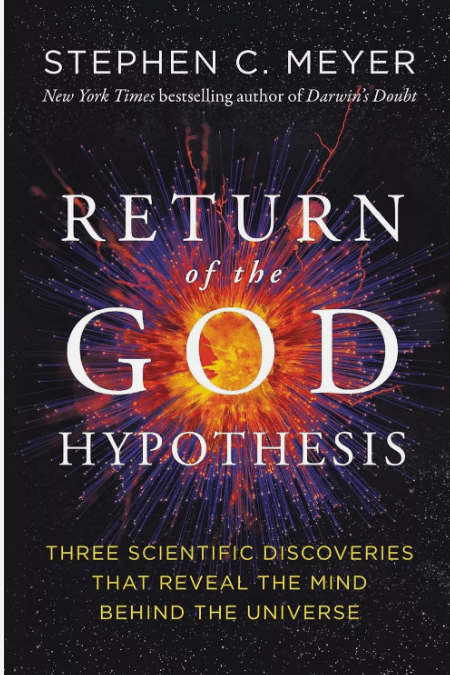
The Return of the God Hypothesis

The Return of the God Hypothesis

I wrote this 3 years ago and was reminded of it today:
Stephen Meyer’s third book, ‘The Return of the God Hypothesis: Three Scientific Discoveries That Reveal the Mind Behind the Universe ‘ is most impressive!

View at https://returnofthegodhypothesis.com/

His other 2 main books, ‘Signature in the Cell’ and ‘Darwin’s Doubt’ were absolute classics that give abundant support for the scientific paradigm of Intelligent Design (ID).

I have a whole section on my main website, circumcisedheart.info on ID.

Some of the historical facts that he introduces have really surprised and delighted me. Having spent many years at University studying Physics, and even reading some biographies on Physicists like Einstein I still found some of his insights really illuminating. I am also dismayed and a little disappointed with myself to learn that there were certain great questions of Physics that I don’t ever remember asking, such as how gravity actually works!

I learned all the laws of Universal Gravitation, etc., and could apply them as needed, but I don’t remember asking some of the deeper questions. 

In learning Physics and doing research in areas of Physics (for me it was mainly Electronics, Microwave Theory and Atmospheric Physics) I didn’t really need to know much of the history of Physics beyond what I learned in a few years of Physics classes at High School but Meyer has specialized in the history of Science, so he brings a wealth of great insights and historical narratives. 

A couple that have really struck me:
I knew a fair bit about Isaac Newton and the fact that he spent more time on his theological studies than his scientific research (if the church and government had known of some of his doctrinal positions they would have dumped him in prison, such as his rejection of the Trinity). And I knew his mathematical model of Universal Gravitation was a massive advance at the time.

But I was not aware that it had led him to argue for an infinite Universe (to balance the gravitational forces of the stars, etc.). This position was problematic for him from a theistic perspective.

Almost three hundred years later, Albert Einstein introduces his General and Special Relativity theories and turns the world of Physics on its head. But as he understood his own theories at the time, and as he rejected the idea of a Creation of the Universe from nothing (i.e the Genesis story), he had to introduce a special ‘fudge factor’, his cosmological constant to try to argue for a steady state Universe that had existed eternally. While the evidence mounted against his cosmological constant for years, it took him close to 20 years to finally overcome his own ego and accept he was wrong!

This from one of the greatest minds in all human history!

If an intellect as great as Einstein can so struggle to place facts and logic ahead of his own pet pre-suppositions and biases, how hard must it be for the rest of us!!

I am firmly convinced that this book should be read be all who wish to reject atheism and the evils that it engenders. This book should also be required reading in Senior High School Science classes.

In Meyer’s ‘Return of the God Hypothesis’ he argues that Theism provides a better explanation of how the first cell was created along with subsequent innovations in the history of life.

He states that “there are 3 keys facts about biological and cosmological origins:

  1. the material universe had a beginning
  2. the material universe has been finely tuned for life from the beginning, and
  3. large discontinuous increases in functionally specified information has entered the biosphere since the beginning.

Deism can explain the first two of these facts, but Theism can explain all three.”

Science today is increasingly finding supporting evidence for Theism and for a Creation event as described in the Bible. The worm has turned! Science truly supports a Creation event ‘ex-nihilo’   (creation out of nothing).

For more on Intelligent Design go to ID @ Circumcised Heart

I also refer to Meyer’s Darwin’s Doubt in this blog post about abductive reasoning:
https://luke443.blogspot.com/2018/01/understanding-abductive-reasoning-and.html

To Climb The Mountain

Rabbi Ari Khan has written an excellent article on last week’s Torah Portion (Shelach – Numbers 13-15)

To start with he argues that:

Of all the sins which the children of Israel perpetrated in the desert, the one with the most far-reaching consequences was the sin of the spies. While other offences generated a local’ concentrated response, in the case of the spies, while the perpetrators perished, the entire nation suffered for the next 40 years by being forced to languish in the desert.”

So why was this sin so great? What did they do that was so wrong. Very simply, they failed to appreciate what the purpose of their mission was and hence they totally failed to trust God and rely on Him and His deliverance. This sounds harsh. Surely they did not break any commandments or did they?

The core commandment, the most foundational instruction in the whole Bible is the Shema, and that is a recognition of the God of Israel and a call to love Him with your all. All your heart, strength, mind and soul. To do so is to trust Him. To fail to trust Him; to see this mission in critical terms; to only see the challenges and barriers; the giant enemies that occupied the Land, was to reject this commandment and trust. [But from our comfortable existence today, it still seems very harsh! Sometimes the lessons were need to teach our children require consequences that can seem very harsh as well.]

Moses did not send these great leaders of the 12 Tribes as spies, but rather he sent them on a spiritual journey to ascend the mountain of their homeland, to ascend to Hebron where the great Patriarch Abraham had purchased the first portion of the Land. The Land of Promise. These great leaders were supposed to fall in love with the Land.

According to Rabbi Khan, the Talmud contains a most sensible ruling that a man should not marry without first meeting his wife to be (arranged marriages were very common). So likewise here, Rabbi Khan argues that Moses is offering these representatives of the 12 Tribes an opportunity to tour the Land, to see it, to embrace it and to share a love of the Land with the people of their tribes. If they had done this, they could have entered the Land without conflict as the Almighty would have opened all the doors for them and removed their enemies before them.

The Almighty was with them, but they rejected His providence and instead only saw impossible odds. Once the people recognized their error they even reacted with bravado and said they would enter the Land and fight off their enemies, but Moses informed them that the Almighty would not now be with them and so they would fail.

This is a most salutary lesson for all of us.

We are to seek the direction of God; we are to trust Him even when the odds seem insurmountable. He will protect us and deliver us (often at the 11th Hour), if we heed the Shema and place our full trust in Him. But if instead we act on our own initiative, yet against His will we are most likely to fail.

Clearly, we need to learn to hear His Will, to heed His Instructions, His Torah. And to trust. True faith is trusting Him.

I highly recommend this great article by Rabbi Khan for the insight it provides – https://aish.com/48944726/

The 5th Word: Honour your parents!

The ‘Ten Commandments’ (or 10 Words) contain enormous truth and the deepest wisdom.

They were referred to many times by both Yeshua and the Apostle Paul as the bedrock of true faith; and they are summarized in what Yeshua declared the two greatest commandments as well as when the Apostle Paul quotes Leviticus 19:18 and states that:  “For the whole Torah is fulfilled in one word: You shall love your neighbour as yourself.”  – Gal 5:14.

Recognition and acknowledgment of these 10 Words as the Moral Code of the Universe is vital to our well-being. So what about the 5th Word?

Honour your parents!

“Honour your father and your mother, that your days may be long in the land that the Lord your God is giving you.” – Exodus 20:12 (ESV)

The only one of the Ten Words that contains a promise, a promise of a longer and better life, and also a promise to Israel that they would possess the Land of Israel for a much longer time-frame.

This Instruction being part of the 1st Tablet is first and foremost about God. The 1st tablet gives us 5 Words, 5 Instructions about how we are to relate to the Almighty and the 2nd Tablet gives us 5 Words/Instructions on relating to our fellow man.

Yet the 5th Word is also a bridge to the 2nd Tablet as it introduces us into life via our generation as children of our parents.

We are called to honour our parents:

  • to show deference to them;
  • to remember the sacrifice they made in raising us up;
  • not to shame them or belittle them,
  • not to neglect them or their memory.

And in doing so we can expect  or at least have some hope  that the same honour will be shown to us by our children, and even in this way alone it may prolong our life and length or broaden its impact.

This Instruction may seem very easy to heed if you have been blessed to have great parents (though no-one is perfect).

Yet even here, you may take them for granted or perhaps not even have the insight to recognize how blessed your upbringing has been. And then, if you were to, in some way abuse them, it would seem such abuse would cut even deeper.

If your parent(s) considers that they have generally made a good effort of raising you and you reject them in some way such as through expressing disgust or dissatisfaction in an offensive manner, even to the point of not wishing to be associated with them anymore, then clearly such parents would be extremely offended.

On the other side of the coin, as adult children, we need to give our parents a fair bit of slack. This is I think part of what honouring them entails. It can mean seeing them with ‘rose coloured’ glasses to some degree; being more tolerant of this short-comings at least as they relate to us, their children. Honouring and respecting perfection is easy; honouring and respecting flawed individuals not so much.

On a personal note, my Dad was an awesome Dad, yet when I got much older I noticed that he seemed to use me a little as a ‘punching bag’ (in a non-physical manner) when angry due to some incident and, especially it seemed, if my Mum had caused him some grief. He seemed to have so much respect for her (and perhaps a little fear of getting on her bad side!) that he looked for something or someone to take his anger or frustration out on and I felt this fell to me much more than anyone else, including my siblings. Some in the family felt it was because I was the most like him and this may have been true (though I deny it!).

My wife also thought this! Regardless, while it upset me, to the best of my recollection I never reciprocated in any way but just sucked it up. I think my great love and respect for this amazing man overrode any desire to ‘return fire’. So, I do believe I have for the most part really lived up to the 5th Word and to this day my love and respect for my late father and for my Mum remains extremely strong and deep.

But we are not commanded to love our parents, as love, though principally a commitment, is also much more and sometimes perhaps too much to expect if our parents have not lived up to all that God created them to be.

It is very hard to love parents who have abused you; or have never even been half-decent at the parenting role. But regardless, the Almighty does ask us to honour them. Our parents represented the our Father in Heaven to us as we grew up – they were His representatives in our young lives; they were like gods to us.

So, when we reach adulthood and honour our parents, we are in turn honouring the Almighty. This last point may not be obvious. The 10 Words were given to adults, for adults to heed. They were not given to children. Under Jewish jurisprudence over many centuries, children only reach an age of accountability at 13 years, so until then these Instructions are only of secondary importance to them.

But when adult children abuse their parents in some way whether through insults, shaming them or even physical or financial abuse, it is really a rejection by these adult children of the Almighty Himself. Clearly it brings great hurt to the parent(s), and the emotional pain may be much longer lasting than any physical pain, but I wonder how much more it grieves our Father in Heaven?

The 5th Word is one that really is in play for almost all adults (even once you parents have passed away, you still need to honour them memory and not bring shame to their good names). So I think we would all do well to reflect on this Word/Instruction on a regular basis and look to right any wrongs we may have committed in this regard in recent memory.

Shavuot/Pentecost and the Torah

Shavuot, also called the Festival of Weeks, is at the centre of the three main Biblical Feasts periods. Shavuot is to be celebrated 7 weeks + 1, that is 50 days after the Sabbath of Pesach (Passover). While it appears clear from Scripture that these 50 days are to start on the Sunday, the first day after the regular weekly Sabbath that falls during the Feast of Unleavened Bread/Passover, most of Judaism (the Karaites are an exception) counts from the day after Passover/Pesach, that is from the 15th Nisan.

Personally, I have tended to celebrate with Israel for the sake of unity.

While it would also appear that the 2 Tablets (the 10 Words)  were not actually given to Israel on this day, nonetheless Israel celebrates the giving of the 10 Words on this day or at the very least the preparedness of Israel to accept the Torah.

Rabbi Moshe Kempinski argues that:
“… the festival of Shavout represents not the giving of the Torah, but rather the Jewish people’s resolve to stand at the foot of the mountain to receive the Torah. That decision to stand and enter into a covenant of obedience to G-d’s direction marks the power of that day. Shavuot represents the wedding of the Jewish people to their Creator. G-d is seen as the groom beckoning His bride, the people of Israel, to stand under His cloud-huppah covering and to accept His marriage contract (ketubah), His Torah. The joy of this festival is that this people agreed to enter the huppah.”

This take seems to me to be in good harmony with the events of Shavuot as described in Acts 2, as this incredible outpouring of power and spirit on some 3000 zealous Jews from around the world resulted in these people taking the message, joy and goal of Torah[1] to the entire world (even though the message has been seriously distorted and disturbed over the centuries since).

We read in Acts 2 that the followers of Yeshua waited for Shavuot in Jerusalem, after Yeshua had ascended some 10 days before. They waited and then received great power from HaShem which was witnessed by thousands and which resulted in some three thousand becoming followers of Yeshua and believing his message that very day.

In Numbers we read:

“Then the LORD said to Moses, Gather for me seventy men of the elders of Israel, whom you know to be the elders of the people and officers over them, and bring them to the tent of meeting, and let them take their stand there with you.

And I will come down and talk with you there. And I will take some of the Spirit that is on you and put it on them, and they shall bear the burden of the people with you, so that you may not bear it yourself alone.” – Numbers 11:16-17

Note here that God’s Spirit, His Power ‘emanated’ from Moses to these followers, these elders who loved HaShem and were obedient to Moses. Thus, Moses no longer bore the burden alone, but even more importantly, the light of Torah and the power to proclaim it was now in the hands of many more so that the truth of the Almighty could be shared with a great many more and begin to emanate throughout the whole people of Israel gathered in the desert.

Fast forward to the miracle of Shavuot/Pentecost in Acts 2, and we see a very similar event, where just as Yeshua had predicted his proclamation of the Gospel and Torah was now able to emanate into the world through his followers, these ‘elders’ of The Way, who would now have the Power of the Almighty to enable them to proclaim Yeshua’s message, which was of course the message of the Almighty, just as Moses had been told when HaShem declared that He would sent a prophet who would speak His Words.

Deut 18:18-19

“I will raise up for them a prophet like you from among their brothers. And I will put my words in his mouth, and he shall speak to them all that I command him. And whoever will not listen to my words that he shall speak in my name, I myself will require it of him.”

In Jerusalem for Shavuot at that time were very many zealous believers from the Diaspora, who saw this great outpouring of the Spirit of God. In returning home, the message of the Kingdom, the message of Yeshua was thus powerfully magnified and ‘emanated’ throughout the world so that Yeshua and his followers could truly be a ‘Light to the Nations’, that is, a revealer of Torah, of The Way (Ps 119) and of the Good News of the Kingdom (Luke 4:43).

There are also some interesting parallels when we investigate the chiastic structure of the 10 Words and also a summary of a midrashic commentary on the delegation/emanation of Numbers 11:16-17 (quoted  above).

The Ten Words are ordered in a triple chiastic structure:

Chiastic structure is a literary structure used in ancient literature including the Bible.

For example, suppose that the first topic in a text is labeled by A, the second topic is labeled by B and the third topic is labeled by C. If the topics in the text appear in the order ABC…CBA so that the first concept that comes up is also the last, the second is the second to last, and so on, the text is said to have a chiastic structure. [Also, a chiastic structure can be of the form ABBAABB…ABBA. i.e. when only 2 ideas are being repeatedly referenced rather than 3 or more].

So to help visualize this we write it in this indented manner:

                  A
                     B
                        C
                      C’
                  B’
                A’

There is normally an inverted parallelism in the sequence.

For example, Matthew 7:6 contains a simple chiastic structure:

A  “Do not give what is holy to dogs,

                B  and do not throw your pearls before swine,

                B’ lest they trample them under their feet,

A’  and turn and tear you to pieces”

In this instance, the propositions A and B are reflected as in a reversed mirror image by the propositions B’ and A’.

This helps us understand this verse better as we can see that the dogs (A) tear to pieces (A’), and the swine (B) do the trampling (B’).

A very good example of formal chiasmus may be found in Genesis 17:1-25:

A   Abram’s age (1a) 

           B  The LORD appears to Abram (1b)        

                       C  God’s first speech (1b-2)           

                                           D  Abram falls on his face (3)               

E  God’s second speech – Abram’s name changed (4-8)                  

  X  God’s Third Speech -the covenant of circumcision; (9-14)                     

                                                         E’ God’s fourth speech – Sari’s name changed (15- 16)                                                  

                                             D’  Abraham falls on his face (17-18)      

        C’  God’s fifth speech (19-21) 

           B’  God “goes up” from Abraham (22)

A’  Abraham’s age (24-25)

[See http://www.inthebeginning.org/chiasmus/introduction/chiasmus_intro.htm]

The ordering of the Ten Words can be seen to have a chiastic structure when placed into one of three categories of:
– emotion,  speech, and action

The first two commandments, 1) Belief in God and 2) Not worshipping other gods, both have to do with what is in our hearts, what we feel to be true.

We are then told not to take God’s name in vain; this is clearly speech. The fourth Word, ‘Keeping the Sabbath’ is all about action, as is the fifth, as ‘honouring our parents’ is all about how we act toward them.

Beginning with the top of the second tablet (the 2nd 5 Words) we have: Murder, Adultery, and Stealing which are all ‘action’ sins. The 9th Word, ‘Bearing false witness against your neighbour’ is a transgression through speech. The final commandment, coveting that which belongs to your neighbour, is contained within one’s heart, one’s emotions.

Thus we can see that the Ten Words; the Ten Commandments follow the chiastic structure of  AABCC – CCCBA.

AA

                  B

                                    CC

                                    C’C’C’

                  B’

A’

This order and categorization also helps us appreciate which are more difficult as it is always hardest to control the heart[2]. The above is mostly paraphrased from an article by Stacey Goldman.

Her conclusion is also well worth contemplation:

“Through this literary analysis, we discover a very deep lesson from the Torah. When it comes to our relationship with G‑d, we need to work on our belief so that we can control our speech which will help to refine our actions. This will then further control our actions towards other people which will help to control our speech and refine our thoughts and beliefs about ourselves. This is what it is all about. We cannot respect and treat one another properly unless we respect and care about ourselves, and we can only truly care about ourselves when we recognize that we were created for a reason and that we need to have a relationship with our Creator.”

In Leviticus 19:18 we read ‘Love your neighbour as yourself’. This is surely the greatest principle of the Torah. God is involved in the human-to-human relationships. He is manifest when neighbours and friends get along, when people treat one another with mutual respect and caring. The “greatest principle of the Torah”, then, must be read as a rejoinder to behave towards one another in a manner that brings God into our personal and collective lives. This is the path to holiness; indeed, loving your neighbour as yourself becomes the epitome of holiness.

And the inclusion of God in this ‘greatest principle’ is evident when we read the conclusion of verse 18 where we read  “I am God”.

“… but you shall love your neighbour as yourself: I am God.” – Lev 19:18b

God is part of the equation. Loving your neighbour is a summation of the 2nd Tablet. And when it is done in the ‘fear of God’ it sums up the whole of Torah as the Apostle Paul stated: “For the whole of the Torah is summed up in this one sentence: “Love your neighbour as yourself” – Gal 5:14

Thus the holiness of man is connected to keeping the commandments – specifically, the Ten Commandments, the “essentials of Torah.” And the Almighty provides the strength and power to heed this call and be holy.

Yeshua had told his disciples that they would receive the power of the holy Spirit and to wait for this event. As it was only 10 days until Shavuot in seems likely that they would remain in Jerusalem until then.

“But you will receive power when the Ruach HaKodesh comes upon you; you will be my witnesses both in Yerushalayim and in all Y’hudah and Shomron, indeed to the ends of the earth!” – Yeshua in Acts 1:8

What this incredible event seems to illustrate is the delegation of the Gospel message to a much greater number of people from all lands of the Diaspora. It seems then to match the events we read in Numbers as below:

Numbers 11:16-17 and Delegation

“If the burden is too heavy for you to bear alone, says G-d to Moses, “Gather to Me seventy men of the elders of Israel, whom you know to be the elders of the people, and officers over them; and bring them to the Tent of Meeting, that they may stand there with you.”

And I will come down and talk with you there. And I will emanate of the spirit which is upon you, and will bestow it upon them; and they shall bear the burden of the people with you, that you bear it not yourself alone.

On the most basic level, this is the difference between physical and spiritual giving. In physical giving, the givers resources are depleted by his gift–he now has less money or energy than before. In spiritual giving, however, there is no loss. When a person teaches his fellow, his own knowledge is not diminished if anything, it is enhanced.

Upon deeper contemplation, however, it would seem that spiritual giving, too, carries a “price.” If the disciple is of inferior knowledge and mental capability than the teacher, the time and effort expended in teaching him is invariably at the expense of the teachers own intellectual development; also, the need for the teacher to “coarsen” and simplify his ideas to fit the disciples mind will ultimately detract from the depth and abstraction of his own thoughts. By the same token, dealing with people of lower moral and spiritual level than oneself cannot but affect one’s own spiritual state. The recipients of this “spiritual charity” will be elevated by it, but its giver will be diminished by the relationship, however subtly.

Indeed, we find an example of such spiritual descent in Moses bestowal of the leadership upon Joshua. In contrast to the appointment of the seventy elders, where he was told to “emanate” his spirit to them, Moses is here commanded to “Take Joshua the son of Nun, and lay your hand upon him… and give of your glory upon him” (Numbers 28:18-20). Here the Midrash comments, “Lay your hand upon him like one who kindles a candle from a candle; Give of your glory like one who pours from one vessel into another vessel.”

In other words, there are two kinds of spiritual gifts: a gift that “costs” the giver nothing (“emanation”, which is like “kindling a candle from a candle”), and a gift that involves a removal of something from the giver in order that the recipient should receive something (“pouring from one vessel into another”).

There are times we indeed sacrifice something of ourselves for the benefit of a fellow. But there are also times when we commit ourselves to our fellow so absolutely–when the gift comes from a place so deep and so true within us–that we only grow from experience, no matter how much we give of ourselves.”

 – by The Lubavitcher Rebbe (seehttp://www.chabad.org/therebbe/article_cdo/aid/1088/jewish/The-Emissaries.htm for a fascinating article on the Rebbe which also relates to the ‘outpouring’ or ‘emanation’.

In the case of the Shavuot experience of Acts 2 the spiritual gift was really from the Almighty who can’t in anyway be diminished.

May you experience something of the joy and power of being filled with the Spirit of the Almighty this Shavuot and may the joy of Torah be yours as well and bring you into a deeper holiness.


[1] http://circumcisedheart.info/The%20Goal%20of%20Messiah.pdf

[2] see http://www.chabad.org/library/article_cdo/aid/521897/jewish/The-Meaning-in-the-Order.htm

The Evangelists’ sources originated from an environment of both spoken and literary Hebrew …

In scientific circles when a hypothesis is presented, evidence is given to support this thesis. It is also implied and expected that over time future findings should for the most part add support to the hypothesis, if it is indeed a valid and accurate one.

In 2013 I completed my book, ‘The New Testament: The Hebrew Behind the Greek’. While I have made some minor edits and included some minor additional material through 2014 – 2016, it is simply not possible to be aware of all the supporting and/or contrary evidence that might have since been found and detailed. So it is only today in February 2023 that I came across this paper (see link below) from 2014 that adds some strong supporting evidence to my basic contentions and main hypothesis. Thus, I would argue that this paper adds some strong support to the basic premises and hypothesis that my book presents and hence further validates it. In fact, this paper by R. Steven Notley and Jeffrey P. García even concludes with essentially the same contentions:

“So we witness once again that the method and meaning of Jesus’ use of Scripture attests to his intimate familiarity with the contours of the Hebrew Bible. … It is clear that his exegesis was not based on a Greek or Aramaic translation, but upon the Hebrew Bible.

… The value of taking into account the original language of the discourse—Hebrew—can hardly be overstated in understanding the sense and purpose of the biblical allusions that undergird these ideas. Indeed, our aim throughout this modest study has been to demonstrate the importance of the Hebrew language and a thorough knowledge of the contours of emerging Jewish thought in order to grasp better both the method and meaning of Jesus’ exegesis of the Hebrew Scriptures.”

In this paper they also offer some supporting evidence, excerpts below (I quoted Grintz, but not Safrai and Breuer):

“Scholars had been of the opinion that, after the return of the Babylonian exiles, Hebrew no longer served as a spoken language. On this account Hebrew retained its status as a holy tongue and was used in prayer and in Torah study, and for this reason the Mishnah and contemporary Tannaitic literature was composed in Hebrew, but in everyday life Aramaic alone was spoken. Today this view is no longer accepted, the scholarly consensus now being that Hebrew speech survived in all walks of life at least until the end of the tannaitic period (the beginning of the third century CE)” (authors’ emphasis).

– Safrai, “Spoken and Literary Languages”; Buth, “Language Use”; Joshua M. Grintz, “Hebrew as the Spoken and Written Language in the Last Days of the Second Temple,” JBL 79 (1960): 32–47. Yonathan Breuer, “Aramaic in Late Antiquity,” in The Cambridge History of Judaism. Vol. 4, The Late Roman-Rabbinic Period (ed. S. Katz; Cambridge: Cambridge University Press, 2006), 457–58.

“It should be noted, however, that in terms of the New Testament (for Josephus, see Instone-Brewer, Techniques and Assumptions, 184) the majority of scholars have argued that the LXX was the authors’ primary source. While it is expected that authors in the Diaspora utilized the Greek version of the Scriptures, there is little reason to presume that within the confines of the land of Israel matters were the same. For all intents and purposes, it appears that Second Temple exegetical traditions developed out a reading of the Hebrew text. Furthermore, as several articles in the present volume indicate, it appears that the Evangelists’ sources originated from an environment of both spoken and literary Hebrew. In their conclusion: It is clear that his exegesis was not based on a Greek or Aramaic translation, but upon the Hebrew Bible….

The value of taking into account the original language of the discourse—Hebrew—can hardly be overstated in understanding the sense and purpose of the biblical allusions that undergird these ideas.

… Along with the colloquial Hebrew attested in the Bar-Kokhba documents, it is now accepted that in the New Testament era Hebrew was still utilized for oral communication. Second, it is routinely assumed, but rarely explicitly stated, that the ancients most often utilized the Hebrew Bible for matters of interpretation. The terseness of biblical narratives and linguistic nuances of the Hebrew language inspired the exegetical traditions which appear in various translations (e.g. the LXX, Targumim), as well as the Dead Sea re-workings of the Pentateuch —in addition to the wealth of exegetical materials that appear elsewhere in Second Temple period texts. The five Synoptic narratives that will be examined here—“Jesus’ Preaching in the Nazareth Synagogue” (Luke 4:18–19), “Jesus’ Witness Concerning John” (Luke 7:27; Matt 11:10), “And You Shall Love . . .” (Luke 10:25–37), “The Cleansing of the Temple” (Luke 19:45–46; Mark 11:11–17; Matt 21:12–13), “Jesus and Caiaphas” (Luke 22:66–71)—preserve rabbinic exegetical techniques that appear for the first time in written record. The earliest iteration of these exegetical methods (i.e. middoth) is first attributed to Hillel (a Jewish sage who flourished in the first century b.c.e.) and appears for the first time in the Tosefta (t. Sanh 7.11)—a supplement to the Mishnah which has been shown to be an amalgam of pre-mishnaic, mishnaic and later Rabbinic traditions. Yet, already in the Gospel of Matthew there is evidence of at least one of them, קל וחומר (a minori ad maius14): εἰ δὲ τὸν χόρτον τοῦ ἀγροῦ σήμερον ὄντα καὶ αὔριον εἰς κλίβανον βαλόμενον ὁ θεὸς οὕτως ἀμφιέννυσιν, οὐ πολῷ μᾶλον ὑμᾶς, ὀλιγόπιστοι; (“But if God so clothes the grass of the field, which today is alive and tomorrow is thrown into the oven, will he not much more clothe you, O ones of little faith?,” Matt 6:30).

Prof. R Steven Notley

In the passage, the comparison of God’s care for the grass in light of its impermanence with the more important concern for humanity reflects the transition from minori (קל) to maius (חומר). Certain middoth, especially those that are found in pre-70 c.e. texts, were conveyed orally and likely intended to be utilized in teaching contexts (e.g. bet midrash). The employment of these exegetical techniques reflects the manner in which a sage might readily interpret Scripture in the process of teaching or in regular conversation. Coupled with the acknowledgment of spoken Hebrew in the first century, we suggest that these exemplify a fluid development of interpretive techniques (middoth) that were derived out of a speaking environment rather than a literary/scribal one. Therefore, the fact that the Synoptic Gospels preserve stories with contemporaneous methods of exegesis and that most of these accounts portray a setting where Jesus is teaching, it indicates not only the language of exegesis (i.e. Hebrew) but also the primary language of discourse. …”

https://www.academia.edu/9228226/Hebrew_Only_Exegesis_A_Philological_Approach_to_Jesus_Use_of_the_Hebrew_Bible

Should our pre-suppositional approach to the New Testament be Hebraic or Hellenistic?

Almost all of Christian scholarship approaches the NT from a Western and Hellenistic (Greek) mindset, and for most they are not even aware of their pre-suppositions. This may be in part because so many historical and cultural understandings over the centuries re-enforced this approach.

But since as early as the 1950’s these false understandings began to be questioned and re-evaluated. Sadly though the new evidence and understandings have for the most part not been reflected in new  editions of our Bible translations or even in much recent scholarship (with very notable exceptions being scholarly groups such as the Jerusalem School for Synoptic Research[1], and some Bible translators such as Ann Nyland[2] and Uriel ben Mordechai).

I have written and presented a number of articles on the Hebraisms in the NT as well as discussing the evidence is some depth in my book ‘The New Testament: The Hebrew Behind the Greek’[3].

But a question that was raised recently is how to open the minds and hearts of Bible scholars and students to at least consider that their inherent pre-suppositional understandings may need to be re-evaluated.

The approach of have used in the past is to look at some of the apparent contradictions between different accounts of the same event and try to demonstrate that a Hebraic approach seems to best resolve the apparent conflict and contradiction.

I have detailed many of these in my articles, but I raise just one here to highlight this issue.

Yeshua is asked who might sit next to him in the Kingdom. Mark gives us the impression that Yaa’cov (James) and Yochanan (John) themselves personally asked whether they might sit next to Yeshua in places of royal authority (Mk. 10:35-40).

Matthew though tells us that in fact it was the mother of Zebedee’s children who actually made the request to Yeshua (Mt. 20:20-23). Here we see the Hebraic principle of agency at play. The agent fully represents the principal in any transaction. All the Gospels, as well as other books of the NT make use of this Hebraism and many others.

Many have argued that these Hebraisms are not evident in John’s Gospel. I have addressed this question in depth here: http://circumcisedheart.info/Hebraisms%20in%20John’s%20Gospel.pdf

I would also like to highlight how easy it is to totally miss these Hebraisms and the strong Hebraic Mindset and perspective used throughout the NT. Some of the examples are staring us in the face, yet we can not see them without an indepth knowledge of the historical and cultural context.

Just one example for now comes from ‘Non-Septuagintal Hebraisms in the Third Gospel: An Inconvenient Truth’by R. Steven Notley (of the Jerusalem School for Synoptic Research).

“Luke’s terminology reflects Post-biblical Hebrew idioms that he has not adopted from the Septuagint, the other Gospels or any other known Jewish Greek literature of the period. The problem is that scholarship is often looking for the obscure, enigmatic idiom when the examples are right in front of the reader. Their sense is so obvious and the reading so familiar that we simply over-look their Hebraic character. [My emphasis] For example, Luke refers to the work of Isaiah as βιβλίον τοῦ προφήτου Ἠσαΐου (Luke 4:17). Yet, nowhere else in the corpus of Jewish Greek literature (i.e., Septuagint, Greek Pseudepigrapha, Josephus, Philo, etc.) in late antiquity is this prophetic work designated a βιβλίον (or βίβλος). It is likewise not designated by the Hebrew equivalent (ֵסֶפר) [sefer == book] in the Hebrew Scriptures.

Yet, the work of Isaiah is called exactly that in the Dead Sea Scrolls. Indeed, at Qumran the Lukan phrase—the book of the prophet Isaiah—appears in its precise Hebrew equivalent on four occasions (ספר ישעיה הנביא: 4Q174 f1.2i.15; 4Q176 f1.2i.4; 4Q265 f1.3; 4Q285 f7.1).”[4]

As I document in my ‘Hebrew Behind the Greek’ text, Luke and all the authors of the NT were very much Hebraists in their perspective, though having been translated into Greek their Hebraic mindset is not as easy to distinguish. Further, I discuss some of the serious damage that has resulted from the failure to view the NT through Hebraic eyes in my book ‘Doctrinal Pitfalls of Hellenism[5].


[1] https://web.archive.org/web/20110721090037/http://www.js.org/

[2] https://luke443.blogspot.com/2019/02/the-source-new-testament.html

[3] https://www.amazon.com.au/New-Testament-Language-Mindset-Hellenistic-ebook/dp/B009XO0NQU/

[4][4] https://www.semanticscholar.org/paper/8-Non-Septuagintal-Hebraisms-in-the-Third-Gospel:-Notley/ed5b1eb2016cae942a0f6a67d0bfa31a965e0bbb?p2df

[5] https://www.amazon.com.au/Doctrinal-Pitfalls-Hellenism-Studies-Greek-ebook/dp/B00DO17CK8/