Finding Happy

I have 100 free registrations for my course ‘The Ten Happiness Principles’ to give away this week.

This course gives a presentation on the top 10 Principles which can lead you to a conscious, consistent and enduring sense of peace and joy as you go about your everyday life.

This is NOT a religious course pushing my doctrinal positions, but a very practical course involving 11 very short lectures followed by some practical activities to test out for yourself.

The Principles are Biblically-based, in that they can all find support in the Bible, but this course is all about what you do day to day, NOT what you may or may not believe about God, the World, Salvation, etc.

This course is primarily based on the research and wisdom of Rabbi Jonathan Sacks and the writings of one of Harvard’s all-time most popular psychology lecturers, Tal Ben-Shahar. But it also has very solid support from Neurological Research – for example, I strongly recommend the work of Dr Jeffrey M Schwartz (see for example his great book ‘The Mind and the Brain: Neuroplasticity and the Power of Mental Force’), along with a number of others such as Professor Michael Egnor and Dr Carol Dweck.

Give it a try – you have nothing to lose and possibly much to gain!

After a presentation on each principle some simple tasks are suggested to help exercise the principle and with repeated practice over a short period of time these tasks can become part of your daily routine.

Each Principle is presented in 5-10 minute segments with the whole course taking around 1 hour. While you may want to go through the whole course in one sitting, it is recommended that you address each Principle one at a time and spend a week working on the related tasks. With this recommended approach the course will take some 10 Weeks to complete.

By working through this course and doing the follow-up exercises you can expect to see your general sense of well-being and happiness improve in some tangible way. 

By appreciating the underlying concepts and learning the pro-active tasks that create new neural pathways to solidify the skills/thinking involved you will be able to make permanent and positive changes to your world. To repeat, this course gives a presentation on the top 10 Principles which can lead you to a conscious, consistent and enduring sense of peace and joy as you go about your everyday life.

Access the free coupon for the course here – https://www.udemy.com/the-ten-happiness-principles/?couponCode=Happy4Free


Hosea on Israel’s relationship with the Almighty

In an article by Rabbi Jonathan Sacks posted this week (April 16th 2015), he makes some references to the prophet Hosea. In reading this article I was again reminded of the many references in the Tanakh that declare that HaShem never really left His Chosen People, the children of Abraham, Isaac and Jacob, but rather separated Himself from them at times, arguably as part of His loving discipline.

Hosea makes it very clear that the the ‘betrothal’, the marriage relationship between YHVH and Israel is an eternal one, that YHVH is and will always be the Husband of Israel.

Here are some excerpts from the article that help clarify this point:

“The inner history of humanity is in part the history of the idea of love. And at some stage a new idea makes its appearance in biblical Israel. We can trace it best in a highly suggestive passage in the book of one of the great prophets of the Bible, Hosea.

Hosea lived in the eighth century BCE. The kingdom had been divided since the death of Solomon.  The northern kingdom in particular, where Hosea lived, had lapsed after a period of peace and prosperity into lawlessness, idolatry and chaos. Between 747 and 732 BCE there were no less than five kings, the result of a series of intrigues and bloody struggles for power. The people, too, had become lax:
“There is no faithfulness or kindness, and no knowledge of God in the land; there is swearing, lying, killing, stealing and committing adultery; they break all bounds and murder follows murder” (Hos. 4: 1-2).

Like other prophets, Hosea knew that Israel’s destiny depended on its sense of mission. Faithful to God, it was able to do extraordinary things: survive in the face of empires, and generate a society unique in the ancient world, of the equal dignity of all as fellow citizens under the sovereignty of the Creator of heaven and earth. Faithless, however, it was just one more minor power in the ancient Near East, whose chances of survival against larger political predators were minimal.

What makes the book of Hosea remarkable is the episode with which it begins.  God tells the prophet to marry a prostitute, and see what it feels like to have a love betrayed. Only then will Hosea have a glimpse into God’s sense of betrayal by the people of Israel.

Having liberated them from slavery and brought them into their land, God saw them forget the past, forsake the covenant, and worship strange gods.

Yet He cannot abandon them despite the fact that they have abandoned Him.

It is a powerful passage, conveying the astonishing assertion that more than the Jewish people love God, God loves the Jewish people.

The history of Israel is a love story between the faithful God and his often faithless people. Though God is sometimes angry, He cannot but forgive.

He will take them on a kind of second honeymoon, and they will renew their marriage vows:

“Therefore I am now going to allure her;
I will lead her into the desert
and speak tenderly to her . . .
I will betroth you to me forever;
I will betroth you in righteousness and justice,
in love and compassion.
I will betroth you in faithfulness,
and you will know the Lord.” (Hosea 2: 16-22)”

It is possible that that reference to ‘leading her (Israel) into the desert’ is a reference to the exiles that Israel has experienced. Yet, all these exiles were only temporary for those who were found faithful. The faithful returned from Assyria, they returned from Babylon, and they have in the last 60+ years returned, and are returning, from the final exile to the ‘four corners’ of the earth[1].

Rabbi Sacks goes on to say:

“… One verse in the midst of this prophecy deserves the closest scrutiny. It contains two complex metaphors that must be unraveled strand by strand:

“In that day,” declares the Lord,
“you will call Me ‘my husband’ [ishi];
you will no longer call Me ‘my master’ [
baali]. (Hosea 2: 18)

This is a double pun. Baal, in biblical Hebrew, meant ‘a husband’, but in a highly specific sense – namely, ‘master, owner, possessor, controller.’ It signalled physical, legal and economic dominance.

It was also the name of the Canaanite god – whose prophets Elijah challenged in the famous confrontation at Mount Carmel. Baal (often portrayed as a bull) was the god of the storm, who defeated Mot, the god of sterility and death. Baal was the rain that impregnated the earth and made it fertile. The religion of Baal is the worship of god-as-power.

Hosea contrasts this kind of relationship with the other Hebrew word for husband, ish. Here he is recalling the words of the first man to the first woman:

“This is now bone of my bones And flesh of my flesh; She shall be called Woman [ishah], Because she was taken from Man [ish].” (Gen. 2: 23)

Here the male-female relationship is predicated on something quite other than power and dominance, ownership and control.

Man and woman confront one another in sameness and difference. Each is an image of the other, yet each is separate and distinct.

The only relationship able to bind them together without the use of force is marriage-as-covenant – a bond of mutual loyalty and love in which each makes a pledge to the other to serve one another.

Not only is this a radical way of reconceptualizing the relationship between man and woman. It is also, implies Hosea, the way we should think of the relationship between human beings and God.

God reaches out to humanity not as power – the storm, the thunder, the rain – but as love, and not an abstract, philosophical love but a deep and abiding passion that survives all the disappointments and betrayals.

Israel may not always behave lovingly toward God, says Hosea, but God loves Israel and will never cease to do so.”[2]

The Tanakh repeatedly states that Israel shall be restored to the Land, to Eretz Israel, not because they necessarily deserve to be, but because this return, and re-establishment of their ‘betrothal’ to their Husband, is for His Name’s sake. 

The Almighty declares His sovereignty and His eternal love by returning His People to the Land of Israel.

Today this understanding carries little favour in the Hellenistic Christian world which embraces Replacement Theology. I have a chapter on this issue in my book ‘Doctrinal Pitfalls of Hellensim’ – see http://www.amazon.com/Doctrinal-Pitfalls-Hellenism-Studies-Greek-ebook/dp/B00DO17CK8/


[1] see my article ‘Israel: Return in Belief or Unbelief’ – http://goo.gl/hwBeoO

[2] – quoted from “http://www.israelnationalnews.com/Articles/Article.aspx/16788#.VTGfkGSqqkp

Love ‘loving-kindness’ – Micah 6:8

It is not only the Jewish people who love Micah 6:8 for it’s simple, yet extremely powerful message and instruction of how to live right before the Almighty.

This passage is also a favourite of many Christians (though it appears most of them have never looked very deeply at this verse in its broader context, and in particular at the truth shared in Micah 6:6).

But I do not wish that to detract from my recent, and fresh insight, on this passage that I have loved and very often meditated on over many years.

There are of course many English versions, and as is normal when trying to translate truth from the inspired Hebrew Scriptures into other languages, often something is lost in the translation.

Consider a few of these English versions:

He hath shewed thee, O man, what is good; and what doth the Lord require of thee, but to do justly, and to love mercy, and to walk humbly with thy God?” – KJV

“He has shown you, O mortal, what is good. And what does the Lord require of you? To act justly and to love mercy and to walk humbly with your God.” – NIV

“He has told you, O man, what is good; and what does the Lord require of you but to do justice, and to love kindness, and to walk humbly with your God? – ESV

Quite a few are very similar and appear (as usual) to copy the KJV.

The Complete Jewish Bible (David Stern) is a little different:

“Human being, you have already been told what is good, what Adonai demands of you — no more than to act justly, love grace and walk in purity with your God.” – CJB

The Hebrew word חֶסֶד (chesed) is the word being translated as ‘kindness’ (ESV) and ‘mercy’ (KJV & NIV), and as ‘loving-kindness’ in many other places.

In fact, the word ‘chesed’ which occurs hundreds of times in the Tanakh (The Hebrew Scriptures) is most commonly translated as ‘grace’ throughout the New Testament (for some depth and interesting analysis of this aspect see my article ‘Amazing Grace’ here: – Amazing Grace.

But note that if we use the translation ‘loving-kindness’ in particular to help us see the full picture here, we have the injunction that we are called to ‘love loving-kindness’.

We are to love showing and giving grace; to love acting with mercy, to LOVE being kind. We are not to just BE kind, but to LOVE being kind!

Kindness, mercy, grace should be so much a part of our heart that we can’t help practicing this attribute of the Almighty whose image we are made in!

You may ask ‘How do we get this way if we are not already in this place?’ I think part of the answer is to act as if our heart already loves being kind and gracious and full of compassion, and therefore we must do acts of loving kindness. It’s almost like ‘fake it to you make it’.

The more we act this way, the more the neural pathways in our brains will be stimulated to create a new pathway of truth and a new mindset, and a new heart, where we increasingly become ‘lovers of loving-kindness’.

In other words, in living this call we in fact circumcise our own hearts! (Deuteronomy 10:16, Jeremiah 4:4).

Thanks to the Mussar teaching of Alan Morinis in ‘Everyday Holiness: The Spiritual Path of Mussar’ for this insight. 

You Shall Be Holy – Introduction

A series of commentaries on the soul:

Poetry, music, love, wonder – these things that have no survival value, but which speak to our deepest sense of being – all tell us that we are not mere animals, assemblages of selfish genes.

By bringing that which is animal within us close to God, we allow the material to be suffused with the spiritual and we become something else:

no longer slaves of nature but servants of the living God. – Rabbi Jonathan Sacks (from a commentary on the Torah Portion Vayikra)

As ‘servants’ what does the living God ask of us? He asks that: ‘You shall be holy’.

This is your purpose for your life. This is your calling as a servant of the living God.

This is the advice from the Almighty. He has built into our very being, a desire to improve ourselves (and our surroundings). Yet, this urge can be mistaken as a drive for material possessions. It is instead, an innate drive to spiritual growth, to becoming holy.

In the Tanakh (the Hebrew Bible – see in particular, Leviticus), the Hebrew word translated as ‘Holy’ is קָדוֹשׁ (qadosh) and  is an adjective, or an active verb and thus a state of being. The goal of holiness is an individual one, but it is also one which we are all, (and by ‘all’  I mean every single living human being), called to hear, even if that call is virtually deafened out by our chaotic lifestyles.

We were made incomplete. Deliberately so.

While we were made ‘very good’, and made in the image of the Almighty, He has deliberately made everyone of us less than complete, less than whole, so that part of our task in this life is to heal and complete ourselves, and in doing so, and as part and parcel of this task, we are called to heal or ‘repair the world’ (tikkun haOlam).

Full Holiness means wholeness.

In this sense then, all our weaknesses, our shortcomings and failings are deliberate, to the degree that we have been made with these less than perfect traits so that we do, in fact, have a job to do – the job of completing ourselves.

What is really challenging and almost unbelievable is that it is in fact possible to complete ourselves!

It is possible to gain that state of completeness, when a person becomes all that HaShem created him/her to be.

Sadly, most brought up in the Western tradition, and especially within the Christian community are taught to reject this fact, through the insidious and seriously harmful doctrine of ‘Original Sin’.

So how are we to become holy?

Firstly, we need to appreciate that we all have a life curriculum – the good, the bad and the ugly come our way to help mould us (if willing), to be the unique people G-d intended us to be and to be fully Holy. This ‘curriculum’ is daily before us whether we consciously choose to engage with it or not. It is impacting our lives, and hopefully in a positive manner whether we acknowledge it or not.

But learning of this ‘curriculum’ and being aware of its daily teachings can make the path to completing it, both smoother and quicker.

Surely, if we all realized we were in ‘school’ and working on a curriculum designed by the world’s best Educator (G-d Himself), to lead us to be the best person we could be and that we were designed to be, wouldn’t we want to complete the curriculum as quickly and effectively as possible!?

There is a spark of Holiness, a spark of divinity in every person. There is also every character trait in every person. As part of our “curriculum’ we each uniquely have some traits that we find more problematic than others, and that we need to work on more than others. We should not see these traits that we struggle with as bad or wrong or sinful, but as traits that need addressing so that ultimately they become under our control and in the proper balance.

The person who appears in general to be an extremely angry person, still has some moments of calm and some circumstances in which he/she has control over that anger. But also the calmest person has some degree of anger in him/her, some circumstances that really test his or her peace and serenity.

Anger can be bad, yet anger at injustice helps motivate us to try to correct that injustice.

A man with unbridled lusting for a women not his wife, is clearly acting in a sinful manner (it is breaking the 10th Commandment), yet this very Commandment implies that a man should lust after his own wife!

Lust (as in a ‘lust of life’) or desire is the true secret to a successful marriage. A marriage where that desire for each other is recognized and knowingly cultivated and maintained is a marriage that will survive.

All character traits can be shown to be beneficial if in the right balance and exercised to the right degree.

Imagine all the possible character traits on a continuum, such as anger and passivity being at opposite ends of a balance. Or humility and arrogance on a separate continuum. Imagine each and every character trait being on a continuum between the two extremes of that characteristic.

Inside us, in our inner-most soul is a light of divinity, a light made in the image and likeness of the Almighty that should shine out from us and brighten the world around us.

But also imagine the many character traits that are not in balance as ‘clouds’ that block that light or ‘sun’ that should be shining out from within.

As we mature and grow so that each trait moves towards being in the right balance, our inner ‘light’, our spark of divinity, shines out more strongly as the ‘clouds’ are removed.

As we work on ourselves and our traits, a trait’s balance then moves towards its proper centre, and the ‘black or dark cloud’ gets less and less opaque and more and more transparent.

With many traits to balance, the clouds can really block out the ‘sun’s rays’ (our inner light), the light that should be shining out from our core.

As we learn to improve ourselves and find the proper balance of our character traits and learn which are most problematic for each of us, and how we can learn to control and rectify/balance these traits, we should find that without any real and noticeable effort, our light shines brighter, and begins to impact those around us in positive and helpful ways.

So in seeking to complete ourselves, we quite naturally and effortlessly end up helping others to ‘see the light’ and in so doing perhaps help them to complete themselves.

Next: Dealing with the inner adversary, the Yetzer HaRa.

— to be continued —

This introduction and the articles to further and bring some depth to this overview are some reflections from Mussar instruction and other Rabbinic teachings.

The books that this series of short articles are primarily based on:

‘Everyday Holiness: The Jewish Spiritual Path of Mussar’ by Alan Morinis.

10 Conversations You need to Have With Yourself’ by Rabbi Shmuley Boteach

Shalom in the Home’ by Rabbi Shmuley Boteach

‘Kosher Lust: Love Is Not the Answer’ by Rabbi Shmuley Boteach

‘God According to God: A Physicist Proves We’ve Been Wrong About God All Along’ by Dr Gerald L Schroeder


The Torah is God’s Song

Nitzavim-Vayelech (Deut. 29:9–31:30)

The last command of the Torah[1] reads:

“Now therefore write down for yourselves this song, and teach it to the people of Israel; put it in their mouths, that this song may be my witness within the people of Israel.” D’varim (Deut.) 31:19

Many Jewish scholars have asked ‘why a song?’ and was the song the next section of Deuteronomy or the whole of the 5 Books of Moses?

Rabbi Sacks refers to Rabbi Yechiel Michal Epstein who states that one of the reasons the Torah is called “a song” is because a song becomes more beautiful when scored for many voices interwoven in complex harmonies.

Rabbi Sacks goes on to write: “The Torah is God’s libretto, and we, the Jewish people, are His choir, the performers of His choral symphony. And though, when Jews speak they often argue, when they sing, they sing in harmony, as the Israelites did at the Red Sea, because music is the language of the soul, and at the level of the soul Jews enter the unity of the Divine which transcends the oppositions of lower worlds.

The Torah is God’s song, and ‘we’ collectively are its singers.”
He also argues that through the writing and singing of this Torah ‘song’, the Torah is renewed afresh with each generation and each individual.

The Torah Portion, Nitzavim includes some of the most fundamental principles of faith in The God of Israel.

It speaks of:

  • the unity of Israel;
  • the future redemption;
  • the practicality of Torah; – see here
  • Freedom of choice.

The Torah Portion (Parshah) of Vayelech also speaks of how the Almighty will ‘hide His face’ – see https://globaltruthinternational.com/2012/09/23/moses-and-the-king-who-hides/

(Thanks to Chabad.org & Rabbi Jonathan Sacks for the thoughts paraphrased above).

In considering this Torah Portion, and the concept that the Torah is God’s Song to be sung by all who love the Instructions of God (Torah), as well as considering how it can be renewed through the generations, I think it also worth reflecting on how the writer of Yochanan’s (John) Gospel in the Apostolic Writings (the NT) saw Torah.

You can get closer to the source of Yochanan’s understanding by going back to the original Hebrew of Proverbs 8:

“The L-RD purchased me at the very beginning of His way before any of his activities at that point. From before time began, I was poured out, even before there was “earth” … And I was BESIDE (or WITH) Him, a master artisan, And I was full of delights, daily playing before Him at every moment’ – Proverbs 8:22, 23, 30 translated by Uriel ben Mordechai

This ‘wisdom’ is TORAH. The Torah existed before the foundation of the universe.

Thus, it seems that it is the Torah, that Yochanan (John) refers to in John 1:1, which if we had the original autograph in Hebrew would more likely read in English something like this:

“In the beginning was the Torah, and (the) Torah was for the sake of (the) G-d, And godly was (the) Torah.”

Get Uriel ben Mordechai’s book for more details on the validity of this translation – see  ‪http://above-and-beyond-ltd.com/store/books/if.html

This translation is also very well presented and attested for in Jacobus Schoneveld’s scholarly article: ‘Torah in the Flesh

Further, when we consider that Yochanan was not writing in a vacuum, but actually quoting what other Jewish writers had written before him (and in Hebrew), we can be fairly sure of his intent, even if we only have poor Greek translations.

Yochanan, like Yeshua relied on the Hebrew Bible, the Tanakh.

Yeshua when he repeatedly said ‘It is written …” were referring to the Tanakh. When Yochanan concluded his Gospel account by stating that these things were written so that you may trust, or have faith,  that Yeshua is the Messiah, the Son of God (Jn 20:31), he was clearly endorsing and supporting the work of Yeshua and his own argument that in Yeshua. The Torah had put on (or wore) flesh.

To understand anything in the NT and to appreciate the intent of the NT authors such as Yochanan, we need to look not only into the Tanakh to understand their perspective and biblical reality, but also to documents from the inter-testamental time (perhaps as late as, late 3rd century BCE to early 2nd century BCE, through to around 40-50 CE) to appreciate common Jewish thinking, understanding and terminology. So this includes works like the ‘Wisdom of Sirach’.

In this respect even sectarian works from this period can be relevant.

So with this appreciation, it is worth asking if the concepts and ideas presented in Yochanan’s prologue were already existent or even prevalent in the Tanakh and in Jewish thought of his time.

What we find is that Yochanan’s prologue, for example John 1:3 “through ‘it’ (the Word or the Torah) everything came to be: no single thing was created without ‘it’ ” was a Jewish ‘commonplace’.

That is, it was already part of Jewish writings prior to Yochanan.

For example in the Book of Jubilees we read that God “has created everything by His word/Torah” (12:4), and so it is also said in Wisdom of Solomon 9:1.

Even more similar to Yochanan’s prologue is the wording of two sentences in the Dead Sea Scrolls: “By His (God’s) knowledge everything came to be, and everything which is happening — He establishes it by his design and without Him [nothing] is done” (1QS XI: 11).

And “By the wisdom of Thy knowledge Thou didst establish their destiny ere they came into being, and according [Thy will] everything came to be, and without Thee [nothing] is done” (1QH 1:19-20).

Thus, the concept that God created the world through his ‘word/Torah/wisdom’ is a Jewish concept.

In fact, the Tanakh informs us that Almighty created the entire universe through ‘fiats’; through His word. So not only does the ‘word’ of God have a creative function, it also has an analytical function.

Consider for example, Hebrews 4:12: “For the word of God is living and active, sharper than any two edged sword, piercing to the division of soul and spirit. …and discerning the thoughts and intentions of the heart.”

Here we see the ‘word’ or ‘logos’ having an analytical function. Interestingly, even the Hellenistic Jew Philo (20 BCE – 50 CE) took this position.

In Wikipedia we read: ‘Some scholars hold that his concept of the Logos as God’s creative principle influenced early Christology. Other scholars, however, deny direct influence but say both Philo and early Christianity borrow from a common source. For Philo, Logos was God’s “blueprint for the world”, a governing plan.’

So consider that Yochanan starts with: “In the beginning was the Torah, and (the) Torah was for the sake of (the) G-d, And godly was (the) Torah.” And then goes on to state (paraphrasing Yochanan 1:14):

“And the Torah dressed itself in human flesh and so dwelt amongst us, so that we could see its (the Torah’s) glory from the Father, a glory full of grace and truth.”

So God’s Song has dressed itself in humanity, so that all who love Torah, and see the perfect example (in Yeshua) of how to live Torah, can properly renew, and in unity, sing Torah daily.

Perhaps we can even sense the rising crescendo of this ‘Torah Song’, as we witness the great signs through the creation of State of Israel, and the dawning of the final Redemption!

Shalom!

[1] The word תּוֹרָה (Torah) means teaching or instructions. It is also used to refer to the 5 Books of Moses, as these contain the Torah. Normally when referring to the whole Hebrew Bible, the phrase Torah, Prophets and Writings is used, but at times this may also be shortened to ‘Torah’.

A re-translation and reconsideration of some of Isaiah 53

Isaiah 53 is a much loved passage in the Tanakh, both for Judaism and for Christianity. Yet, there is much debate over it’s true and full meaning.

This debate has gone on for at least 1800 years with some famous commentaries such as the intriguing commentary of Rabbi Nachmanides (Rabbi Moshe ben Nachman, who lived from 1194 to 1270 CE), which I discuss briefly in my article ‘The Messiah from an Hebraic Perspective’ – http://goo.gl/0Z5AHc

I even have a book entitled ‘The Fifty-third Chapter of Isaiah According to the Jewish Interpreters’ (first published in 1896) which has over 50 leading Rabbi’s and Jewish scholars who give their take on this amazing chapter and prophecy.

So what more could be added to the mix? How could anyone give some added value or new insight, with possibly greater validity, to the many books and articles already written on this great portion of Isaiah (correctly transliterated as Yishaiyahu)?

Before I answer that question, consider that Yishaiyahu was first written for and to the Jewish people, at least some 2,600 years ago and possibly even as early as 2,780 odd years ago. Until the Dead Sea Scrolls discoveries the oldest versions of Yishaiyahu in the original language was the Masoretic Text of the Codex Leningrad, (dated at 1000 CE), but first complied around 700 CE.

The DSS discovery of the Great Isaiah Scroll (dated at the latest to be around 100 BCE with some carbon dating giving an age of 350 BCE) changed all this. While this text has been in public circulation for some decades now, to the best of my knowledge no Jewish Hebrew translator had compiled a re-translation with commentary until now. Very recently this task has been undertaken.

Note that I stated a ‘Jewish Hebrew translator’, meaning someone not only Jewish but a native Hebrew speaker and also a skilled translator. Why is this important?

The Jewish people, if you take the time to ask them, will argue that the Gentile/Hellenistic Christian church has taken their Bible, which they paid for in their own blood, translated it without properly understanding it, and then, handed back to the Jewish people a corrupted version, which has effectively striped the Torah from the Apostolic Writings (the NT).

These same ‘translators’ and Christian leaders then have the check to call the Jewish people ‘blind’, when they refuse to accept the re-worked and corrupted Bible that has had its very core and essence (Torah) seriously diminished and sidelined in its pages.

What really amazes me is that Yishaiyahu (Isaiah) foresaw all this and more over 2,500 years ago when he composed his book of the Tanakh!

The translation below is by a Jewish translator living in Jerusalem. In undertaking to translate the Great Isaiah Scroll, Uriel ben Mordechai took careful notice of every Hebrew letter difference between the Aleppo and Leningrad texts versus the Great Isaiah Scroll. While DSS scholars such as the great Frank Moore Cross inform us that the differences between the MT and the Great Isaiah Scroll are minimal, Uriel found that there were some significant differences.

To help with readability in translating a Hebrew document, whose original composition was over 2500 years ago, and with which the extant copy is at least 2100 years old, Uriel added some clarifications in square brackets. These are not part of the original text, but add a lot of clarity and explanation for today’s English readership (note also, AM Israel means ‘the people of Israel’).

Yishaiyahu 52:15 – 53:5:

“Concerning him [AM Israel, the Servant of HaShem], leaders shall jump into formation to open their mouths [in a panic], because that which was not told to them, they will grasp, and that which they would not hear, they will discover.

[These leaders will say,] “Who [now] will believe our version of the story, and [what we once claimed with reference] to whom the arm of HaShem had [in actual fact] been revealed,…

who also grew up as a nursing child, before Him [i.e. HaShem], and like a root in the desert, without him having had title [or rank], and without any honor, that we might have noticed him; Unimpressive, that we would have found him attractive?”

“He [the Servant of HaShem, AM Israel] was [considered by us to be] revolting, lacking personality [or repugnant], like a grief-stricken man, known [by us] to be ill [or deficient]. And in that he distanced himself from our company, [all the more] we found him despicable, and we handed him [only] our contempt.

Undeniably, he shouldered [the brunt of] our insanities. Our regrets [i.e. our sad stories, or shameful acts] — he tolerated them. We deemed him contaminated; [having been] defeated by G-d [Himself]; and [utterly] humiliated!

And he was dishonored [or desanctified] on account of our misconduct [or crimes]; [he was] downtrodden [i.e. tyrannized, or persecuted] from our improprieties. Moral values [i.e. our own ethical standard] with which we were comfortable, were thrust upon him. And yet [only] in the company of his people, shall we be restored to health.” <end quote>

For those of you seeking a prophecy here about Yeshua, remember that ‘the Servant of HaShem’ describes the people of Israel, and Yeshua is a member of this Servant Nation. Therefore, this text can also refer to him, both as a part of AM Israel and also individually as the Mashiach (Messiah) of Israel.

I strongly recommend you re-read this short section of Uriel’s translation and contrast the prophecies with the events of today. What can you see?

How much does this scream anti-Semitism? Can you see the pogroms and mistreatment of the Jewish people as a result of the Gentile ignorance and arrogance with respect to Israel?

And yet, can you also see that the time will dawn when we Gentiles will recognize that our restoration, our return to full health and lasting vitality will only come when we embrace HaShem’s Servant Nation (and of course, His Mashiach)! But we can’t have one without the other. We can’t have Mashiach without first accepting AM Israel!

AM Israel Chai!

A different take on Isaiah 9:6

This prophecy is one, which is extremely well known within Christendom, or more accurately, it is very often quoted and preached on by Pastors and preachers in the mainstream Christian churches. For example, I have attended Christmas Day services where this was the main Scripture quoted and discussed.

One of these occasions some years ago led me to write to the Pastor of a large Pentecostal church here in Brisbane, and try to share with him my understanding of the many ways in which he was mis-interpreting this passage.

Now, in looking back over what I wrote, while I still believe I was pointing him in the right direction, I now believe that if I had better understood this passage in Hebrew, I would have been much more able to show him how very far his understanding was from the truth. I am fairly sure though, that I would still not have influenced him in any significant way to change his cherished Hellenistic doctrines and lens through which he read this passage.

Here though is the utterly remarkable way in which the Hebrew of this passage can be fairly and accurately translated into English that sheds an amazing light on what this passage was really revealing.

Let me first share his translation and then try to explain how this comes about and what it means:

“… For unto use a child is born, to us a son is given, and the government shall be on his shoulders.
A Wonder, a Counselor, Mighty G-d, my Father in perpetuity, shall call him … “Prince of Peace”’
– translation by Uriel ben Mordechai

There are many Christian ‘Hebrew scholars’ who have translated this phrase differently, but very few of those ‘Hebrew scholars’ have been native speakers of Hebrew like Uriel.

As Uriel points out in much detail, his translation is much closer to how a native Hebrew speaker who knows his/her Tanakh would pronounce it, in particular because they would know how to read the ‘nikud’ (a system of diacritical signs used to represent vowels and distinguish between alternative pronunciations and determine the intended grammatical structure).

Many Hebrew versions of the text also have ‘cantillation marks’ (a system of marks to help with chanting the text which are very much like todays commas and colons, but which dates back to the time of Ezra – circa 510 BCE). This clearly establish where breaks occur in the text and thus establishes that the first 4 ‘nicknames’ belong to the ‘caller’ and only the last nickname, ‘Prince of Peace’ belongs to the one being ‘called’ by the ‘caller’.

Further evidence that these first four nicknames; Wonder, Counselor, Mighty G-d and ‘my Father in perpetuity’ all are labels/names for the Creator and King of the Universe; the God of Israel, is seen in these verses from the Tanakh, where each of this ‘nicknames’ are applied to the Almighty:

פֶּ֫לֶא – ‘Peleh’, a noun meaning a ‘Wonder’ – see Ex 15:11 “Who is like you, Adonai, among the gods? 
Awesome in praise, doing a wonder (peleh)?”

יוֹעֵץ (Yo-etz) – a noun meaning ‘a counselor’ – see Psalm 16:7 “I will bless Adonai, my counselor.”

(el Gibor גִּבּוֹר אֵל – Hebrew back to front sorry) – meaning ‘mighty or powerful God’ – see Deut 10:17 “For the LORD your God, He is God of gods, and Lord of lords, the great God (Ha’El – הָאֵל), the mighty (ha-Gibor הַגִּבֹּר), and the awful, who regardeth not persons, nor taketh reward.”

אֲבִי-עַד – (Avi-ad) – meaning ‘my Father for eternity’ or ‘my Father for perpetuity’ – see 1 Chronicles 29:10b “…Blessed be Thou, O L-RD, the God of Israel our father for eternity”

So we can see that al these ‘nicknames’ have been used elsewhere in the Tanakh to refer to the Almighty. It is true that ‘El Gibor’ can also refer to great leaders of men, but in the grammatical structure of this verse, Uriel shows very clearly, that here it is referring to YHWH Himself.

Lastly שַׂר-שָׁלוֹם (sar Shalom) refers to a Prince or Ruler of peace (see Psalms 2 for example). In could well be that Isaiah had Hezekiah in mind when he penned this, but we can also see how this verse may apply to the end-times Mashiach when he comes to rule the Earth and bring the Peace of God to this world.

This is all articulated in great detail in ‘If: The End of the Messianic Lie’ – get it at http://above-and-beyond-ltd.com/store/books/if.html


The 2nd Word Revisited – A Prophetic Statement?

In his brilliant book, ‘If: The End of a Messianic Lie’, Jewish author and teacher, Uriel ben Mordechai points out that most English translations of Exodus 20:3, which is the 2nd Word (Commandment) are incorrect.

He points out the the phrase עַל-פְּנֵי (Al Panai) has been mistranslated as ‘before me’ or ‘over me’, wherein fact the phrase should be translated as ‘upon the face of’. This phrase occurs in Genesis 1:2 for example and is translated as ‘upon the face of’.

The Hebrew for Ex 20:3 is לֹא-יִהְיֶהלְךָאֱלֹהִיםאֲחֵרִים, עַל-פָּנָי and this is transliterated as “Lo yihyeh lecha elohim acherim al-panai.”

Most translations put this is English as “You shall have no other gods before Me.”.

Commentaries such as the Pulpit Commentary explain that “Before me” literally means, “before my face,” and is a Hebrew idiom, and equivalent to “beside me,” “in addition to me.”

However, Uriel goes into great detail to point out that a more accurate translation is “You shall have no other gods before me” or better still “There shall not be for you another G-d of Israel upon My Face’.

He then goes on to explain that the Almighty is making it clear that the Jewish people were called to never, ever place a face of any being, man, animal or spiritual entity onto the image of God. No being with a face of any sort can fully be YHWH.

As Uriel ben Mordechai puts it “.. we are forbidden to ASSIGN OR ATTACH ANY (visible) FACE, ON OR UPON THE FACE OF GOD’.”

Therefore, this commandment means “You shall not regard another persona imposed upon My Face, as the G-d of Israel’.

What a prophetic statement!

How many have tried to place a ‘face’, a persona upon the Face of the God of Israel and tried to call someone else the Creator and King of the Universe?!

This is a great book – get it now – see http://above-and-beyond-ltd.com/store/books/if.html

A couple of others who share this understanding:

“It is crystal clear in many, many verses that the Almighty 
G-d of Israel is the ONE and only creator. He was, is and will continue to exist forever. He shares his glory with NO ONE. He is the only Rock and Saviour.

There is NO ONE else. That is the crux of Judaism’s belief. G-d made that very clear to my people at Mt. Sinai from the Ten Commandments alone. Why does it say as part of the Second that you shall not have any G-d’s upon my face?

It means that you shall not add on any additional G-ds. We must worship the One and only G-d of Israel.”

– Rebecca – http://disqus.com/proud_conservative_mom/

And:

“After witnessing what Israel had witnessed in Egypt, the mere thought of projecting onto G-d an image or “Face” was not an option.

The second commandment accurately states this. In English, it is translated as; “You shall have no other gods before me.” (Ex.20:3).

Actually a correct translation should read, “You shall have no other gods upon my Face.”

–        Rabbi Ariel Bar Tzadok – http://www2.mrbrklyn.com/resources/avodah-zara.pdf 


What does it mean to be God’s witness?

“Do not desecrate My holy name. I must be sanctified among the Israelites. I am YHVH, who made you holy and who brought you out of Egypt to be your God. I am YHVH’ – Leviticus 22:32
[
Two great commands[1]: – from this weeks Torah Portion – Emor – Leviticus 21-24]

In this sentence are two really important instructions from the Almighty – they are firstly a prohibition against desecrating God’s name, and secondly the positive corollary, to sanctify God’s name.

What are these commands and what do they mean?

First we have to understand the concept of “name” as it applies to God.

A name is how we are known to others. God’s “name” is therefore His standing in the world.

Do people acknowledge Him, respect Him, honour Him?

We read in Isaiah: “You are my witnesses, says God, that I am God” (Isaiah 43:10)

Witness2

So here we see that HaShem (The Name = YHVH), through the great prophet Isaiah informs the Jewish people that they are the witnesses to God Himself and to the reality that He is God. His standing; the degree to which the Almighty is held in respect and honoured is through the degree to which the Jewish people have been powerful and effective witnesses.

Yet, the God of Israel is the God of all humanity. He created the universe and life itself. He made all of us – Jew and Gentile – in His image. He cares for all: “His tender mercies are on all his works (Psalm 145:9).

Because He is Spirit, because He created the Universe, He transcends it; HE is beyond it. So how can He be known?

Science can only measure and ‘know’ the material universe. Yet there is no question that Nature does declare the Almighty and His works. Science continues to further reveal the amazing design of the Universe and the powerful and undeniable inference of an Intelligent Designer[2].

Science is increasingly revealing to us that this mind-bogglingly vast Universe was created over an incredibly long period of time for the central purpose of creating mankind! Science is also demonstrating that the truths of the Universe have been revealed to us in a tutorial like fashion, in a similar way to the unpeeling of an onion of increasing complexity as we reach toward its core.

But such revelations of Science tell us little about the nature and ‘personality’ of this Designer or Creator.

So incredibly the Creator decided to reveal Himself to the world through a ‘Chosen People’, the nature sons and daughters of Abraham, Isaac and Jacob – the Jewish people.

Yet, because He is the God of the Gentile as well as the Jew, he also eventually opened a doorway for Gentiles to not only learn of Him through the witness of the Jewish people, but also to be adopted into the family of Abraham.

To reiterate then, the Creator of the Universe has made Himself and His nature known primarily (not exclusively), through Jewish history and the Jewish impact, influence and witness to the world.

At the end of his life Moses stated:

Ask now about the former days, long before your time, from the day God created human beings on the earth; ask from one end of the heavens to the other.

Has anything so great as this ever happened, or has anything like it ever been heard of?

Has any other people heard the voice of God speaking out of fire, as you have, and lived?

Has any god ever tried to take for himself one nation out of another nation, by testings, by signs and wonders, by war, by a mighty hand and an outstretched arm, or by great and awesome deeds, like all the things YHVH your God did for you in Egypt before your very eyes?  -Deut. 4:32-34

Some 3,300 years ago Moses already knew that Jewish history was and would continue to be unique. No other nation has survived such trials. The revelation of God to Israel was unique.

No other religion is built on a direct revelation of God to an entire people as happened at Mount Sinai.

Therefore God – the God of revelation (nature & Mt Sinai) and redemption (the Exodus & the Resurrection) – is known to the world through Israel.

Thus the Jewish people (and all who have been grafted into the commonwealth of Israel) are testimony to something beyond ourselves.

They (we) are God’s ambassadors to the world.

Therefore when the Jewish people, or the ‘Grafted Ones’, behave in such a way as to evoke admiration for their faith and way of life, that is a sanctification of God’s name.

When the opposite occurs – when they/we betray that faith and way of life, causing people to have contempt for the God of Israel – that is a desecration of God’s name.

That is what the prophet Amos means when he says:

“They trample on the heads of the poor as on the dust of the ground, and deny justice to the oppressed … (in doing) so (they) desecrate My holy name.” – Amos 2:7

When Jews or ‘grafted ones’ behave badly, unethically, unjustly, they create a desecration of God’s good name.

People then say, ‘I cannot respect a religion, or a God, that inspires people to behave in such a poor manner’.

The same applies on a larger, more international scale. Ezekiel made this clear:

I dispersed them among the nations, and they were scattered through the countries; I judged them according to their conduct and their actions. And wherever they went among the nations they profaned my holy name, for it was said of them, “These are YHVH’s people, and yet they had to leave his land.”  – Ezekiel 36:19

Rabbi Sacks writes:

“When Jews are defeated and sent into exile, it is not only a tragedy for them. It is a tragedy for God. He feels like a parent would feel when he sees a child of his disgraced and sent to prison. He feels a sense of shame and worse than that, of inexplicable failure.

“How is it that, despite all I did for him, I could not save my child from himself?”

When Jews are faithful to their mission, when they live and lead and inspire as Jews, then God’s name is exalted. That is what Isaiah means when he says, “”You are my servant, Israel, in whom I will be glorified” (Isaiah 49:3).”[3]

The fate of God’s “name” in the world is dependent on us (Jews and ‘grafted ones’) and how we behave.

No nation has ever been given a greater or more fateful responsibility than Israel.

When we gather to pray for the peace of Jerusalem (Ps 122:6) and share in the support of her people, we ‘grafted ones’ also have a share in this task.

BUT, when we, especially the more religious and zealous amongst us, behave badly; that is when we act unethically in business, or are guilty of sexual abuse, or utter a racist remark, or act with contempt for others, etc. – such failure; such desecration of He who we represent; who we are witnesses of;  reflects badly on all Jews and righteous Gentiles, and on the faith of Abraham itself[4].

And when we act well – when we develop a reputation for acting honourably in business, or caring for victims of abuse, or showing conspicuous generosity of spirit – not only does this reflect well on our community, and on the commonwealth of Israel, it naturally increases the respect people have for religion in general, and thus for the One True God, YHWH.

This is how Maimonides puts it in his law code:

If a person has been scrupulous in his conduct, gentle in his conversation, pleasant toward his fellow creatures, affable in manner when receiving, not retorting even when affronted, but showing courtesy to all, even to those who treat him with disdain, conducting his business affairs with integrity …
And doing more than his duty in all things, while avoiding extremes and exaggerations – such a person has sanctified God.”[5]

Throughout history the Jewish people have been trust into the limelight so that their witness, both good and bad, has really been unavoidable. Despite their very small numerical size, their witness has been undeniably huge.

The Jew, Milton Himmelfarb wrote: The number of Jews in the world is smaller than a small statistical error in the Chinese census. Yet we remain bigger than our numbers. Big things seem to happen around us and to us.‘[6]

God trusted the Jewish people enough to make them His ambassadors to an often faithless, brutal world.

Yet, individually, tribally and corporately the choice is always theirs.

They each daily need to decide ‘Will my life be a sanctification of God , or a desecration? Will my life further enhance the good reputation of God, or will my choices today bring dishonour on Him and further denigrate the reputation of good standing of the Almighty in the eyes of the world?”

If you are Jewish or a ‘grafted one’, you too need to make this choice every day. I think all who seek God; all who are truth seekers, will eventually learn that they are, or can become part of the family of Abraham.

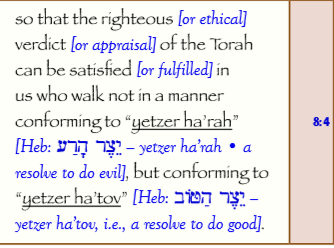
Yet this choice, this freedom to follow our ‘fleshly hearts’, our ‘Yetzer HaRa’ and in turn potentially desecrate the name and reputation of the Almighty, or instead to heed the call of our ‘spiritual heart’, our ‘Yetzer HaTov’ and act in ways that sanctify His Name, is always in front of us.

Perhaps when we reflect that an act of good that we participate in has in turn sanctified the honour, and reputation of God, and in doing so has been a faithful and effective witness of the true reality of our Father in Heaven, our joy should increase!

We can then also take comfort in having inspired others to believe and have faith, and in turn, seek Him whose mercies are new every morning!

May it be so! Amen!

[1] Most of the article is a paraphrasing of a great Parsha from Rabbi Jonathan Sacks. Rabbi Sacks is one of the most amazing theologians and authors of our time. I am deeply indebted to his scholarship.

[2] See my article ‘Does God Exist’ – https://goo.gl/dfZ7aE

[3] I have written at length on Isaiah 49, an amazing and prophetic chapter – see Isaiah 49 – a commentary

[4] For more on the ‘family of Abraham’ see ‘The Tripartite Salvation Paradigm’

[5] Maimonides, Hilkhot Yesodei ha-Torah, 5:11

[6] Milton Himmelfarb, Jews and Gentiles, Encounter Books, 2007, 141